AGV vs AMR in Smart Factories: How to Choose Automated Guided Vehicles & Autonomous Mobile Robots for Conveyor & Palletizing Lines
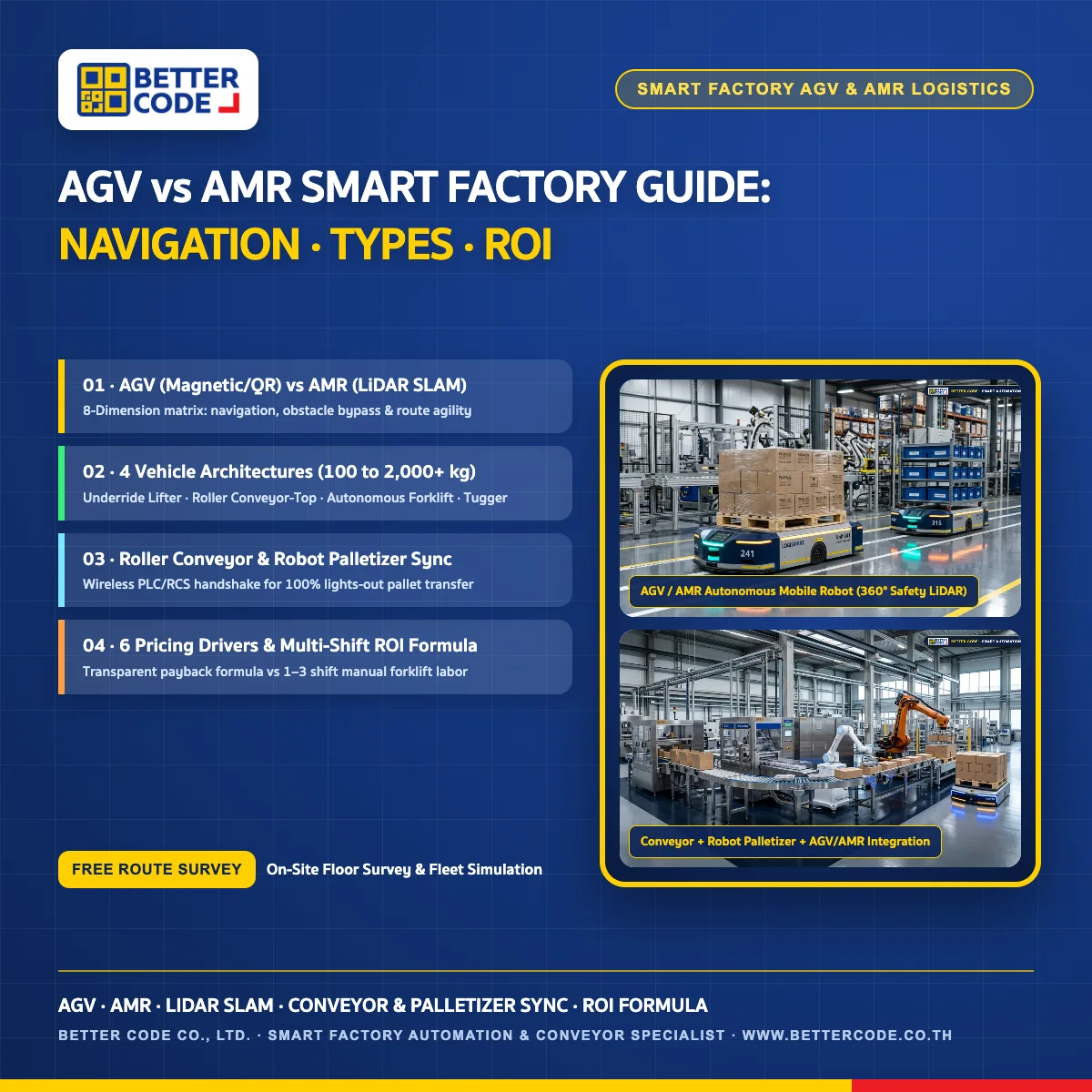
How Does an AGV (Automated Guided Vehicle) Differ from an AMR (Autonomous Mobile Robot), Which Navigation System Should Your Factory Choose (Magnetic/QR vs LiDAR SLAM), and How Do You Calculate ROI Against Manual Forklifts?
An AGV (Automated Guided Vehicle) follows fixed magnetic strips or floor QR codes on dedicated routes, whereas an AMR (Autonomous Mobile Robot) uses LiDAR SLAM navigation to dynamically bypass obstacles without floor tracks. Factories evaluate investment and payback (ROI) by integrating autonomous mobile robots with roller conveyors and palletizers from Better Code Co., Ltd. to replace multi-shift manual forklift transfers.
What Is an AGV vs AMR? 8-Dimension Engineering Comparison Matrix for Smart Factories
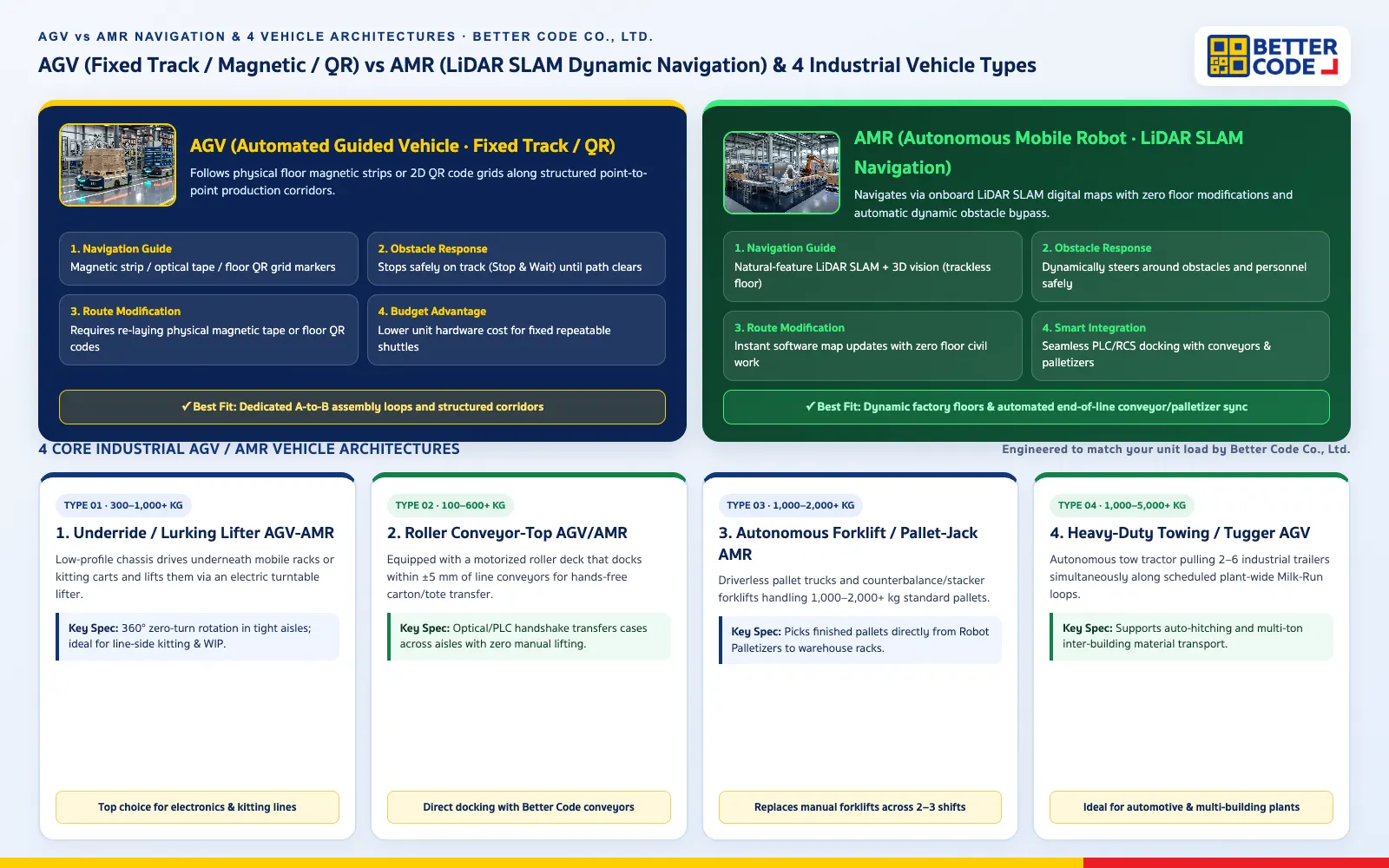
When planning intralogistics upgrades within a Smart Factory Automation project, plant managers frequently ask how an Automated Guided Vehicle (AGV) differs from an Autonomous Mobile Robot (AMR). While both eliminate manual material transport, their navigation architecture, obstacle handling, and layout flexibility differ across 8 engineering dimensions:
| Engineering Dimension (8 Pillars) | AGV (Automated Guided Vehicle · Guided Track) | AMR (Autonomous Mobile Robot · LiDAR SLAM) | Better Code Engineering Selection Advice |
|---|---|---|---|
| 1. Navigation Technology | Follows physical floor guides such as Magnetic Tape, optical color strips, or floor-mounted 2D QR Code grids. | Uses onboard LiDAR SLAM (Simultaneous Localization and Mapping) and natural building contours—requiring zero floor tape. | If heavy forklifts frequently cross the aisle, choose LiDAR SLAM AMR to avoid floor-tape wear. |
| 2. Behavior When Encountering Obstacles | Stop & Wait: Decelerates and stops safely in place until the obstacle blocking the magnetic track is removed. | Dynamic Path Rerouting: Automatically calculates a safe bypass trajectory around stationary pallets or personnel when aisle width permits. | Busy packaging floors and shared aisles benefit strongly from AMR dynamic avoidance. |
| 3. Route Modification When Relocating Lines | Requires physical removal and re-laying of magnetic tape or floor QR stickers whenever station locations change. | Routes, speed zones, and docking nodes are updated digitally via drag-and-drop map software in minutes with zero floor civil work. | Plants planning future conveyor or packaging line expansions gain lower lifecycle cost with AMRs. |
| 4. Chassis Types & Payload Range | Available as Underride/Lurking lifters (300–1,000 kg), Heavy-Duty Towing tractors (1,000–3,000+ kg), and Autonomous Forklift AGVs. | Available as Powered Conveyor-Top AMRs (100–300 kg), Underride Rack AMRs (300–1,500 kg), and Pallet-Jack / Forklift AMRs. | Match chassis architecture to your unit load (totes, corrugated cases, mobile racks, or 1,000×1,200 mm pallets). |
| 5. Roller Conveyor & Robot Palletizer Integration | Reliable fixed-station docking via optical I/O or PLC handshake with ±5 to ±10 mm positioning accuracy at conveyor handoffs. | Wireless Fleet RCS / Modbus TCP/IP handshake with multi-line conveyors and Robot Palletizers, using laser/V-marker fine docking (±5 mm). | For multi-line dynamic dispatching across several packaging lines, choose AMR + Fleet RCS. |
| 6. Safety Architecture (LiDAR & Bumpers) | Directional safety laser scanners + tactile safety bumpers + audible warning chimes and LED status beacons. | 360° Safety LiDAR (ISO 3691-4 PLd) + 3D depth cameras for overhanging loads + dynamic speed-dependent protective fields. | All Better Code AGV and AMR deployments are engineered to strict industrial safety standards. |
| 7. Initial Investment Structure (CAPEX) | Lower per-vehicle starting cost: Well-suited for straightforward 1–2 vehicle point-to-point shuttles on dedicated tracks. | Higher onboard intelligence, zero floor-track maintenance: Delivers superior TCO in dynamic, multi-station environments. | Better Code also configures Hybrid SLAM + QR Docking fleets to optimize both cost and precision. |
| 8. Best-Fit Factory Environment | Structured automotive/electronics assembly milk-runs and dedicated point-to-point warehouse corridors. | Food, beverage, pharma, FMCG, and smart warehouses linking End-of-Line packaging automation directly to storage. | Send your plant CAD layout or photos to Better Code Co., Ltd. for a free route simulation. |
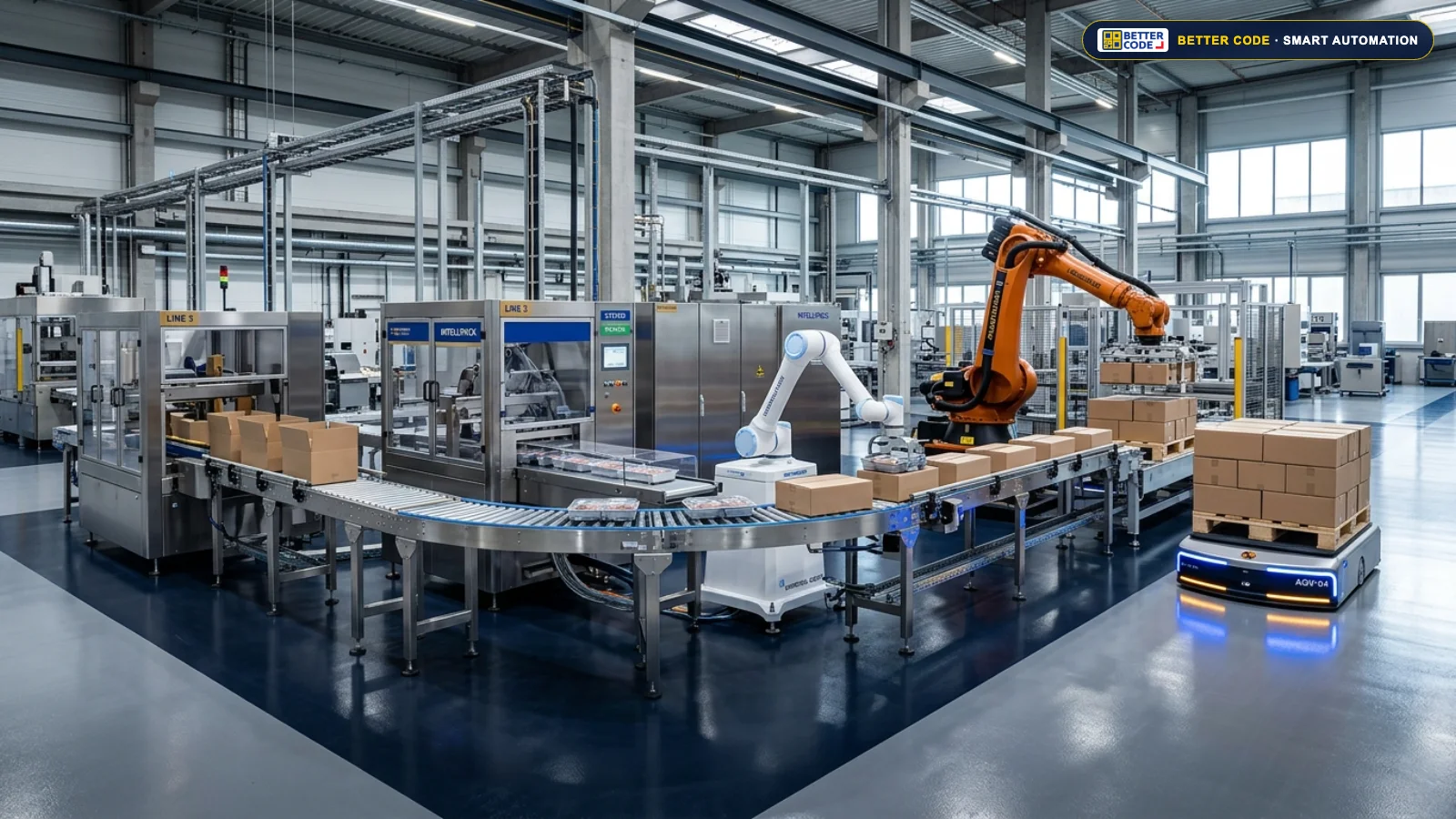
Deep Dive: 4 Most Popular AGV & AMR Vehicle Architectures in Modern Factories
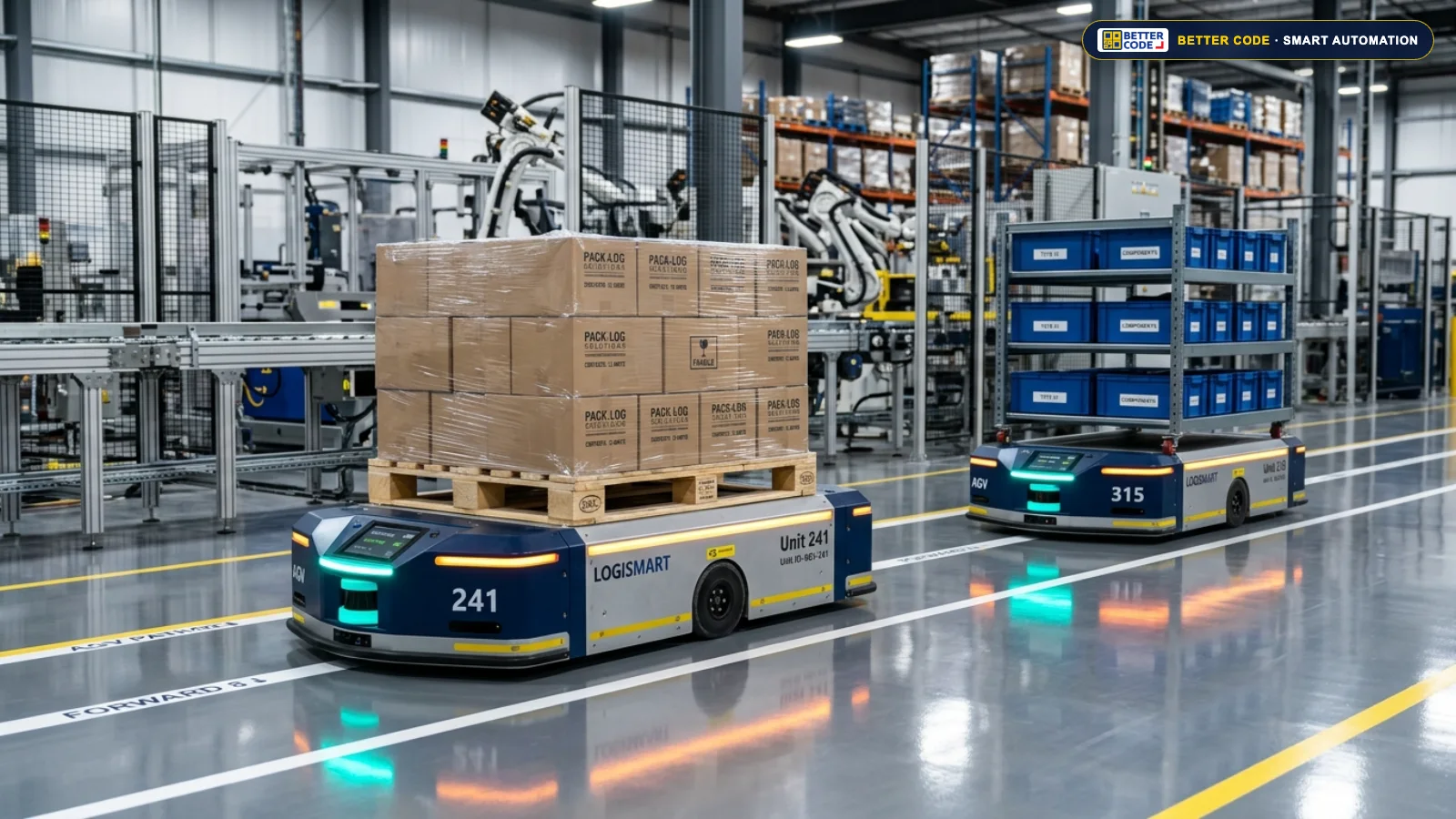
Selecting the right mechanical chassis and top-module attachment is just as critical as choosing between AGV and AMR navigation. Here are the 4 industrial vehicle architectures most widely deployed in Thailand’s manufacturing and warehouse facilities:
Type 1: Underride / Lurking Lifter AGV-AMR (Rack & Trolley Transport)
The most versatile chassis for line-side kitting, WIP transfers, and Goods-to-Person fulfillment. With an ultra-low profile, the robot drives underneath a stationary mobile rack or trolley, engages its electric lifting turntable to raise the rack off the floor, and spins 360° on the spot (zero-turn radius) to navigate tight factory aisles.
Type 2: Powered Roller Conveyor-Top AGV/AMR (Automated Conveyor Docking)
Purpose-built to bridge industrial belt and roller conveyors across aisles without obstructing floor traffic. Equipped with a single- or dual-deck motorized roller bed and photoelectric load sensors, the robot docks within ±5 mm of your stationary conveyor and transfers corrugated cartons or totes automatically via optical/PLC handshake.
Type 3: Pallet Truck & Autonomous Forklift AGV-AMR (1,000–2,000+ kg Pallets)
Engineered to replace manual pallet jacks and sit-down forklifts for heavy 1,000–2,000+ kg standard pallets. Available as compact Low-Lift Pallet-Jack AMRs for floor-to-floor transfers and High-Reach Stacker / Counterbalance Autonomous Forklifts capable of picking from floor conveyors and stacking into 3–6+ m warehouse racking.
Type 4: Heavy-Duty Towing / Tugger AGV (Multi-Trolley Milk-Run Trains)
Acts as an autonomous tow tractor pulling a train of 2–6 wheeled trailers simultaneously with total towing capacities from 1,000 kg up to 5,000+ kg. Optional automatic hitch/unhitch mechanisms allow continuous Milk-Run loops across large manufacturing campuses, replacing multiple manual forklifts in a single trip.
6 Factors Determining AGV / AMR Pricing & Illustrative Factory ROI Calculation Formula
When evaluating Automated Guided Vehicle (AGV) and AMR pricing, plant managers quickly notice that budgets vary based on vehicle class and integration depth. A reliable industrial deployment is governed by 6 core engineering cost drivers:
6 Engineering Cost Drivers Governing AGV & AMR System Pricing
Compact 100–300 kg units use lightweight differential drives, whereas 1,000–2,000+ kg autonomous forklifts require heavy-gauge steel frames and high-torque servo traction/lift motors.
Magnetic/QR-guided AGVs have lower onboard hardware cost, while LiDAR SLAM AMRs include industrial SLAM controllers and 360° laser scanners that eliminate floor-track installation.
Integrating an electric screw lifter, single/dual motorized roller conveyor deck, or precision counterbalance/pallet forks directly shapes unit configuration cost.
A single shuttle can run standalone call buttons, whereas multi-vehicle fleets (2–10+ robots) use centralized RCS software for intersection locking and dynamic task queuing.
Battery capacity (Ah) and fast opportunity Auto-Docking Charging Stations sized to sustain 1-shift, 2-shift, or continuous 24/7 3-shift operations.
Turnkey PLC handshakes with roller conveyors, Robot Palletizers, cargo elevators, high-speed roll-up doors, and plant WMS/MES/ERP platforms.
Engineering Formula: AGV / AMR Intralogistics Payback Period (ROI)
An accurate intralogistics ROI calculation combines multi-shift operator labor savings with eliminated manual forklift rental/fuel/maintenance costs and reduced warehouse collision damage:
How to Plug In Your Plant’s Numbers: A licensed forklift driver or material handler typically costs 18,000 – 25,000 THB/month fully burdened (wages + skill allowance + OT + benefits), plus 12,000 – 20,000 THB/month in manual forklift lease/energy/maintenance—meaning a 2- to 3-shift transport route costs over 1.0M – 1.8M THB/year to operate manually.
| Calculation Parameter (Illustrative Modeling Inputs) | Scenario 1: Single-Shift Plant (8 hrs/day) | Scenario 2: Two-Shift Plant (16 hrs/day) | Scenario 3: 3-Shift / 24-Hr Plant (Auto-Charge) |
|---|---|---|---|
| Modeled Vehicle & System Architecture | Underride AGV / AMR shuttling kitting racks between store and line | Conveyor-Top AMR or Pallet-Jack AMR linked to packaging line | Autonomous Forklift / Pallet AMR + Fleet RCS & Auto-Docking Charger |
| Manual Transport / Forklift Headcount Reallocated | 2 material handlers/day (1 shift) | 4 rotating handlers / forklift drivers/day (2 shifts) | 6 rotating handlers / forklift drivers/day (3 shifts · 24/7) |
| (A) Illustrative Monthly Wage + OT + Benefits Saved (Modeled at 20,000 THB / operator / month) | ~40,000 THB / month (480,000 THB / year) | ~80,000 THB / month (960,000 THB / year) | ~120,000 THB / month (1,440,000 THB / year) |
| (B) Illustrative Monthly Equipment & Damage Savings (Saved forklift lease/energy + zero rack collisions + zero line starvation) | ~10,000 – 15,000 THB / month | ~18,000 – 28,000 THB / month | ~30,000 – 45,000 THB / month |
| Total Illustrative Monthly Benefit (A + B) | ~50,000 – 55,000 THB / month (~600k – 660k THB / year) | ~98,000 – 108,000 THB / month (~1.17M – 1.30M THB / year) | ~150,000 – 165,000 THB / month (~1.80M – 1.98M THB / year) |
| Engineering Payback Takeaway | Takt-Time Reliability: Guarantees punctual line feeding and eliminates manual cart pushing injuries | Sweet-Spot Factory ROI: Nearly doubles payback speed by operating 16 hrs/day with zero overtime cost | Fastest Capital Recovery: Saves nearly 2M THB/year with 24/7 opportunity auto-charging availability |
Seamless End-of-Line Sync: How FASTJET Coders, HIKROBOT Barcode Readers & Robot Palletizers Auto-Dispatch AGV/AMR Fleets
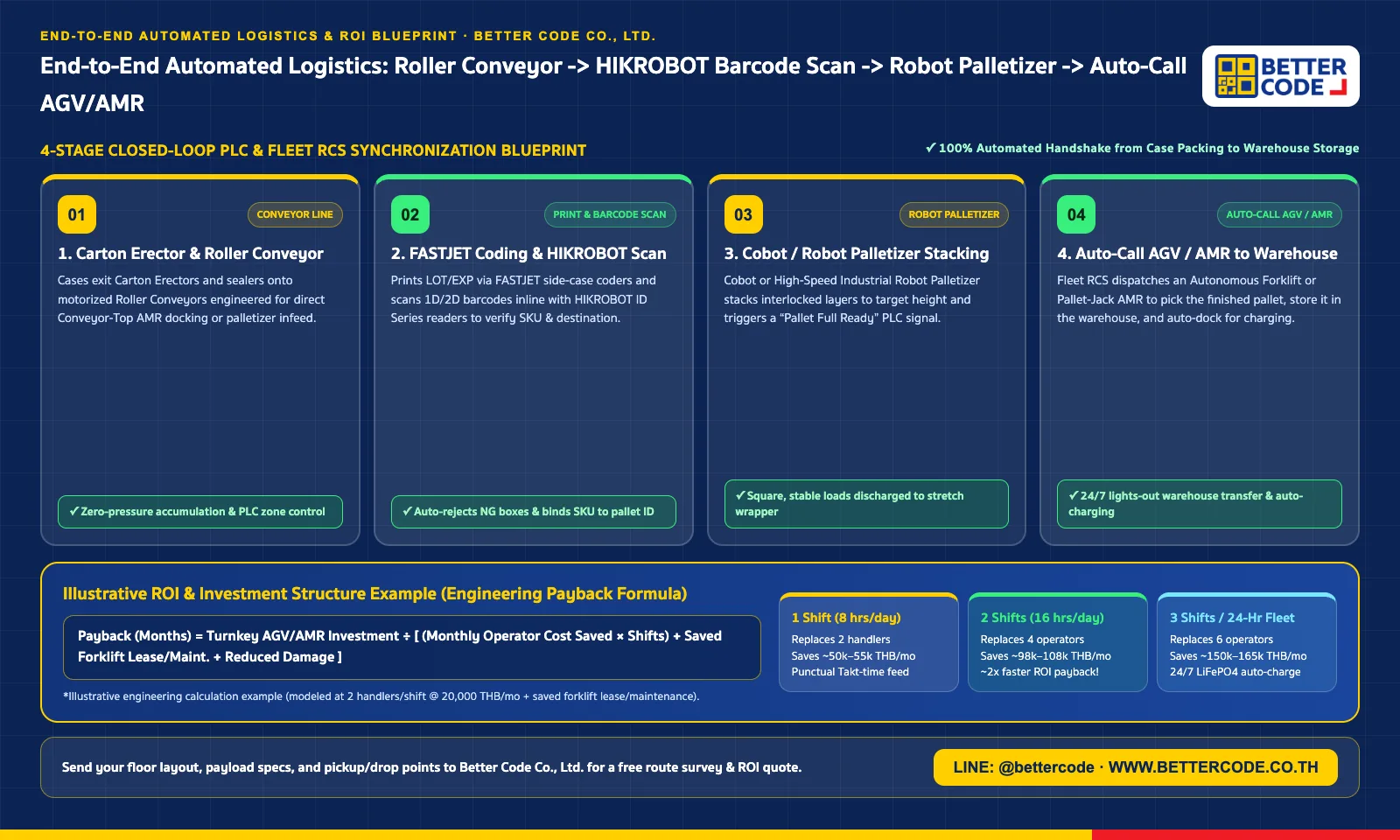
The decisive advantage of partnering with Better Code Co., Ltd. is single-vendor turnkey accountability across your entire Factory Automation line. Rather than deploying isolated robots, we engineer a closed-loop PLC / RCS Handshake connecting all 4 end-of-line stages:
Stage 1: Case Erecting, Sealing & Motorized Roller Conveyor Transfer
Products are packed via automated Carton Erectors, Case Sealers, and Top Seal lines and conveyed onto custom Belt and Roller Conveyors engineered with the exact roller pitch (see our Industrial Belt vs Roller Conveyor Selection Guide) to feed either a Conveyor-Top AMR or a robotic palletizing cell.
Stage 2: Inline FASTJET Case Coding & HIKROBOT Barcode Verification
As cartons travel down the roller conveyor, a FASTJET TIJ / PIJ coder prints high-contrast LOT/EXP dates and barcodes on the case side, immediately verified by a HIKROBOT ID Series industrial barcode reader to confirm SKU identity and target warehouse zone.
Stage 3: Cobot / Industrial Robot Palletizer Stacks Interlocked Pallet Layers
Verified cartons enter the pneumatic squaring station where a Cobot or Industrial Robot Palletizer stacks each layer according to the SKU recipe. The PLC tracks exact layer and case counts until the pallet reaches full target height.
Stage 4: Wireless RCS Auto-Call Dispatches AGV / AMR to Warehouse Storage
Once the full pallet discharges through the inline stretch wrapper, the line PLC sends a wireless mission trigger to the Fleet Management Server (RCS). The nearest Autonomous Forklift AMR or Pallet-Jack AGV/AMR automatically drives to the conveyor pickup bay, lifts the finished pallet, delivers it to the assigned warehouse aisle, and replenishes empty pallets—100% hands-free.
Frequently Asked Questions: AGV vs AMR Selection, Pricing Factors & Factory Integration (FAQ)
What is an AGV vs AMR, and how do they differ in factory intralogistics?
An AGV (Automated Guided Vehicle) travels along fixed physical guides on the factory floor—such as magnetic tape or floor QR code grids—and stops cleanly in place if an obstacle blocks its path. An AMR (Autonomous Mobile Robot) uses onboard LiDAR SLAM (Simultaneous Localization and Mapping) and 3D sensors to navigate via digital maps without floor tracks, allowing it to dynamically steer around obstacles, pallets, and personnel.
What factors determine Automated Guided Vehicle (AGV) and AMR pricing?
Total AGV/AMR investment is governed by 6 engineering factors: (1) Payload capacity (100 kg totes up to 2,000+ kg pallets), (2) Navigation technology (Magnetic/QR vs LiDAR SLAM), (3) Top-module attachment (Underride Lifter, Powered Roller Conveyor-Top, or Counterbalance/Pallet Forklift), (4) Fleet Management & Traffic Control Software (RCS), (5) LiFePO4 battery capacity and Auto-Docking Charging Stations, and (6) PLC / WMS / ERP integration scope.
What factory floor conditions are required to run AGVs or AMRs?
Standard smooth concrete or epoxy-coated industrial floors with expansion joints under 5–10 mm and gradients within 3–5% are ready for AGV/AMR deployment. In busy aisles where heavy manual forklifts frequently cross the path, trackless LiDAR SLAM AMRs eliminate floor-tape wear and maintenance.
How safe are AGVs and AMRs operating alongside factory workers and manual forklifts?
Modern industrial AGVs and AMRs comply with ISO 3691-4 (Safety Performance Level d / PLd). Each vehicle integrates 360° Safety LiDAR scanners with speed-dependent warning and protective stop zones, 3D depth cameras for overhanging loads, tactile safety bumpers, audible/visual beacons, and multi-side E-Stop buttons.
Can AGVs and AMRs automatically interface with existing roller conveyors and robot palletizers?
Yes. Better Code Co., Ltd. engineers complete PLC/Modbus TCP/IP handshakes between your packaging line and mobile fleet. A Roller Conveyor-Top AMR docks within ±5 mm of your powered roller conveyor to transfer cartons automatically, while an Autonomous Forklift AMR picks completed pallets directly from a Cobot or Industrial Robot Palletizer station.
How long do AGV/AMR batteries last during 24/7 3-shift factory operations?
Industrial LiFePO4 batteries deliver 6–10 hours of continuous runtime per charge and support fast opportunity charging. During 2-shift or 24/7 3-shift operation, the Fleet Management system directs idle vehicles to Automatic Charging Stations between missions—achieving continuous 24-hour fleet availability without manual battery swapping.
Consult Our Engineers for an On-Site Route Survey & AGV / AMR System Quote from Better Code Co., Ltd.
Whether your facility needs an Underride AGV/AMR for line-side kitting, a Conveyor-Top AMR docking directly with motorized roller conveyors, or an Autonomous Forklift AMR picking finished pallets from a Robot Palletizer cell, Better Code Co., Ltd. is ready to survey your plant floor and engineer a turnkey solution.
Request Route Survey & AGV/AMR Quote ↗Explore Turnkey Factory Automation ↗Explore Roller Conveyors for AGV/AMR ↗Send Floor Layout on LINE @bettercode ↗Engineering References & Industrial Mobile Robotics Safety Standards
- Industrial mobile robot safety and route design guidelines (ISO 3691-4 Driverless Industrial Trucks and Their Systems): Factory Automation Engineering Division, Better Code Co., Ltd.
- Engineering integration standards for Fleet Management Systems (RCS), PLC handshakes with Motorized Roller Conveyors, FASTJET case coders, HIKROBOT ID Series barcode readers, and Cobot / Industrial Robot Palletizer cells.