FASTJET · FIBER LASER · 1064 nm
Fiber laser marking
FASTJET F7100F Series
Mark dates, lots and codes on metal
Choose 20W / 30W for your production needs
F7121F and F7131F with FCPilot control and a 10.1-inch touchscreen. Test your actual sample with Better Code before choosing a model.
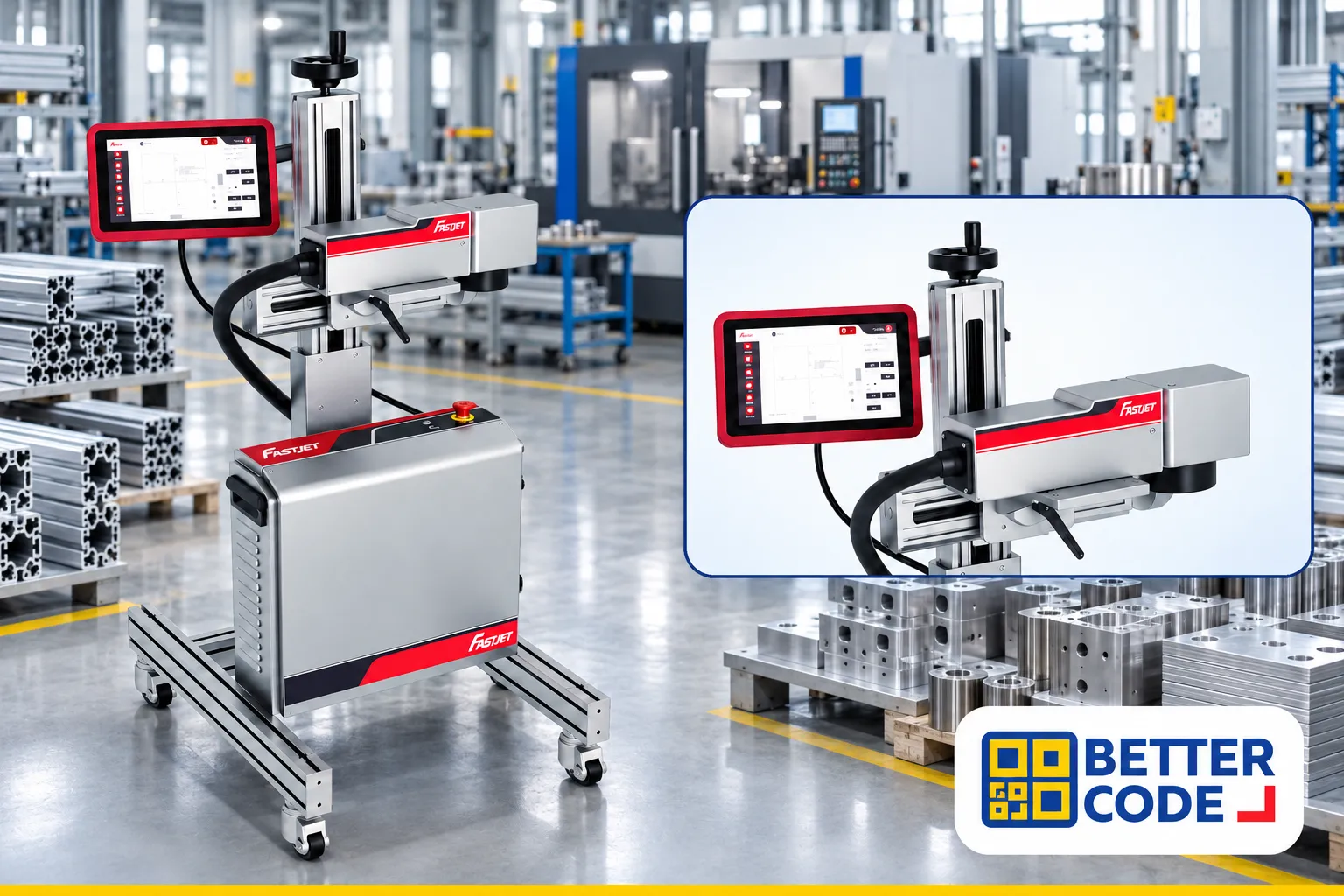
Illustration based on equipment images in the manufacturer’s brochure
Home / Laser marking systems / F7100F Fiber
What is the F7100F fiber laser?
FASTJET F7100F Series is a 1064 nm pulsed fiber laser marking system for manufacturing dates, lot numbers, text, barcodes and QR codes on metals and suitable plastics, without ink.
Candidates for sample testing: Aluminium, steel, metal packaging and suitable plastics such as HDPE, PP, PVC and PS. Marking results vary with material formulation and surface coatings.
Choose the right model for your application
F7121F · 20W
Air-cooled 1064 nm fiber laser. Assess code dimensions, marking area and line speed together.
F7131F · 30W
A 30W option with the same FCPilot platform and 10.1-inch touchscreen. Compare results using actual product samples.
Start with your product sample
Provide the material, message, code dimensions and products per minute to select the power, lens and installation arrangement.
FASTJET F7100F Series specifications
On small screens, swipe the table horizontally to compare models.
| Details | F7121F · 20W | F7131F · 30W |
|---|---|---|
| Model / power | F7121F — 20W | F7131F — 30W |
| Wavelength | 1064 nm | 1064 nm |
| Laser type | Ytterbium-doped Pulsed Fiber | Ytterbium-doped Pulsed Fiber |
| Cooling | Air-cooled | Air-cooled |
| Standard lens | F163 / 110 × 110 mm | F163 / 110 × 110 mm |
| Optional marking areas | 50 × 50 to 500 × 500 mm, depending on the lens | 50 × 50 to 500 × 500 mm, depending on the lens |
| Scanning-head speed* | Up to 9,000 mm/s | Up to 9,000 mm/s |
| Line speed* | Up to 4,600 mm/s | Up to 4,600 mm/s |
| Control system | FCPilot / 10.1-inch touchscreen | FCPilot / 10.1-inch touchscreen |
| Connectivity | UDP, TCP/IP, RS232; Encoder, Sensor; 3 Input / 2 Output | UDP, TCP/IP, RS232; Encoder, Sensor; 3 Input / 2 Output |
| Power supply | 240 VAC, 50/60 Hz, single-phase, 0.80 kW | 240 VAC, 50/60 Hz, single-phase, 0.80 kW |
| Operating environment | 5–40°C; 10–90% humidity, non-condensing | 5–40°C; 10–90% humidity, non-condensing |
| Net weight | Marking head: 5 kg / main unit: 19 kg | Marking head: 5 kg / main unit: 19 kg |
*Brochure maximum speeds are not guaranteed for every application. Actual performance depends on material, code size and complexity.
Source: FASTJET F7100F Series Laser Marking Machine, EF7100F24001 · Reviewed 2 October 2026
What can it mark, and how does it connect?
Product information and codes
Dates and times, lot numbers, serial numbers, text, logos, Code128A/B/C, Code39, Code93, QR Code, Data Matrix, Aztec and Han Xin.
Production-line operation
Supports static and flying marking with encoder and sensor inputs, plus UDP, TCP/IP and RS232 for assessing integration with existing lines.
Application-specific equipment
Select lenses, encoders, sensors and fume extraction within the project scope, and assess laser guarding and installation positions.
Fiber, CO2 or UV—which should you choose?
F7100F fiber uses 1064 nm for metals and suitable plastics. F7100C CO2 is an option for non-metals such as paper and PET. F7100U UV uses 355 nm for suitable plastics, polymers and fine-detail applications. Compare marks on the same sample before choosing.
Explore F7100C CO2 → · Explore F7100U UV → · Compare all three technologies →
Fiber laser FAQs
What is the F7100F fiber laser?
FASTJET F7100F Series is a 1064 nm pulsed fiber laser marking system for manufacturing dates, lot numbers, text, barcodes and QR codes on metals and suitable plastics, without ink.
How do F7121F and F7131F differ?
F7121F provides 20W and F7131F provides 30W. Both use 1064 nm and air cooling. Selection depends on material, code dimensions and complexity, and line speed, followed by sample testing.
Which materials can a fiber laser mark?
The manufacturer lists aluminium, steel, other metals and plastics such as HDPE, PP, PVC and PS. Results depend on composition, colour and coatings, so the actual material must be tested before confirming suitability.
How does fiber differ from CO2 and UV?
F7100F fiber uses 1064 nm for metals and suitable plastics. F7100C CO2 is an option for non-metals such as paper and PET. F7100U UV uses 355 nm for suitable plastics, polymers and fine-detail applications. Compare marks on the same sample before choosing.
Can it mark products on a moving conveyor?
F7100F supports static and flying marking with encoder and sensor inputs. The manufacturer specifies a maximum line speed of 4,600 mm/s, but usable speed depends on the material, code size and complexity.
How much does an F7100F fiber laser cost?
Pricing is quoted per project according to power, lens, marking area, accessories and installation scope. Send product photos, code content and line speed to Better Code for assessment and a quotation.
What is required for installation?
Prepare installation space, a 240 VAC supply and production timing information. Laser guarding, fume extraction and encoder, sensor or PLC connections must be assessed for the site.
Let Better Code help select your model
Our team has over 20 years of experience, with consultation, testing, installation, training and after-sales support throughout Thailand.
Send material photos, messages or codes, marking dimensions, line speed and mounting-location photos for an application-specific assessment.