
Cobot vs Industrial Robot Palletizer: How to Choose Robotic Pick-and-Place & Palletizing Systems with Factory ROI Calculation Guide
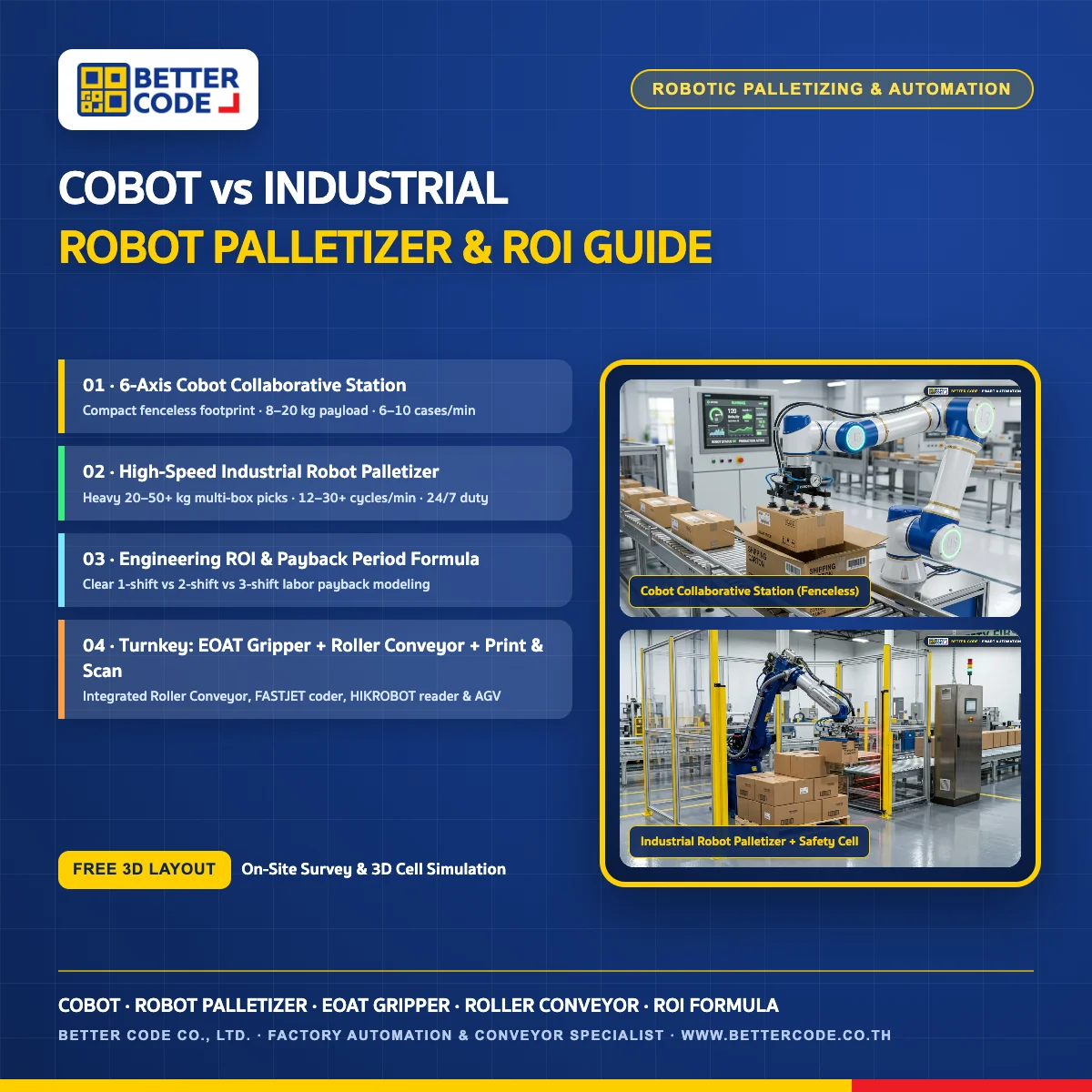
How Does a Cobot (Collaborative Robot) Differ from an Industrial Robot Palletizer, Which System Should Your Factory Choose, and How Do You Calculate Automation ROI?
A Cobot (Collaborative Robot) features built-in torque sensors to work safely alongside operators without safety cages, ideal for pick-and-place and compact palletizing up to 8–20 kg at 6–10 cases/min. Conversely, an Industrial Robot Palletizer handles heavy 20–50+ kg multi-box payloads at 12–25+ cases/min inside a guarded cell. Multi-shift plants achieve rapid ROI by integrating robotics with infeed roller conveyors and factory automation from Better Code Co., Ltd.
What Is a Cobot? 8-Dimension Comparison: Cobot (Collaborative Robot) vs Industrial Robot Palletizer
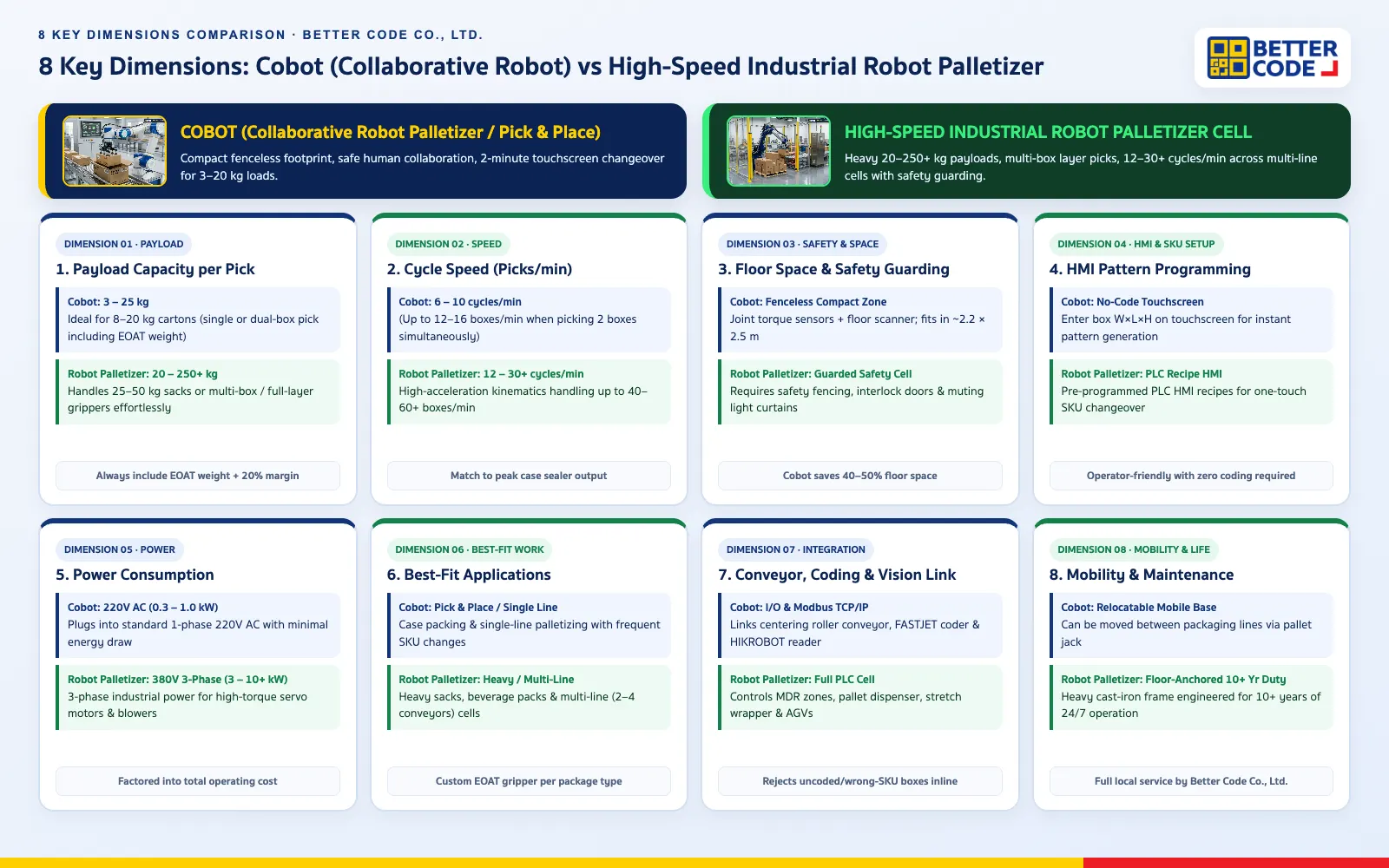
Factory managers planning Factory Automation upgrades frequently ask: “What is the difference between a Collaborative Robot (Cobot) and an Industrial Robot Palletizer, and which one fits our packaging line?” While a Cobot is engineered with built-in torque sensors to operate safely alongside humans in tight spaces, an Industrial Robot Palletizer is built for high-speed, heavy-payload endurance inside a guarded cell. Compare all 8 engineering dimensions below:
| Engineering Dimension | Cobot (Collaborative Robot Station) | Industrial Robot Palletizer (High-Speed Cell) |
|---|---|---|
| 1. Payload Capacity per Cycle | 3 – 25 kg (typically 10–20 kg) Ideal for picking 1–2 corrugated cases per cycle (accounting for 2–4 kg EOAT gripper weight) | 20 – 250+ kg Handles heavy cartons, 25–50 kg woven sacks, or multi-box / full-layer grippers lifting an entire row at once |
| 2. Cycle Speed (Picks per Minute) | 6 – 10 cycles/min (Up to 12–16 boxes/min when engineered with a dual-box vacuum gripper) | 12 – 30+ cycles/min (up to 40–60+ boxes/min) High-acceleration servo kinematics built for high-speed lines and multi-line merging |
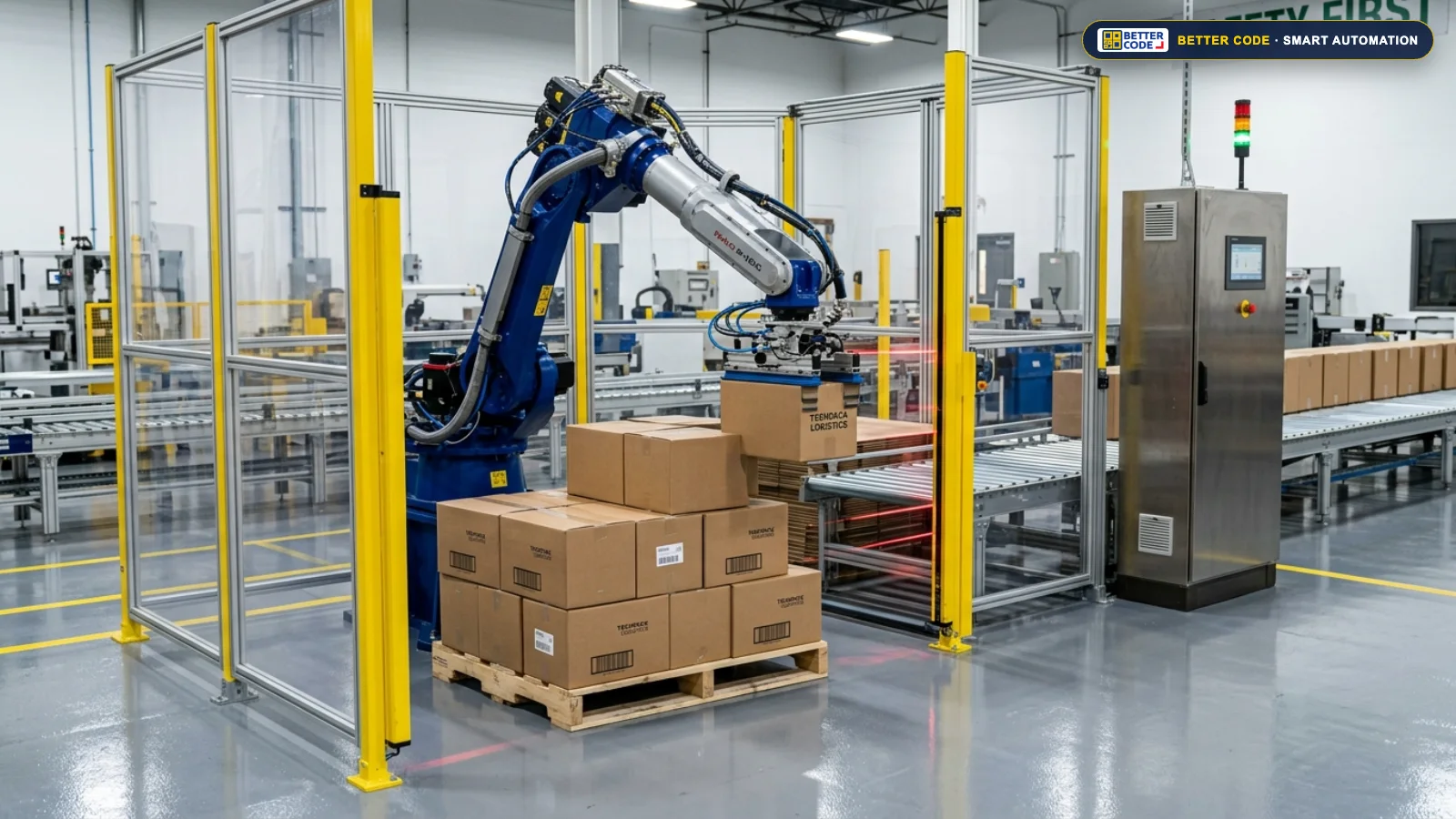
| 3. Floor Space & Safety Guarding | Ultra-Compact (Fenceless Operation) Built-in joint torque sensors and floor area laser scanners slow or pause the arm when an operator approaches | Dedicated Safety Cell Required Requires perimeter safety fencing, interlocked access doors, and muting light curtains at pallet exit bays |
| 4. Ease of Programming & HMI Changeover | No-Code Graphical Palletizing Wizard Supports hand-guided teaching and 2-minute SKU setup by entering box W×L×H dimensions on the touchscreen | Industrial PLC + Custom HMI Recipe Screen Better Code engineers pre-program intuitive HMI recipe screens so operators switch SKUs with one tap |
| 5. Electrical Power Consumption | Ultra-Low Power (300W – 1,000W avg) Most units plug directly into standard single-phase 220V AC plant outlets | 3-Phase 380V–400V AC (3 – 10+ kW avg) Sized for high-torque industrial servo drives and high-flow vacuum blowers |
| 6. Best-Fit Factory Applications | • Robotic Pick-and-Place & Case Packing • Compact End-of-Line Palletizing in tight floor layouts with frequent Multi-SKU changeovers | • High-Speed End-of-Line Palletizing for beverage packs, heavy cartons, and 25–50 kg bags • Multi-Line Palletizing serving 2–4 conveyors simultaneously |
| 7. Conveyor, Date Coder & Vision Integration | Direct Digital I/O or Modbus TCP/IP handshake with infeed roller conveyors, FASTJET case coders, and barcode readers | Full PLC cell control (PROFINET / EtherNet/IP / Modbus) orchestrating MDR accumulation conveyors, pallet dispensers, stretch wrappers, and AGVs |
| 8. Maintenance & Line Mobility | Relocatable Pedestal Base: Can be moved between packaging lines via pallet jack and re-docked in under an hour | Floor-Anchored Heavy-Duty Pedestal: Built for 24/7 continuous multi-shift operation over 10+ years with scheduled gearbox lubrication |
Robotic Automation ROI & Payback Formula with 3 Illustrative Factory Shift Scenarios
When preparing a capital expenditure (CAPEX) proposal for a Cobot or Industrial Robot Palletizer, management needs a clear, auditable payback calculation. Below is the exact engineering formula where you can plug in your factory’s actual labor rates, shift counts, and throughput numbers:
Engineering Formula: Robotic Palletizing Payback Period (ROI)
A true automation ROI model accounts not only for base wages, but also overtime (OT), social security/benefits, recruitment/training turnover costs, ergonomic injury reduction, and eliminated end-of-line bottlenecks:
How to Plug In Your Plant’s Numbers: If one end-of-line manual handler costs 15,000 – 22,000 THB/month fully burdened (base wage + OT + benefits), a heavy palletizing station requiring 2 operators per shift across 2 shifts (4 workers total) costs 60,000 – 88,000 THB/month (720,000 – 1,056,000 THB/year) in direct labor alone.
| Calculation Parameter (Illustrative Modeling Inputs) | Scenario 1: Single-Shift Plant (8 hrs/day + OT) | Scenario 2: Two-Shift Plant (16 hrs/day) | Scenario 3: 24-Hour / 3-Shift Heavy Line |
|---|---|---|---|
| Typical Robotic Configuration | Compact Cobot Palletizer Station (8–15 kg cases) | Cobot Palletizer or Standard Robot Palletizer Cell | High-Speed Industrial Robot Palletizer + Safety Cell |
| Manual Stacking Headcount Reallocated | 2 manual handlers/day (1 shift) | 4 manual handlers/day (2 operators × 2 shifts) | 6 manual handlers/day (2 operators × 3 shifts) |
| (A) Illustrative Monthly Wage + OT + Benefits Saved (Modeled at 18,000 THB / worker / month) | ~36,000 THB / month (432,000 THB / year) | ~72,000 THB / month (864,000 THB / year) | ~108,000 THB / month (1,296,000 THB / year) |
| (B) Illustrative Monthly Indirect Operational Savings (Reduced box damage + zero fatigue micro-stops + lower turnover) | ~8,000 – 12,000 THB / month | ~15,000 – 25,000 THB / month | ~25,000 – 40,000 THB / month |
| Total Illustrative Monthly Benefit (A + B) | ~44,000 – 48,000 THB / month (~528k – 576k THB / year) | ~87,000 – 97,000 THB / month (~1.04M – 1.16M THB / year) | ~133,000 – 148,000 THB / month (~1.60M – 1.77M THB / year) |
| Engineering Payback Takeaway | Ergonomic & Stability Driven: Eliminates back injuries and labor shortages while ensuring 100% square pallets | Sweet-Spot Factory ROI: Nearly doubles payback speed vs 1-shift lines by running 16 hrs/day with zero overtime | Fastest Capital Recovery: Saves over 1.5M+ THB/year in direct & indirect costs with 24/7 uninterrupted output |
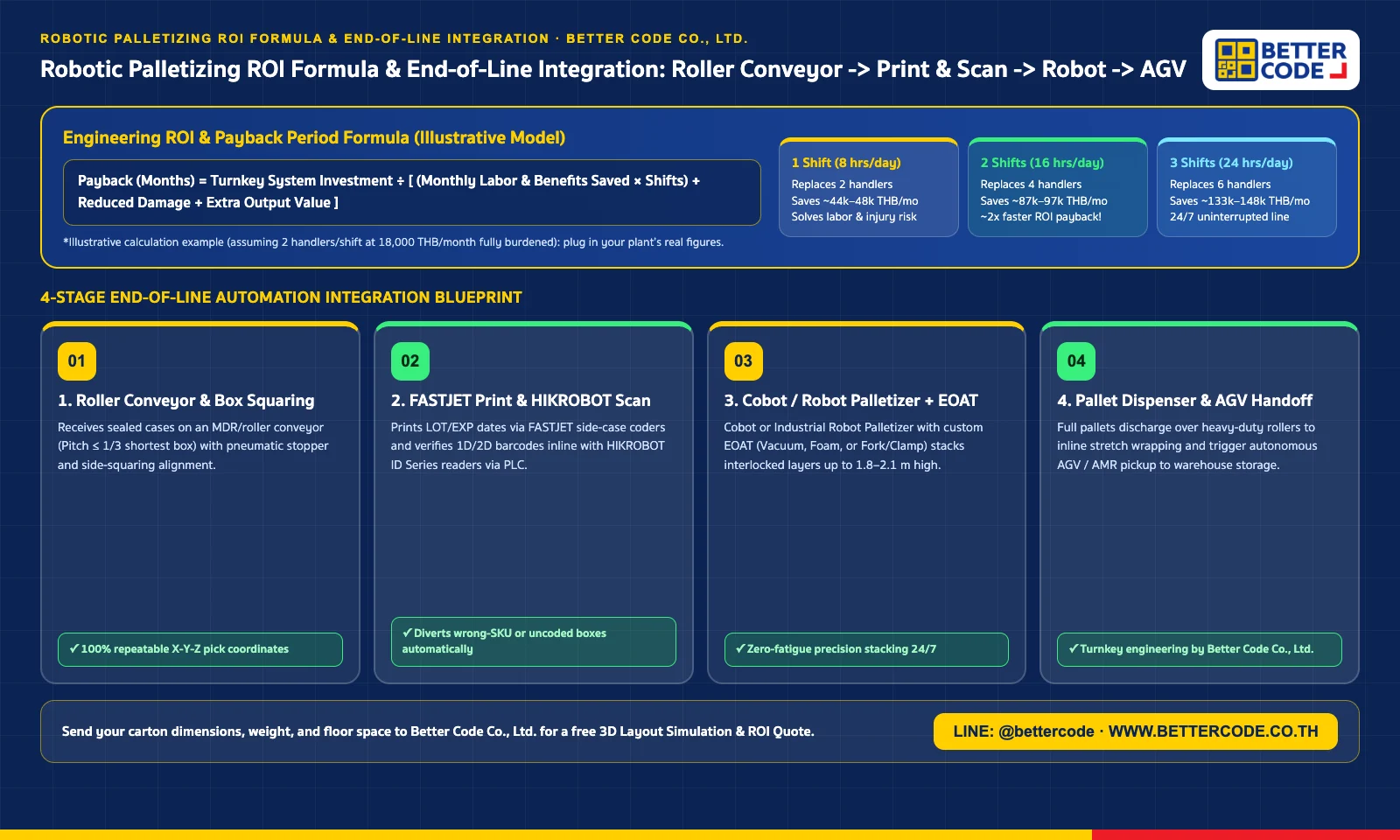
4 Critical Engineering Elements for 100% Stable Robotic Palletizing Without Dropped or Skewed Boxes
Buying a bare robotic arm alone will not guarantee reliable palletizing. True 100% end-of-line stability depends on engineering these 4 surrounding subsystems into a synchronized cell:
Element 1: Custom End-of-Arm Tooling (EOAT) Matched to Your Packaging
The EOAT gripper is the mechanical interface between robot and product. Better Code engineers custom-specify: (1) Multi-Cup Vacuum Suction Grippers for standard taped cartons, (2) Full-Area Foam Vacuum Grippers that handle varied box sizes without mechanical changeover, and (3) Stainless Fork & Bag Clamp Grippers that cradle heavy 25–50 kg woven sacks, rice/fertilizer bags, ice bags, or shrink-wrapped bottle packs from underneath so packages never tear or drop.
Element 2: Infeed Roller Conveyor with Pneumatic Box Squaring & Centering
A robot palletizer can only stack square, stable pallets if every incoming carton stops at an identical X-Y-Z coordinate. We custom-build infeed roller conveyors equipped with pneumatic pop-up stoppers and side-squaring pushers, engineered with the proper roller pitch (see our Industrial Belt vs Roller Conveyor Selection Guide).
Element 3: PLC Handshake with FASTJET Case Date Coders & HIKROBOT Barcode Readers
Stacking an uncoded carton or a mixed-SKU box onto a finished pallet causes costly warehouse rework. We integrate the palletizer PLC directly with FASTJET TIJ / PIJ side-case date coders (explore all coding solutions on the Better Code Co., Ltd. homepage) and HIKROBOT ID Series industrial barcode readers. If a carton fails barcode verification, the robot automatically diverts it to an NG reject chute instead of placing it on the good pallet.
Element 4: Turnkey Handoff to Autonomous Mobile Robots (AGV / AMR) & Warehouse Lines
Once a pallet reaches its target layer count, the cell can automatically convey the full pallet through an inline rotary stretch wrapper and trigger an AGV / AMR pickup via wireless PLC handshake—completing a lights-out Factory Automation workflow from Carton Erector to warehouse storage.
6-Point Engineering Checklist Before Requesting a Free 3D Layout Simulation & Quote
To help our automation engineers at Better Code Co., Ltd. determine whether a Cobot Palletizer or Industrial Robot Palletizer best fits your line—and generate a 3D cell layout and itemized quotation—share these 6 parameters via LINE @bettercode or our Request a Quote page:
Corrugated cartons, woven bags, shrink-packs, or totes? How many SKUs and what is the min–max weight (kg) per unit?
Peak boxes per minute exiting your case sealer, and how many infeed conveyor lines will feed the robot cell?
Standard pallet footprint (e.g., 1,000×1,200 mm or 1,100×1,100 mm), boxes per layer, total layers, and max loaded pallet height (m).
Floor area (W × L), ceiling height, and forklift / hand-pallet-truck access direction at the end of your packaging line.
Number of shifts per day (1, 2, or 3 shifts) and operators per shift currently stacking pallets, for custom ROI payback modeling.
Do you also need infeed roller conveyors, Carton Erectors, FASTJET side-case date coders, HIKROBOT barcode readers, or AGV transfer?
Frequently Asked Questions: Cobot vs Industrial Robot Palletizer & Factory ROI (FAQ)
What is a Cobot (Collaborative Robot) and how does it differ from an industrial robot arm?
A Cobot (Collaborative Robot) is a 6-axis robotic arm equipped with internal force and torque-limiting sensors in every joint, allowing it to stop immediately upon human contact. Following risk assessment, Cobots can operate safely alongside factory workers without bulky safety cages. Traditional Industrial Robots prioritize high speed, long reach, and heavy payloads, requiring physical safety fencing and light curtains.
Our corrugated cartons weigh 10–15 kg at 8 boxes per minute—should we choose a Cobot or an Industrial Robot Palletizer?
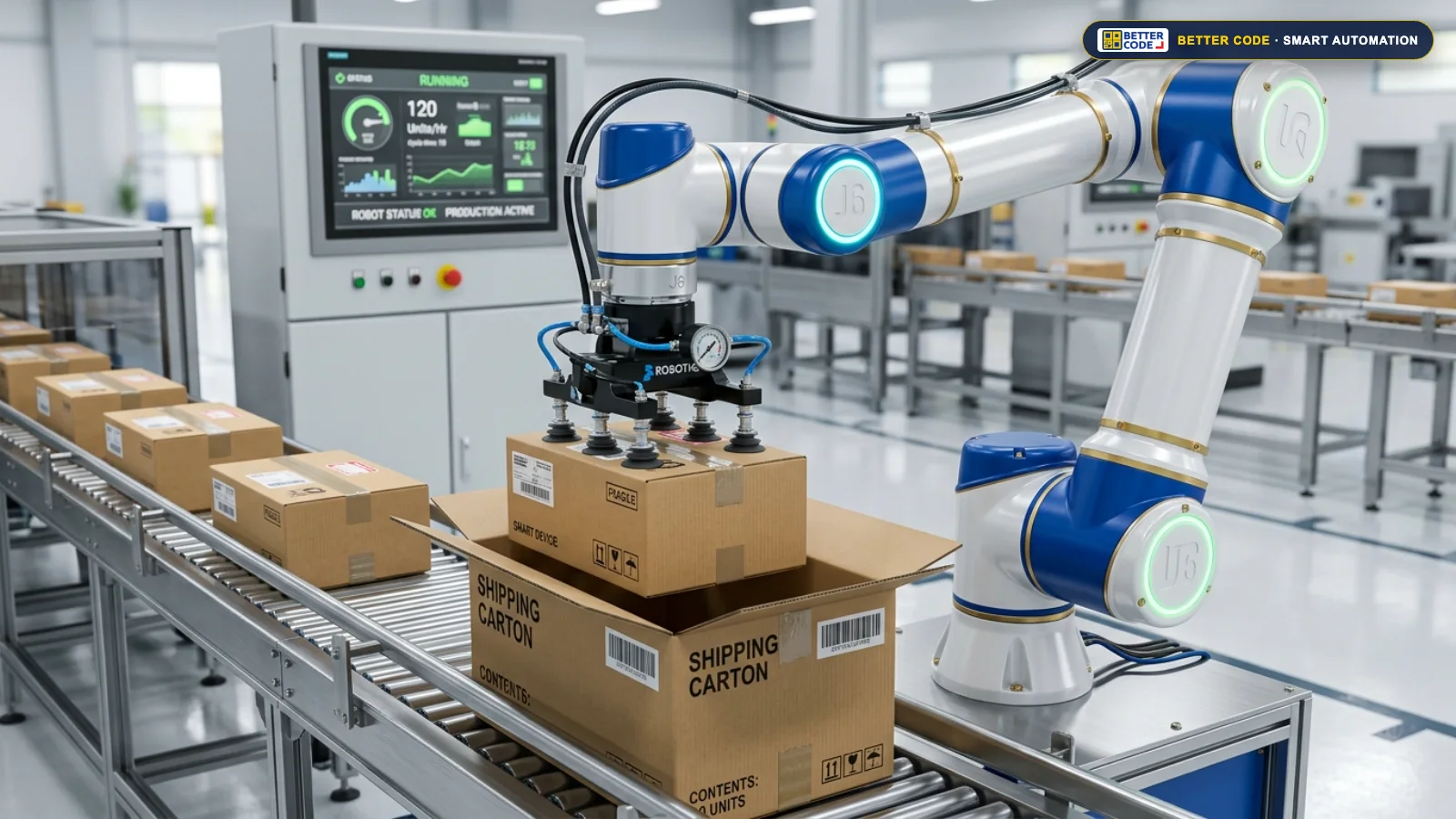
A 10–15 kg carton at 6–10 boxes/min is the sweet spot for a 20–25 kg payload Cobot Palletizing Station. It occupies a compact footprint barely larger than two standard pallets, runs on standard plant power, and allows operators to switch box dimensions and pallet stacking patterns in minutes via a graphical touchscreen.
How difficult is it to change palletizing patterns when running multiple box sizes (Multi-SKU)?
Both Cobot and Industrial Robot Palletizer cells engineered by Better Code Co., Ltd. include no-code graphical palletizing software on the HMI touchscreen. Operators simply enter carton dimensions (W × L × H), pallet size, and layer count—or select a saved SKU recipe—and the controller automatically generates interlocked stacking paths without manual programming.
Can a robot palletizer handle woven bags, rice sacks, ice bags, or shrink-wrapped bottle packs?
Yes. The critical factor is engineering the right End-of-Arm Tooling (EOAT). While sealed corrugated cartons use vacuum suction cups or full-area foam grippers, flexible bags (rice, fertilizer, flour, ice) and shrink-wrapped beverage packs are handled using stainless steel fork-and-clamp bag grippers or side-clamping mechanical paddles that support the load from underneath.
Do we need to replace our existing packaging conveyors to install a robotic palletizer?
No need to replace your entire line. We simply add a dedicated modular Infeed Roller Conveyor with a pneumatic box-squaring and centering station at the end of your existing case sealer. This guarantees every carton stops at the exact X-Y-Z pick coordinates required by the robot arm.
Does Better Code Co., Ltd. provide turnkey site surveys, 3D layout simulation, and full end-of-line integration?
Yes. Better Code Co., Ltd. delivers complete turnkey engineering in Thailand—from on-site measurements, cycle-time simulation, custom EOAT gripper fabrication, and Belt/Roller Conveyors to FASTJET side-case coding, HIKROBOT barcode verification, Carton Erectors, Cobot/Robot Palletizers, and autonomous AGV handoffs.
Consult Our Engineers for a 3D Layout Simulation & Cobot / Robot Palletizer Quote from Better Code Co., Ltd.
Whether your plant needs a compact fenceless Cobot Palletizer or a high-speed Industrial Robot Palletizer Cell integrated with infeed roller conveyors, FASTJET case coders, and HIKROBOT barcode readers, Better Code Co., Ltd. is ready to survey your line and engineer a turnkey solution.
Request 3D Layout & Quote ↗Explore Factory Automation Solutions ↗Explore Custom Conveyor Systems ↗Send Box Specs on LINE @bettercode ↗Engineering References & Robotic Integration Standards
- Engineering design guidelines for Collaborative Robot (Cobot) stations, High-Speed Industrial Robot Palletizer cells, and custom End-of-Arm Tooling (EOAT): Factory Automation Engineering Division, Better Code Co., Ltd.
- End-of-line integration standards for synchronizing infeed roller conveyors, pneumatic box squaring stations, FASTJET side-case date coders, and HIKROBOT industrial barcode readers via PLC handshakes.