
PIJ High-Resolution Case Coders vs Pre-Printed Labels: Direct Carton Barcode & Logo Printing Cost Comparison for Factories
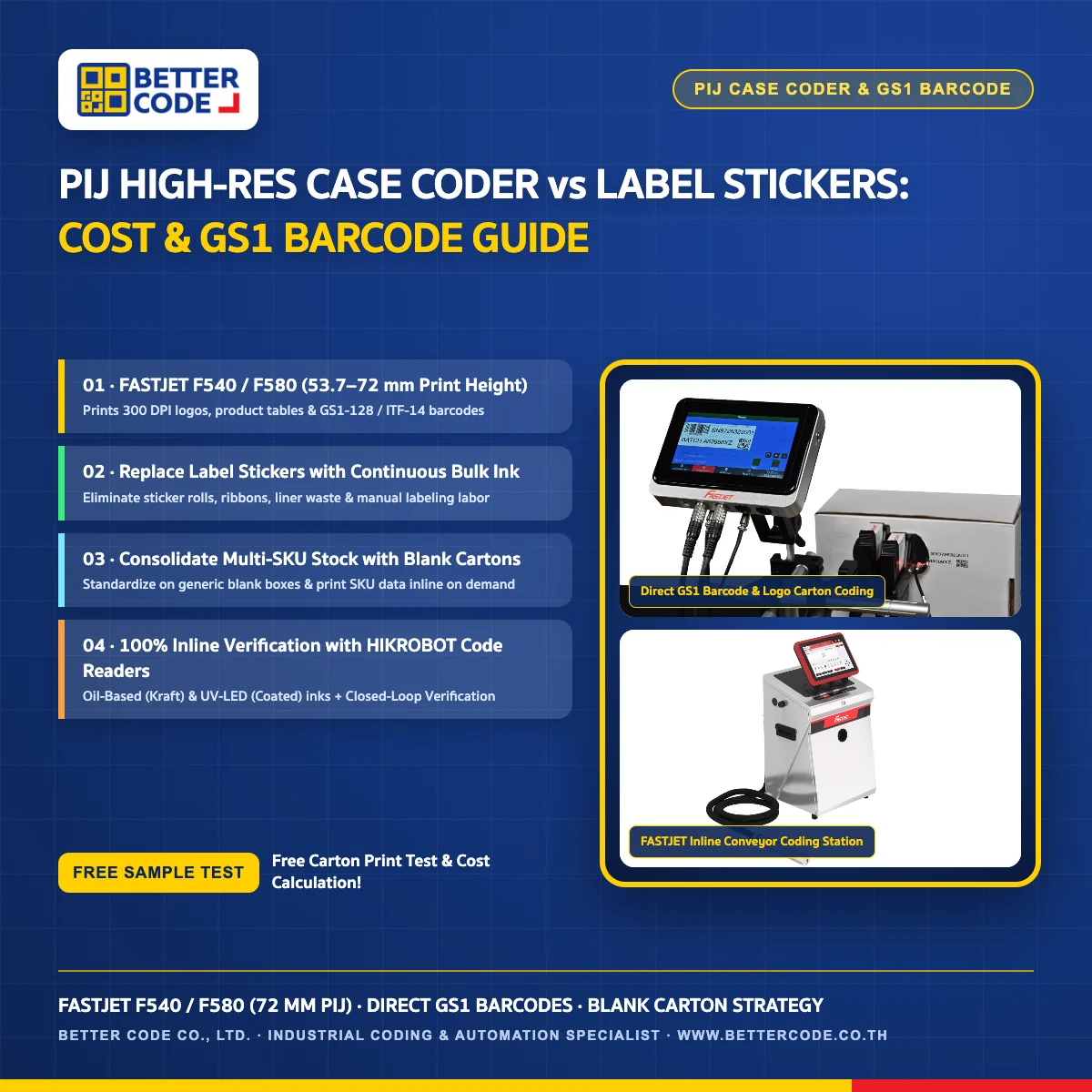
How Does a High-Resolution PIJ Case Coder (Such as FASTJET F540 / F580) Differ from TIJ/CIJ Printers and Pre-Printed Label Stickers, and How Does Direct Carton Coding Cut Label Costs and Multi-SKU Box Inventory?
A High-Resolution Piezo Inkjet (PIJ) Case Coder such as the FASTJET F540 / F580 prints up to 53.7–72 mm height per printhead directly onto corrugated cartons using a continuous bulk ink system. Unlike small-character TIJ/CIJ date coders or expensive pre-printed stickers, PIJ eliminates label/ribbon consumables and lets factories standardize on generic blank cartons with Better Code Co., Ltd.
4-Way Carton Coding Comparison: High-Resolution PIJ (FASTJET F540/F580) vs TIJ (FASTJET F3500) vs CIJ (FASTJET F650) vs Pre-Printed Label Stickers
Plant managers and packaging engineers evaluating end-of-line cost reduction frequently ask: “What is a PIJ printer (High-Resolution Case Coder), and how does it compare against TIJ, CIJ, or pre-printed thermal transfer labels?” The engineering matrix below compares all 4 carton marking technologies side by side:
| Engineering Criterion | 1. High-Res PIJ Case Coder (FASTJET F540 / F580) | 2. Thermal Inkjet TIJ (FASTJET F3500) | 3. Continuous Inkjet CIJ (FASTJET F650) | 4. Adhesive Label Stickers (Manual or Print & Apply) |
|---|---|---|---|---|
| 1. Print Height per Single Printhead | 53.7 mm to 72 mm per single head (stitchable across multiple heads to replace large shipping labels in one seamless pass) | 12.7 mm or 25.4 mm per cartridge head (daisy-chain up to 2–4 heads; ideal for 1–4 lines of text) | 2–15 mm (small-character dot-matrix date and lot coding) | Fixed to pre-die-cut label dimensions (e.g., 4×2 in. or 4×6 in.; changing size requires swapping label rolls) |
| 2. Print Resolution (DPI) & GS1-128 / ITF-14 Barcode Grade | High-Resolution 180–300 DPI; prints graphics, product tables, and GS1-128, ITF-14 & QR barcodes at ANSI/ISO Grade A–B | 300–600 DPI high resolution, limited to smaller vertical print swaths (ideal for dates and compact barcodes) | Dot-matrix array suited for human-readable MFG/EXP dates; cannot print large high-density GS1 carton barcodes | 203–300 DPI thermal printing on white paper labels, but prone to wrinkling, skewed placement, or peeling in humid transit |
| 3. Ink Delivery System & Consumables | Continuous Bulk Ink System (500–1,000 ml bottles) refilled without stopping the line; zero silicone liner waste | 42 ml snap-in cartridges; ultra-clean and simple, though higher ink cost per ml when printing heavy solid graphics | Continuous ink + make-up solvent reservoirs (economical strictly for small-character date coding) | Triple consumable burden: die-cut label rolls + thermal transfer ribbons + wear-prone thermal printheads + heavy liner waste |
| 4. Cost per Carton for Large Format (50×100+ mm) | Lowest Cost #1 (Saves 60–80%+ vs sticker labels)—you pay only for the exact picoliters of ink jetted onto the box | Highly economical for 1–2 lines of date/lot text (see our CIJ vs TIJ Carton Date Coding Guide) | Low cost for 1–2 line dates, but cannot replace product identification labels | Highest fixed cost per carton—every box incurs label stock + ribbon + manual application labor (or applicator maintenance) |
| 5. Multi-SKU Pre-Printed Carton Stock Reduction | Complete Blank-Carton Enabler (★★★★★) Standardize on generic blank boxes and print SKU names, logos, and GS1 barcodes inline | Prints variable SKU/lot text onto boxes, though smaller swath than PIJ for full-panel graphics | Requires cartons to be pre-printed with SKU artwork and barcodes at the box manufacturer | Reduces box SKUs only by shifting inventory burden to pre-printed label rolls and risking wrong-label mix-ups! |
| 6. Maintenance & Production Line Uptime | Long-life industrial Piezo printhead with one-touch purge recovery and non-stop bulk ink refilling for continuous shifts | Zero Maintenance—every cartridge swap provides a brand-new nozzle array | Automated nozzle flush with scheduled filter replacement intervals | Frequent line stops every 500–1,500 cartons to reload label rolls and ribbons, plus adhesive buildup cleaning |
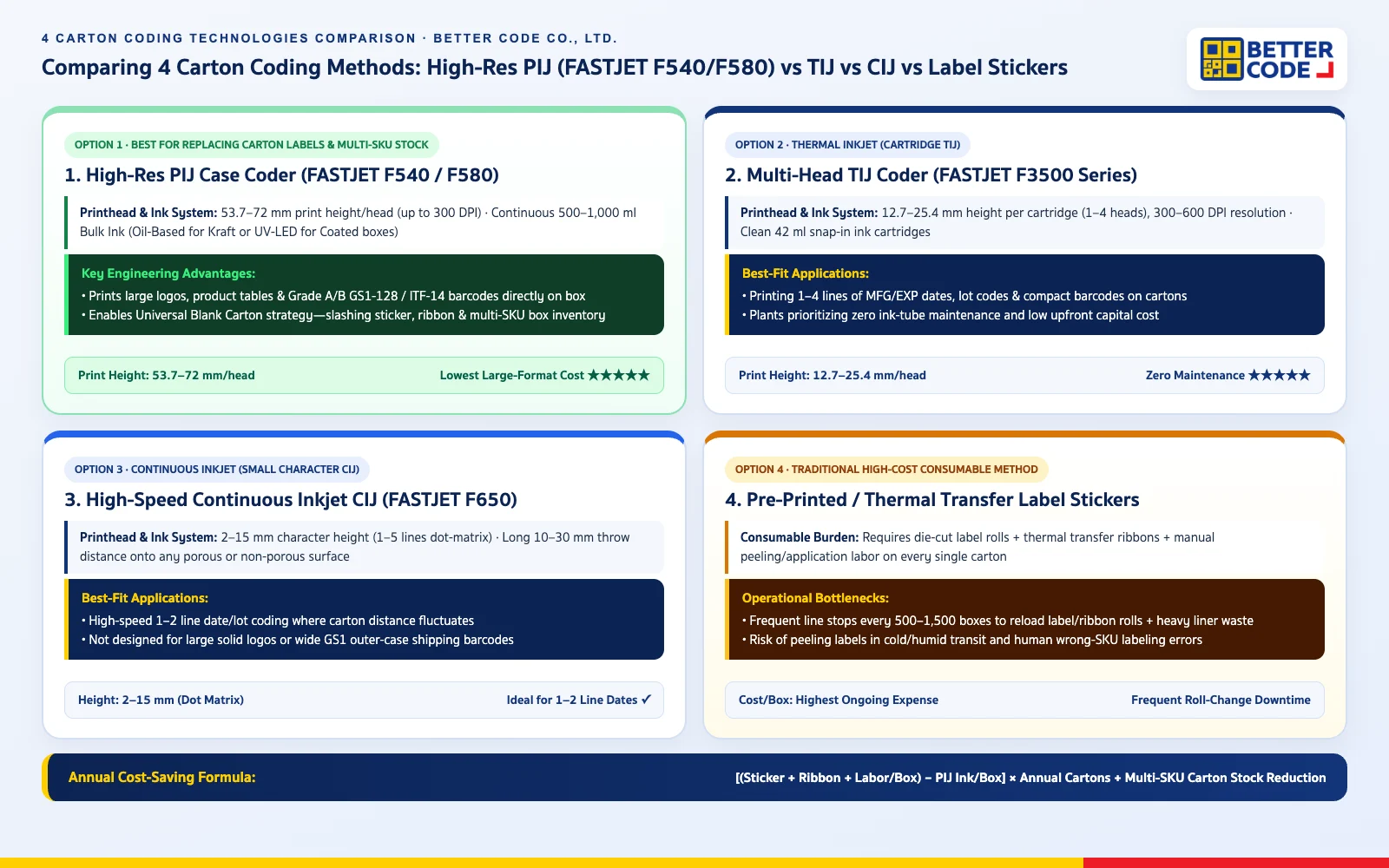
Illustrative Cost Formula & Worksheet: How Much Can Factories Save by Replacing Carton Label Stickers with Direct PIJ Coding?
Adhesive carton labels carry hidden operational costs far beyond the raw sticker price—including thermal transfer ribbons, manual labeling labor (or label applicator downtime), liner waste disposal, and multi-SKU carton inventory. Below is the engineering cost-comparison formula where you can plug in your factory’s actual label prices and carton volumes:
Engineering Formula: Annual Carton Coding Cost Savings
Subtract the direct bulk-ink cost per carton of a FASTJET F540 / F580 High-Resolution PIJ Case Coder from your unit sticker, ribbon, and manual application labor cost, then multiply by your annual carton throughput:
Engineering Note: Actual PIJ ink consumption per box depends on character height, logo fill density, and GS1 barcode dimensions. Send your label artwork to Better Code Co., Ltd. for a complimentary droplet-level ink cost calculation on your exact layout.
Illustrative Cost-Per-Carton Comparison Formula (ตัวอย่างการคำนวณเปรียบเทียบโครงสร้างต้นทุนต่อกล่อง)
| Cost Structure Component (5 Core Items) | Traditional Method: Pre-Printed / Thermal Transfer Label Stickers | Direct Method: Inline PIJ Case Coder (FASTJET F540 / F580) | How to Plug In Your Factory’s Numbers (Worksheet Formula) |
|---|---|---|---|
| 1. Label Stock & Thermal Ribbon vs Bulk Ink Cost per Carton | Requires paying for a die-cut adhesive label + thermal transfer ribbon on every single carton (doubled if labeling two adjacent panels) | Zero label or ribbon cost; consumes only picoliters of PIJ ink from a 500–1,000 ml bulk bottle proportional to actual print coverage | (Label Unit Price + Ribbon Unit Cost − PIJ Ink Cost/Box) × Labels per Carton |
| 2. Manual Label Application Labor Cost | Requires 1–2 dedicated operators per packing line to peel, align, and hand-apply stickers onto moving cartons | Zero manual labeling labor (100% automated inline coding as boxes exit the Case Sealer) | Number of Labeling Operators × Fully Burdened Annual Wage |
| 3. Roll-Changeover Downtime & Liner Waste Disposal | Standard label rolls hold only 500–1,500 stickers, forcing multiple line stops per shift to re-thread labels and ribbons plus dispose of silicone liner waste | Non-stop bulk ink bottle replenishment prints tens of thousands of cartons continuously with zero roll-changeover stops | (Roll Changes/Day × Minutes per Changeover) × Line Downtime Cost/Min |
| 4. Multi-SKU Pre-Printed Carton MOQ & Warehouse Inventory | Forces high minimum order quantities (MOQs) for pre-printed SKU boxes or pre-printed label rolls, tying up working capital and warehouse space | Universal Generic Blank Carton Strategy: buy blank boxes in bulk volume discounts and print SKU artwork + GS1 barcodes on demand | Working Capital Tied Up in Multi-SKU Box Stock + Annual Obsolete Carton Write-Offs |
| 5. Risk of Peeling Labels, Skewed Barcodes & Wrong-SKU Mix-Ups | Labels peel off in humid containers or cold storage, wrinkle over box seams, or get applied to the wrong product SKU by human error | Direct ink bonding into corrugated fibers (or UV-LED curing) never peels off, verified 100% inline by HIKROBOT code readers | Eliminates retailer barcode rejection penalties and AS/RS warehouse rework |
Eliminate Label Consumables & Silicone Liner Waste
Adhesive carton labeling generates tons of non-recyclable silicone release liner waste every year. Printing directly onto corrugated board with a FASTJET F540 / F580 PIJ Case Coder cuts consumable unit cost while advancing your plant’s ESG & sustainability goals.
Consolidate Multi-SKU Box Stock with Blank Cartons
Instead of ordering and warehousing 30–100 pre-printed flexo carton SKUs subject to high supplier MOQs, standardize on universal blank corrugated boxes (or boxes pre-printed only with your master brand logo) and print SKU-specific data inline on demand.
Native GS1-128, ITF-14 Bearer Bars & Dynamic 2D QR Generation
Built-in FASTJET F540 / F580 software natively generates all GS1 outer-case barcode symbologies—including ITF-14 with heavy rectangular bearer bars, GS1-128 with Application Identifiers (01) GTIN, (17) Expiry, (10) Batch/Lot, and 2D DataMatrix / QR codes.
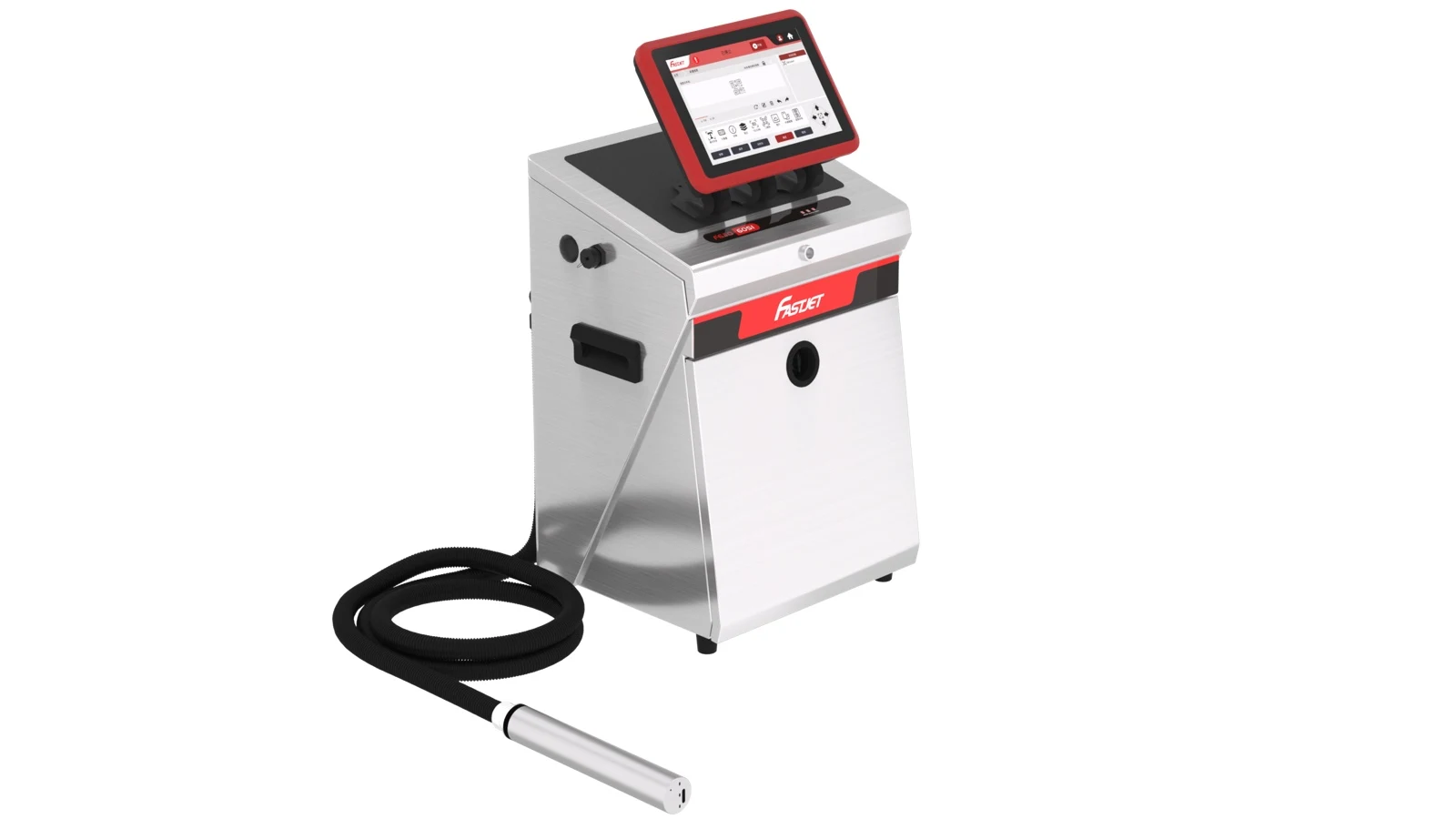
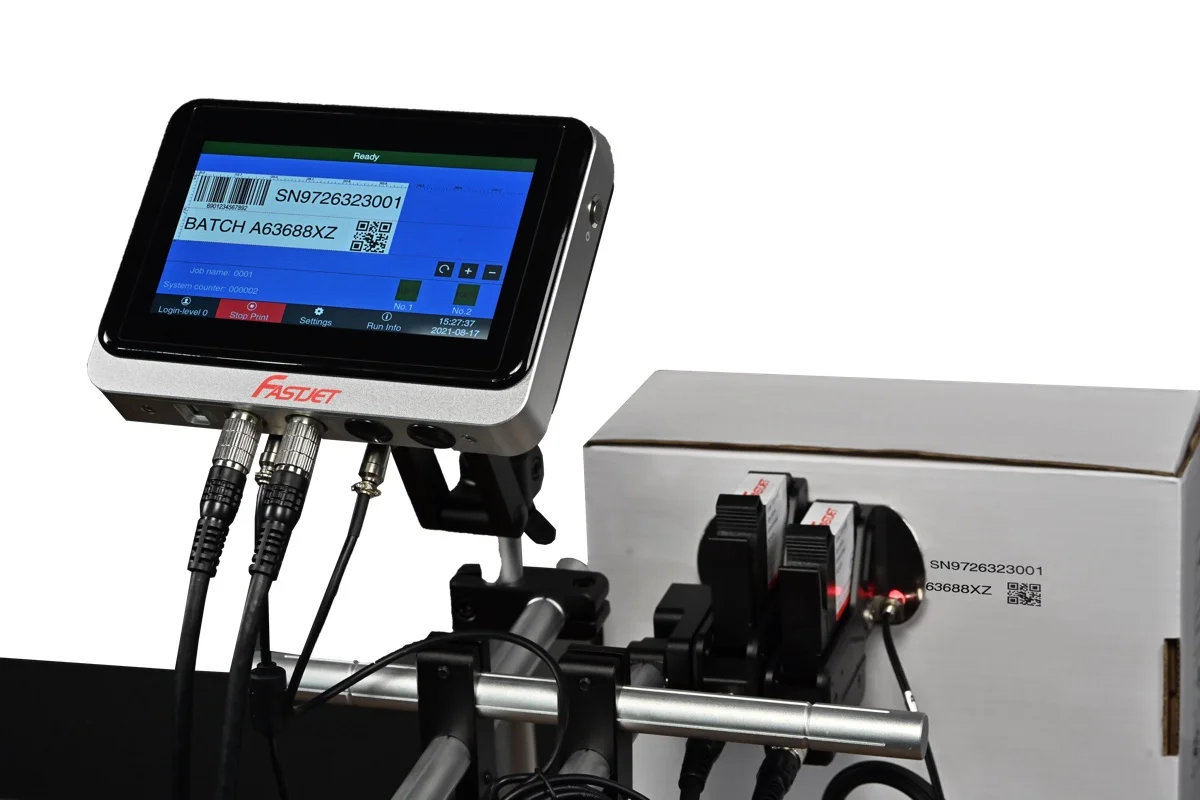
4 Engineering Techniques for Mounting PIJ / TIJ Case Coders on Roller Conveyors or Case Sealers to Guarantee 100% Grade A/B Barcodes
The #1 hesitation factories have before switching from adhesive labels to direct carton coding is: “What if direct-printed corrugated barcodes fail to scan at our customer’s warehouse?” In engineering practice, unreadable case barcodes are almost always caused by improper mechanical mounting rather than the printhead itself. Here are the 4 engineering standards Better Code Co., Ltd. implements on every carton coding line:
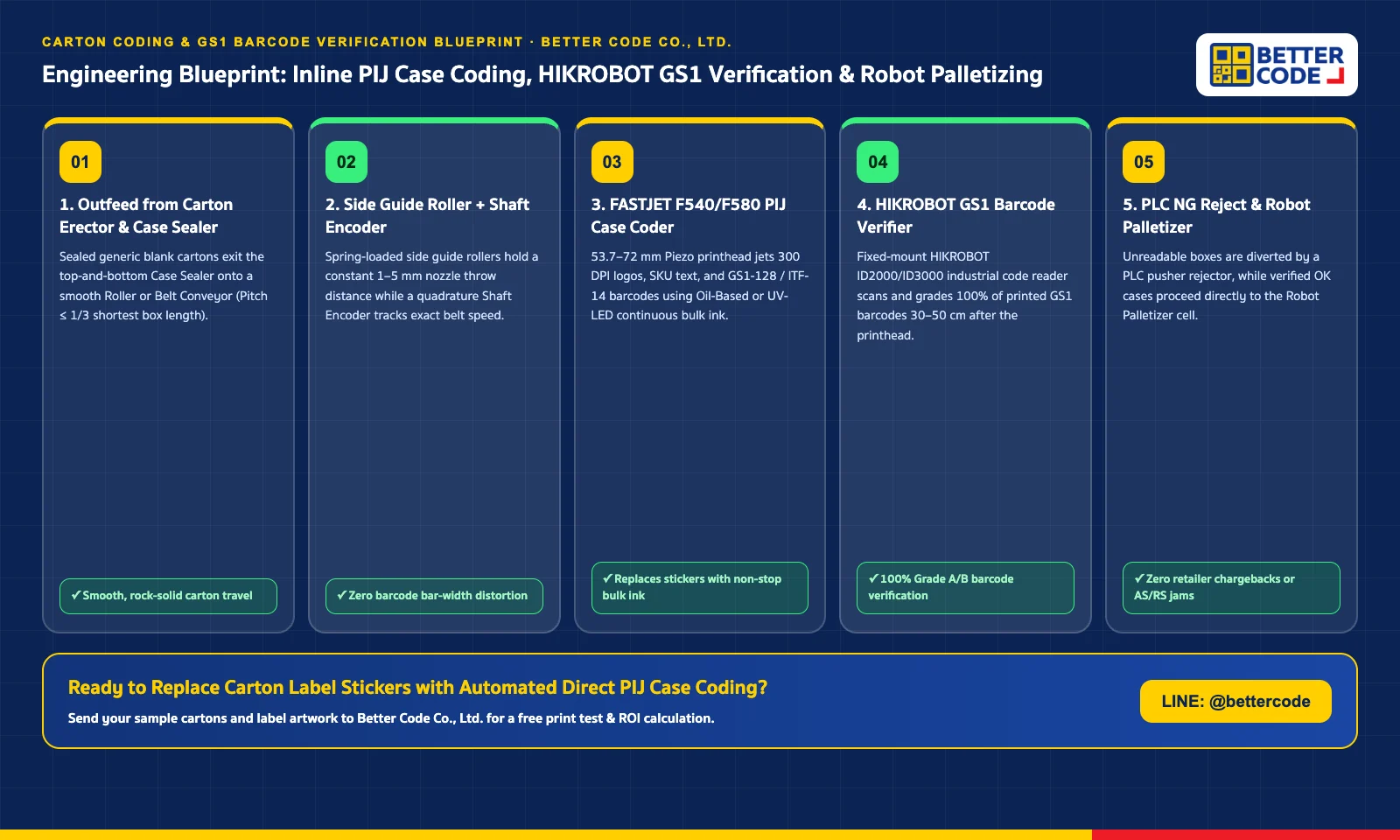
Technique 1: Lock In a 1–5 mm Throw Distance Using Spring-Loaded Side Guide Rollers & Deflector Brackets
High-resolution FASTJET F540 / F580 PIJ and FASTJET F3500 TIJ printheads produce razor-sharp barcode edges when the nozzle-to-carton gap (throw distance) is held between 1 and 5 mm. If cartons skew or wander laterally on a Roller Conveyor, the gap widens and barcodes blur. Better Code engineers install rigid side guide rails paired with a spring-loaded printhead deflector bracket with lead-in rollers that glides smoothly along each carton face—maintaining a constant 1–5 mm gap even if boxes are slightly bulged.
Technique 2: Synchronize Print Firing with a Quadrature Shaft Encoder to Eliminate Barcode Bar-Width Distortion
Scannable GS1-128 and ITF-14 barcodes depend on strict narrow-to-wide bar and space tolerances. If a printer fires at a fixed internal clock rate while a carton transitions between the side-belts of a Case Sealer and the outfeed conveyor, any speed fluctuation stretches or compresses the barcode bars. Mounting a spring-loaded quadrature Shaft Encoder wheel directly against the conveyor belt or drive roller locks droplet firing to exact physical travel distance.
Technique 3: Match Ink Chemistry to Carton Porosity — Oil-Based (Porous Kraft) vs UV-LED Curable / Solvent (Coated Cartons)
Corrugated shipping cases vary widely in surface energy: (1) For standard porous brown or bleached white Kraft cartons, we specify mineral-free Oil-Based Ink that penetrates paper fibers instantly with zero edge feathering and high optical contrast; (2) For glossy clay-coated, offset-laminated, or cold-chain waxed cartons (non-porous surfaces), we deploy UV-LED Curable Ink paired with an inline UV-LED curing lamp (or fast-dry Solvent ink) that polymerizes instantly on contact without smudging.
Technique 4: Deploy Closed-Loop Print & Verify with a HIKROBOT ID2000/ID3000 Barcode Reader Before Robot Palletizing
To guarantee that a damaged or creased box never causes a barcode rejection at a customer’s AS/RS automated warehouse or retail distribution center, we integrate a Closed-Loop Print & Verify Station. Mounting a fixed-mount HIKROBOT ID2000 / ID3000 Industrial Barcode Reader 30–50 cm downstream of the FASTJET printhead verifies 100% of printed GS1 barcodes inline—triggering a PLC alarm, pneumatic pusher rejector, or interlock stop before the End-of-Line Robot Palletizer picks a defective case.
6-Point Checklist to Request a Free Carton Sample Print Test & Exact Ink Cost Calculation from Better Code Co., Ltd.
Want to see actual print quality from the FASTJET F540 / F580 High-Resolution PIJ Case Coder or FASTJET F3500 TIJ Printer on your own corrugated boxes—complete with an inline HIKROBOT barcode grade report? Share these 6 details via LINE @bettercode or our Request a Quote page:
Specify target print height × length (e.g., 50 mm or 70 mm tall) and elements required (logo, product name, MFG/EXP dates, ITF-14, GS1-128, or QR code).
Porous brown Kraft, mottled white Kraft, glossy clay-coated/laminated board, or waxed cold-chain carton? (Ship us sample flats for free lab testing!)
Do you need to print on 1 side panel, 2 opposite side panels simultaneously, or front + side adjacent panels?
Cases per minute (CPM) / cartons per day, and whether the printhead will mount immediately after a Case Sealer, Belt Conveyor, or Roller Conveyor.
Share your unit sticker cost and SKU count so our engineers can calculate your exact picoliter ink cost per box and payback period.
Specify if you require Ethernet TCP/IP database integration or an inline HIKROBOT ID2000/ID3000 barcode verifier prior to palletizing.
Frequently Asked Questions: High-Resolution PIJ Case Coders & Direct Carton Barcode Printing (FAQ)
What is a PIJ printer (Piezo Inkjet Case Coder) and how does it work?
A PIJ (Piezo Inkjet) printer—commonly known in secondary packaging as a High-Resolution Case Coder—uses piezoelectric crystals inside an industrial printhead (53.7 mm to 72 mm tall per head on the FASTJET F540 and F580) to jet high-density ink droplets at 180–300 DPI directly onto corrugated shipping cases. It prints product names, brand logos, tables, manufacturing dates, and GS1-128 / ITF-14 barcodes inline, replacing adhesive thermal labels.
Can barcodes printed directly onto corrugated cartons by a PIJ Case Coder achieve Grade A/B scan rates?
Yes. When installed with a spring-loaded side guide roller to hold a constant 1–5 mm throw distance and a quadrature shaft encoder to track real-time conveyor speed, FASTJET F540 / F580 PIJ coders print crisp, high-contrast ITF-14 (with bearer bars) and GS1-128 barcodes. Pairing the printer with an inline HIKROBOT ID2000/ID3000 industrial barcode reader verifies 100% of cartons immediately after printing.
Can FASTJET F540 / F580 PIJ printers code onto glossy, coated, or waxed corrugated cartons?
Yes. Better Code supplies two specialized ink families: (1) Mineral-free Oil-Based Ink engineered for standard porous brown or white Kraft corrugated boxes, which penetrates paper fibers and dries instantly without heaters; and (2) UV-LED Curable or Solvent-Based Ink paired with an inline UV-LED pinning/curing lamp for coated, glossy, laminated, or cold-chain waxed cartons.
Should we choose a PIJ Case Coder (FASTJET F540/F580) or a TIJ Printer (FASTJET F3500) for side-of-box coding?
Selection depends on your print height and daily carton volume. If you only print 1–3 lines of MFG/EXP dates and lot codes (12.7–25.4 mm tall) at low-to-medium volume, the cartridge-based FASTJET F3500 TIJ printer offers lower upfront capex and zero ink-tube maintenance. However, if you want to replace large 50–72+ mm product labels, print graphics/logos, or run thousands of cases per day, the FASTJET F540 / F580 PIJ with continuous 500–1,000 ml bulk ink bottles delivers a drastically lower cost per print.
How does switching to Generic Blank Cartons with inline PIJ coding reduce warehouse inventory costs?
Factories producing multiple flavors, export languages, or private-label OEM SKUs often get trapped by high minimum order quantities (MOQs) for pre-printed flexo cartons—tying up warehouse floor space and cash flow in slow-moving box stock. Standardizing on universal blank corrugated cartons and printing SKU-specific descriptions, logos, and GS1 barcodes on demand at the packing line eliminates obsolete carton write-offs and slashes safety stock requirements.
Does Better Code Co., Ltd. provide free sample printing and cost-per-carton calculations on our actual boxes?
Yes, completely free of charge. Send your current sticker artwork and sample corrugated cartons to Better Code Co., Ltd. Our engineers will run live print tests on both FASTJET F540/F580 PIJ and FASTJET F3500 TIJ systems, grade the printed barcodes using a HIKROBOT industrial code reader, and provide an exact ink-consumption and ROI breakdown against your current sticker cost.
Request a Free Carton Sample Print Test & Cost-Per-Box Analysis from Better Code Co., Ltd.
Whether your plant wants to replace costly adhesive carton labels with a FASTJET F540 / F580 High-Resolution PIJ Case Coder, deploy a FASTJET F3500 TIJ printer, or integrate custom conveyors with HIKROBOT barcode readers and End-of-Line Packaging Automation, Better Code Co., Ltd. is ready to run free sample prints on your boxes and deliver a complete engineering quotation.
Request Quote / Free Sample Print Test ↗Explore PIJ Case Coders (FASTJET F540/F580) ↗Explore TIJ Printers (FASTJET F3500) ↗Send Box & Label Photos on LINE @bettercode ↗Engineering References & Carton Barcode Standards
- Technical specifications for FASTJET F540 / F580 High-Resolution Piezo Inkjet (PIJ) Case Coders and FASTJET F3500 Thermal Inkjet (TIJ) systems: Industrial Coding Engineering Division, Better Code Co., Ltd.
- GS1 General Specifications for outer-case corrugated carton barcoding (ITF-14 bearer bars, GS1-128 Application Identifiers, and ISO/IEC 15416 linear barcode print quality verification) integrated with HIKROBOT ID Series industrial code readers.