Bottle Cap Date Coding: Choosing CIJ or Laser for Plastic and Metal Caps
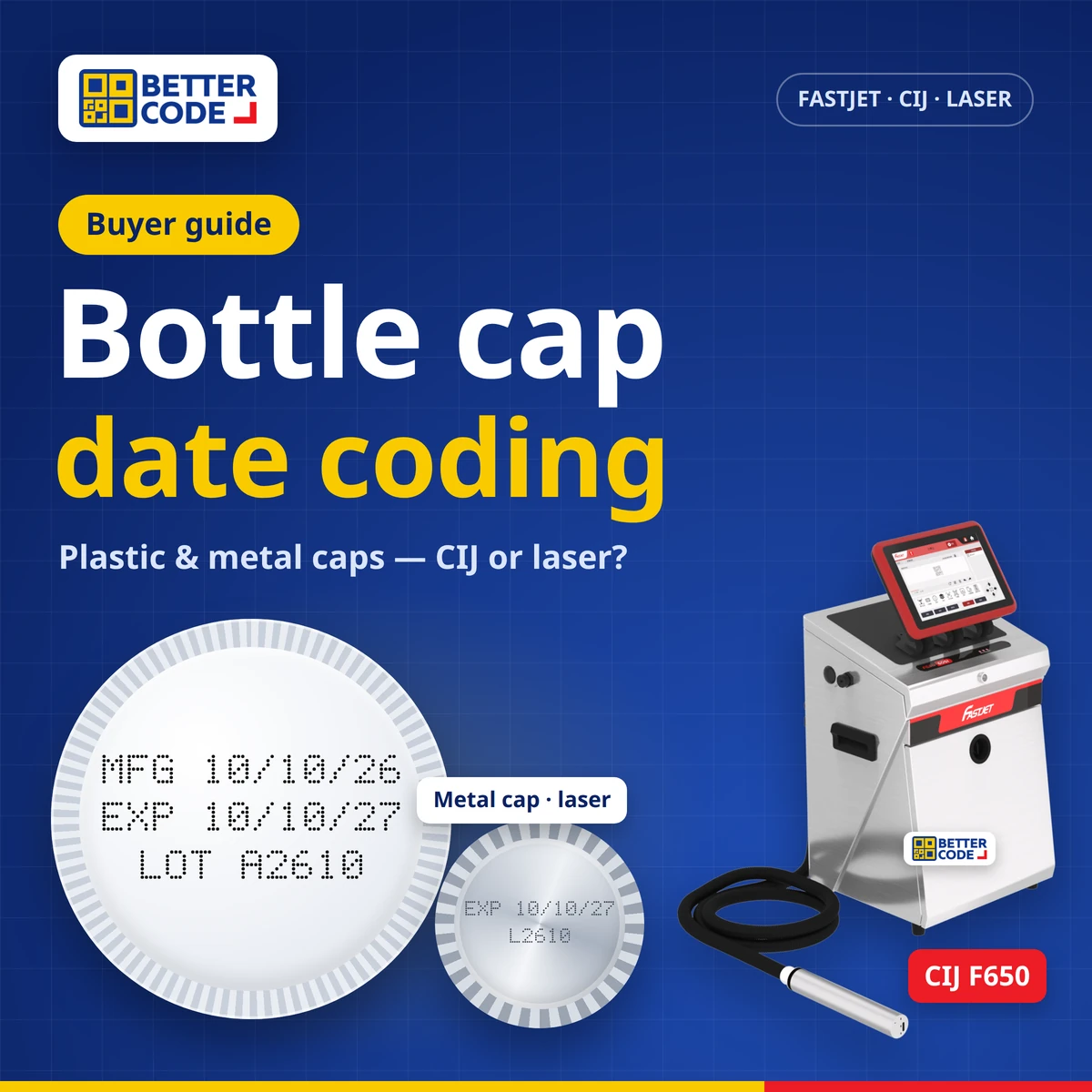
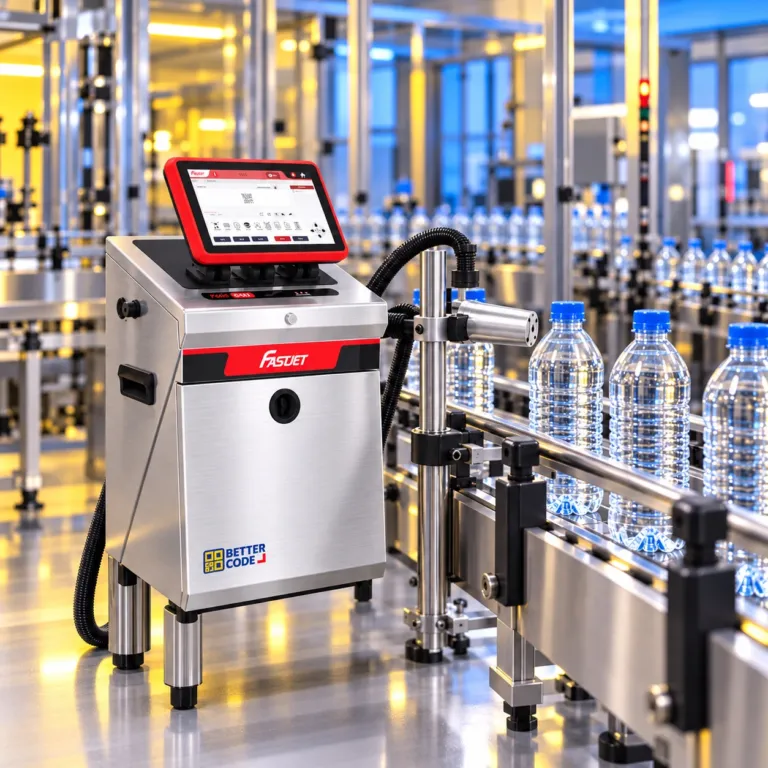
Bottle cap date coding on a production line uses one of two main technologies: 1) a CIJ date coding printer, which jets ink onto the cap without contact while bottles move along the conveyor (FASTJET F640 / F650, 5–40 mm throw distance, dye-based inks that adhere to PE, PET, PVC and metal), or 2) a laser date coder, which creates a permanent mark with no ink (UV 355 nm for PE / PP plastic caps, Fiber 1064 nm for metal caps or suitable plastics). For small batches where caps or bottles are coded one at a time, a handheld date printer works. Choose by cap material, print position (cap top or side), line speed and cap surface condition, then test on your real caps before deciding on a model.
What is a bottle cap date coding printer?
A bottle cap date coding printer is a coding system set up to print the manufacturing date (MFG), expiry date (EXP) and lot number directly on the bottle cap instead of on the label or bottle body. It is common for beverages, drinking water, sauces, cooking oil, dairy, personal care products and chemicals, because the cap is easy for consumers to see, needs no space on the label, and can be coded right after capping while bottles run continuously on the conveyor.
Caps are small, curved, often ribbed and made of different materials, so choosing a printer differs from coding cartons or pouches. For a full drinking-water line, see water bottle date coding printers, and if you are still deciding where to print, read where to print the expiry date on packaging.
Which date coder suits each type of cap?
The most important starting point is the cap material, because it decides how well ink adheres and whether a laser produces a readable mark.
| Cap type | What to test | What to check |
|---|---|---|
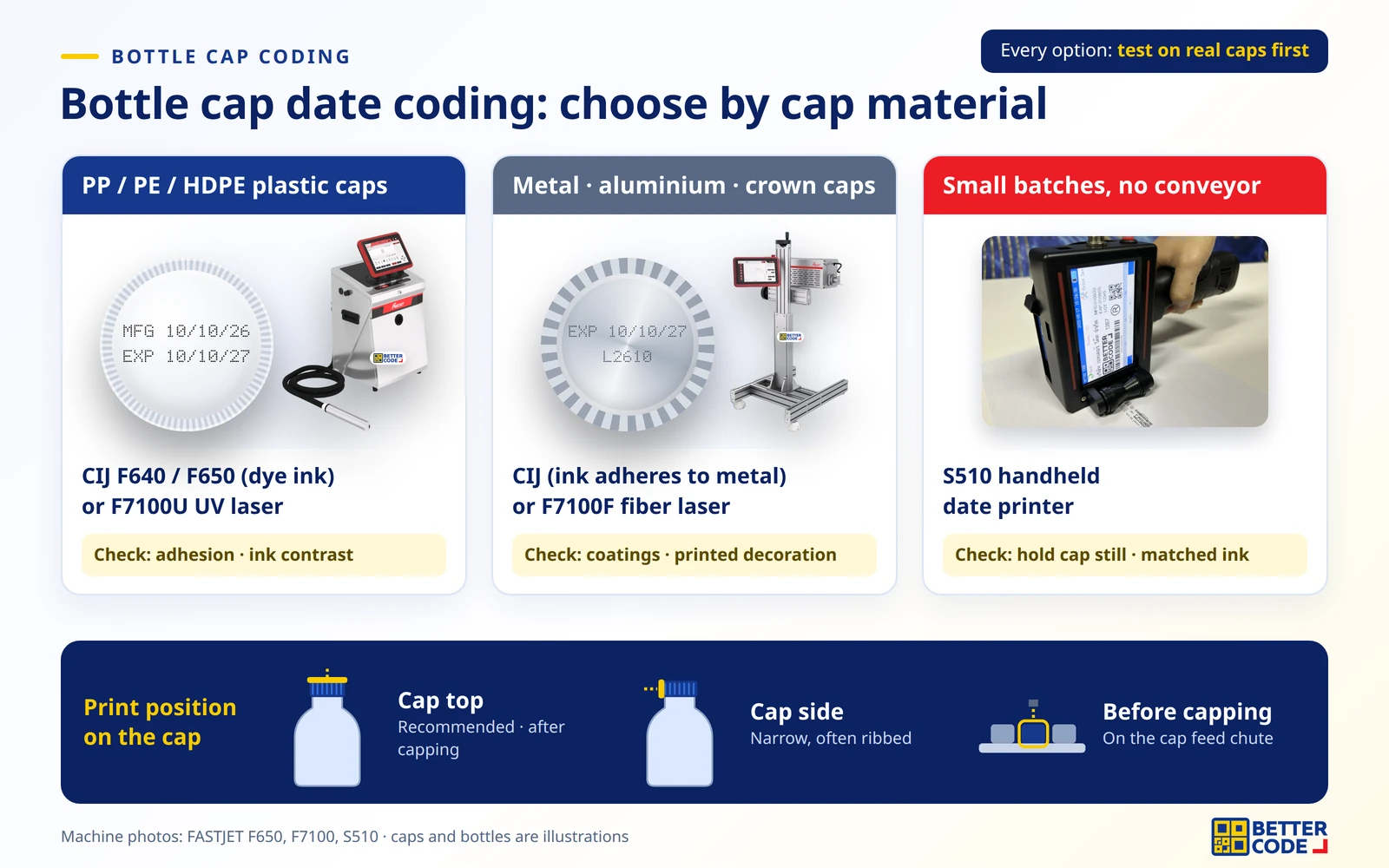
| Plastic screw caps (PP / PE / HDPE) | FASTJET F640 / F650 CIJ with dye ink, or F7100U UV laser | Ink adhesion on glossy plastic, ink colour contrast, laser mark contrast |
| Metal, aluminium and crown caps | CIJ (ink adheres to metal) or F7100F fiber laser | Coatings or printed decoration, edge curvature, focus distance |
| Caps with moisture or condensation (cold filling) | CIJ with moisture removal before the print point, or laser | Test under real line conditions, as droplets stop ink adhering evenly |
| Small batches, no conveyor | S510 handheld date printer | A fixture to hold the cap still, and an ink matched to the cap material |
FASTJET’s F640 and F650 brochures state that dye-based inks adhere to a wide range of materials including PVC, PE, PET and metal. The F7100U UV laser lists plastics PE, PVC, PP, PS, POM and PC plus metals, and the F7100F fiber laser lists aluminium, steel and plastics such as HDPE, PP, PVC and PS, subject to sample testing, because pigments, additives and coatings differ between cap suppliers.
Where on the cap should the date be printed?
Print position affects both code clarity and how the print head is mounted. There are three common options:
- Cap top (recommended for continuous lines): the print head points down from above and codes after the capper as bottles pass. It is the flattest surface and the first thing consumers see.
- Cap side: used when the top carries embossing or a logo, but the area is narrow and often ribbed. Choose a smooth enough band and stop bottles rotating during printing.
- Before capping: code caps on the cap feed chute before the capper. Useful when bottles wobble on the conveyor or a head cannot be mounted above them, but caps must arrive consistently face-up.
When the date is on the cap, many products state on the label “see cap for MFG and EXP” so consumers can find it. Check the date wording against Thai FDA labelling rules: see Thai food label date coding requirements.
CIJ date coding printers for bottle caps
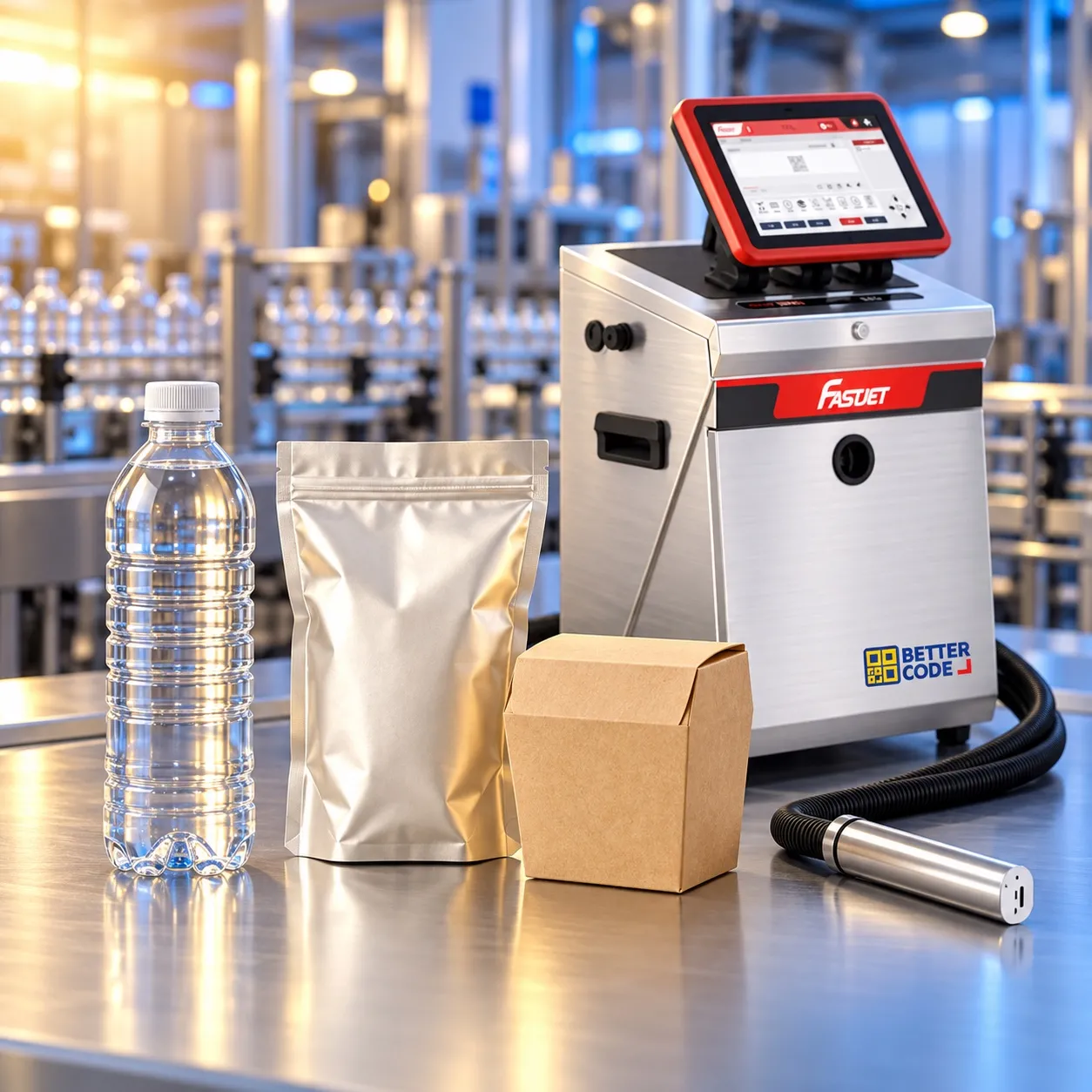
A CIJ (continuous inkjet) printer jets ink droplets onto the cap without contact, so it suits continuous lines and curved caps. Better Code offers two main FASTJET models:
| Brochure specification | FASTJET F640 | FASTJET F650 |
|---|---|---|
| Print lines | 1 line (25 dot) / 3 lines (7×5) | 1 line (34 dot) / 4 lines (7×5) |
| Nozzle size | 60 / 70 µm | 40 / 50 / 60 / 70 µm |
| Throw distance | 5–40 mm | 3–10 mm (40 µm) · 5–25 mm (50 µm) · 5–40 mm (60/70 µm) |
| Print modes | Standard, High Quality | High Speed, Standard, High Quality |
| Example speed | – | 2 lines of 7-dot characters up to 120 m/min (depending on settings) |
| Printable content | Numbers, text, dates, lot codes, shift codes, barcodes, QR codes | |
| Ink / protection | Dye ink · IP55 · 750 ml ink and solvent cartridges | |
For caps that need 2–3 lines such as MFG / EXP / LOT in a small area, the F640 covers most jobs. The F650 suits faster lines, 4-line codes, or the small 40 µm nozzle that can be mounted close to the cap. See FASTJET CIJ date coding printers.
Laser date coders for bottle caps
A laser marks the code directly into the cap surface with no ink or solvent, so the code does not rub off and there are no ongoing ink costs. Choose the laser type by cap material:
- F7100U UV laser (355 nm, 5W / 10W): water-cooled, giving sharp marks on plastics and polymers. The first option to test for PP / PE plastic caps.
- F7100F fiber laser (1064 nm, 20W / 30W): air-cooled, 110 × 110 mm marking field (F163 lens), for metal and aluminium caps and suitable plastics such as HDPE and PP. See FASTJET F7100F.
- F7100C CO2 laser (40W): for non-metals such as paper, labels and PET (the F7143C at 9.3 µm suits PET beverage bottles). For plastic caps, test it against UV first.
See all three series at FASTJET laser date coders, and if you also code PET bottles and cans, read laser date coding for PET bottles and cans.
CIJ or laser: which suits your bottle caps?
| Factor | CIJ date coder | Laser date coder | Handheld printer |
|---|---|---|---|
| Production style | Continuous conveyor line | Continuous conveyor line | Small batches, items coded by hand |
| Consumables | Ink and solvent | No ink | Ink cartridges |
| PP / PE plastic caps | Yes, test adhesion and ink colour | UV is the first choice | Yes, with an ink matched to the material |
| Metal caps | Yes | Fiber or UV | Test according to coating |
| Frequent cap colour changes | Choose an ink colour that contrasts | Contrast depends on material and colour; test | Ink colour can be chosen |
| Maintenance | Routine print head and ink system care | Lens and cooling system care | Cartridge replacement |
For a detailed comparison of all three systems, read CIJ vs TIJ vs laser date coding. For small batches, see the S510 handheld date printer.
5 steps to choose a bottle cap date coding printer
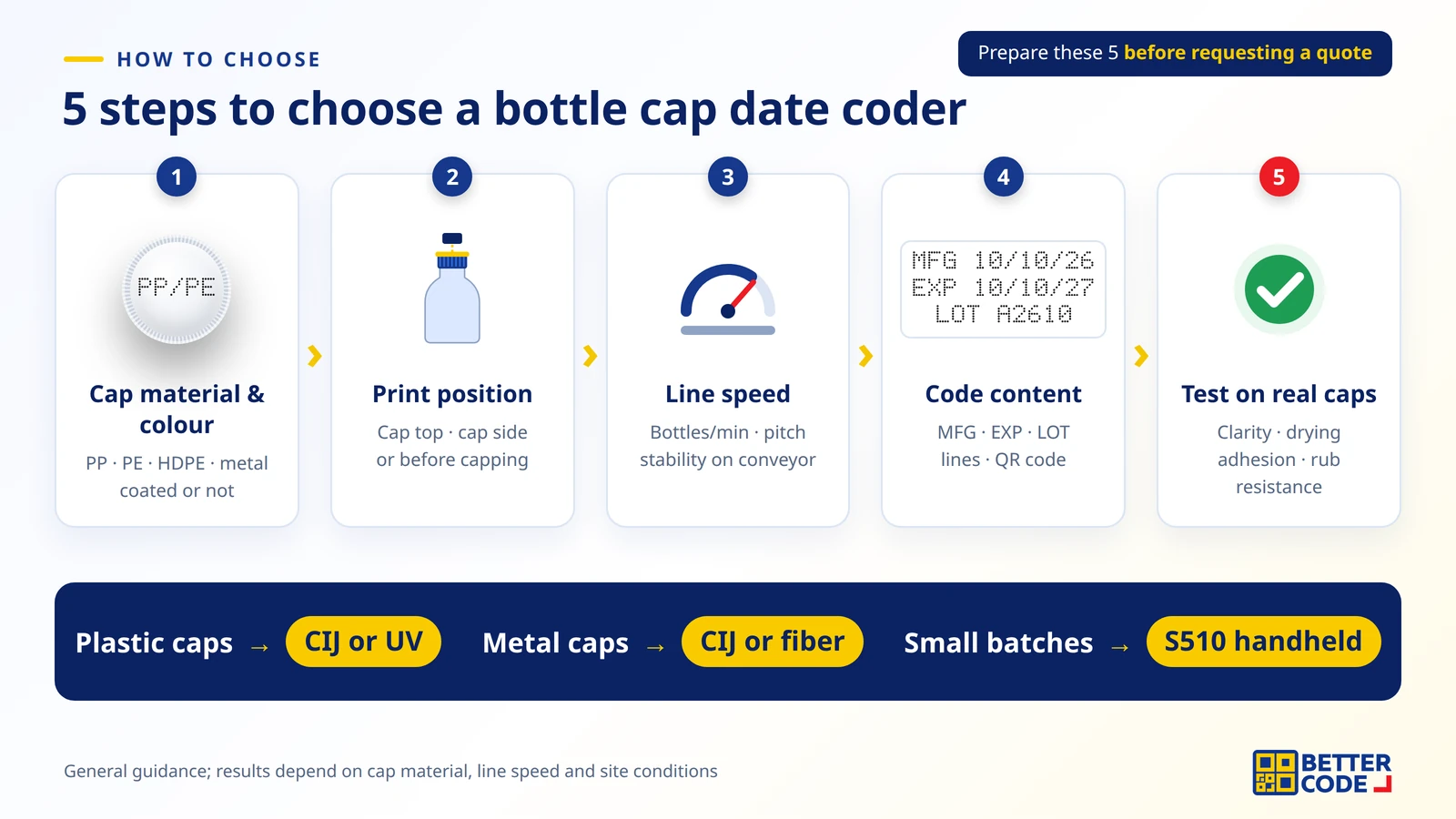
- Cap material and colour: PP / PE / HDPE plastic or metal, which colour, and any coating or printed decoration.
- Print position: cap top, cap side or before capping, and the actual printable area.
- Line speed: bottles per minute, bottle pitch and how stable bottles are on the conveyor.
- Code content: number of lines, and whether you need MFG / EXP / LOT / time / QR code.
- Test on real caps: send sample caps so the team can test clarity, drying, adhesion and rub resistance.
Common problems when coding bottle caps
- Ink rubs off or fades: usually caused by oil, dust or moisture on the cap, or an ink not matched to the material. See how to fix date code ink adhesion problems.
- Skewed codes or codes off the edge: caused by bottles wobbling or rotating on the conveyor. Fix with bottle guide rails and a correctly positioned product sensor.
- Hard to read on dark caps: choose an ink colour that contrasts with the cap, or test a laser that gives higher contrast on that material.
- Wet caps from cold filling: add moisture removal before the print head and test at real line temperature.
Once coding works, verify that every cap carries a complete, correct code with an OCR camera after the print point: see date code inspection cameras; to also check caps, fill level and labels, see packaging inspection cameras.
Summary
Choose a bottle cap date coding printer by cap material first: start testing plastic caps with dye-ink CIJ or a UV laser, use CIJ or a fiber laser for metal caps, and a handheld printer for small batches. Then define the print position, line speed and code content, and test on real caps before deciding. Better Code, the only official FASTJET distributor in Thailand, helps assess your line, test-print, install and provide after-sales service.
Bottle cap date coding FAQ
Which printer is best for bottle cap date coding?
Continuous conveyor lines use a CIJ date coder or a laser. CIJ jets ink without touching the cap and works on many materials, while a laser makes a permanent mark with no ink. Small batches without a conveyor can use a handheld printer. Test on real caps before choosing a model.
Can you print dates on PP or PE plastic caps?
Yes. The FASTJET F640 / F650 brochures state that dye ink adheres to PE, PET, PVC and metal, and the F7100U UV laser lists PE and PP. Results depend on each supplier’s pigments and surface, so test adhesion and clarity first.
Which date coder works on metal or aluminium caps?
Use CIJ, whose ink adheres to metal, or the F7100F fiber laser (1064 nm), which lists aluminium and steel. If the cap is coated or decorated, test that the mark is readable on that surface.
Should caps be coded before or after capping?
Most lines code the cap top after the capper, because the head mounts easily above the conveyor and the surface is flat. Coding before capping is used when bottles are unstable on the conveyor, but caps must arrive consistently face-up.
Can you code caps that are wet with condensation?
Yes, but droplets stop ink adhering evenly. Add moisture removal before the print head or test a laser, and always test under real line conditions.
How many lines can a CIJ printer code on a bottle cap?
According to the brochures, the FASTJET F640 prints up to 3 lines (7×5 characters) and the F650 up to 4 lines. The number of lines you can actually fit depends on cap size and character height.
Where can I buy a bottle cap date coding printer in Thailand?
Contact Better Code (Better Code Co., Ltd.), the only official FASTJET distributor in Thailand, via LINE @bettercode or +66 2-170-9611. The team helps choose a printer for your real caps and provides test printing, installation and after-sales service.
Sources
- FASTJET F640 Series Continuous Inkjet Printer (EF64024001): print lines, nozzles, throw distance, dye ink, PVC, PE, PET and metal substrates, IP55
- FASTJET F650 Series Continuous Inkjet Printer (EF65024001): High Speed mode, 90–120 m/min example speeds, 40–70 µm nozzles and throw distance by nozzle size
- FASTJET F7100C / F7100U / F7100F laser data from Better Code’s laser date coder product page
- Thai FDA Food Division – food labelling rules and label examples
Want to see a code on your own caps before deciding?
Send sample caps, a bottle photo, your line speed and the code content. The Better Code team will test-print with FASTJET CIJ or laser and recommend the right model for your line.