Packaging Inspection Cameras for Bottles, Cans and Beverages: What They Check and How to Choose
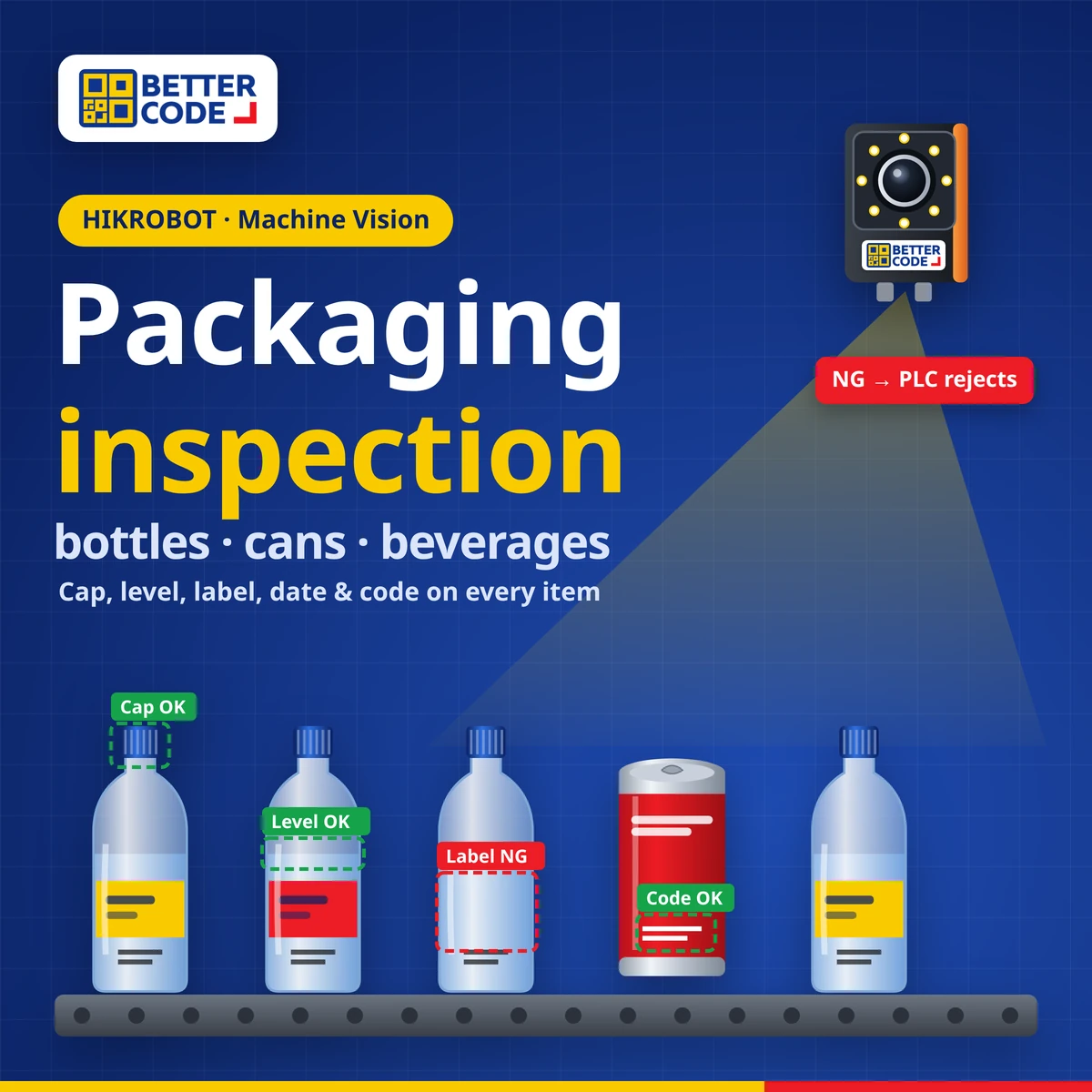
A packaging inspection camera is a machine vision system that checks every bottle, can, carton and pouch on a packaging line. Common checks in beverage and food plants are cap present and seated, fill level, label present and positioned, readable date and lot code (OCR), barcodes/QR/codes on cans, count per pack, and completeness or foreign matter. It then sends OK / NG to the PLC for immediate rejection. Clear-cut checks use a smart camera, code reading uses a code reader, and frequently changing patterns use deep learning. Examples from HIKROBOT cases include cap and label inspection on high-speed conveyors, and reading characters on milk cartons on a filling line at 7 pieces per second with a read rate above 99.95%.
What is a packaging inspection camera?
A packaging inspection camera is an industrial camera installed on a packaging line that images every bottle, can, carton or pouch as it moves along the conveyor, and uses software to confirm the pack is complete and correct before it ships: the cap is on, the fill level is right, the correct label is applied and the date is readable. It is widely used in beverage, drinking water, dairy, food and pharmaceutical plants, because lines are too fast for visual checks and packaging errors often lead to recalls.
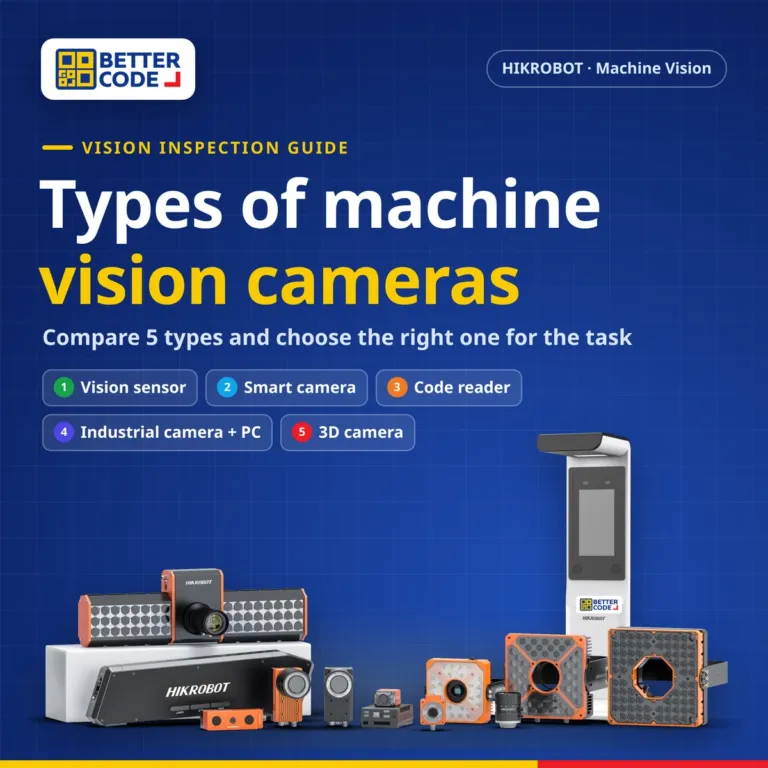
This article focuses on packaging checks. For the basics of vision systems, read types of machine vision cameras.
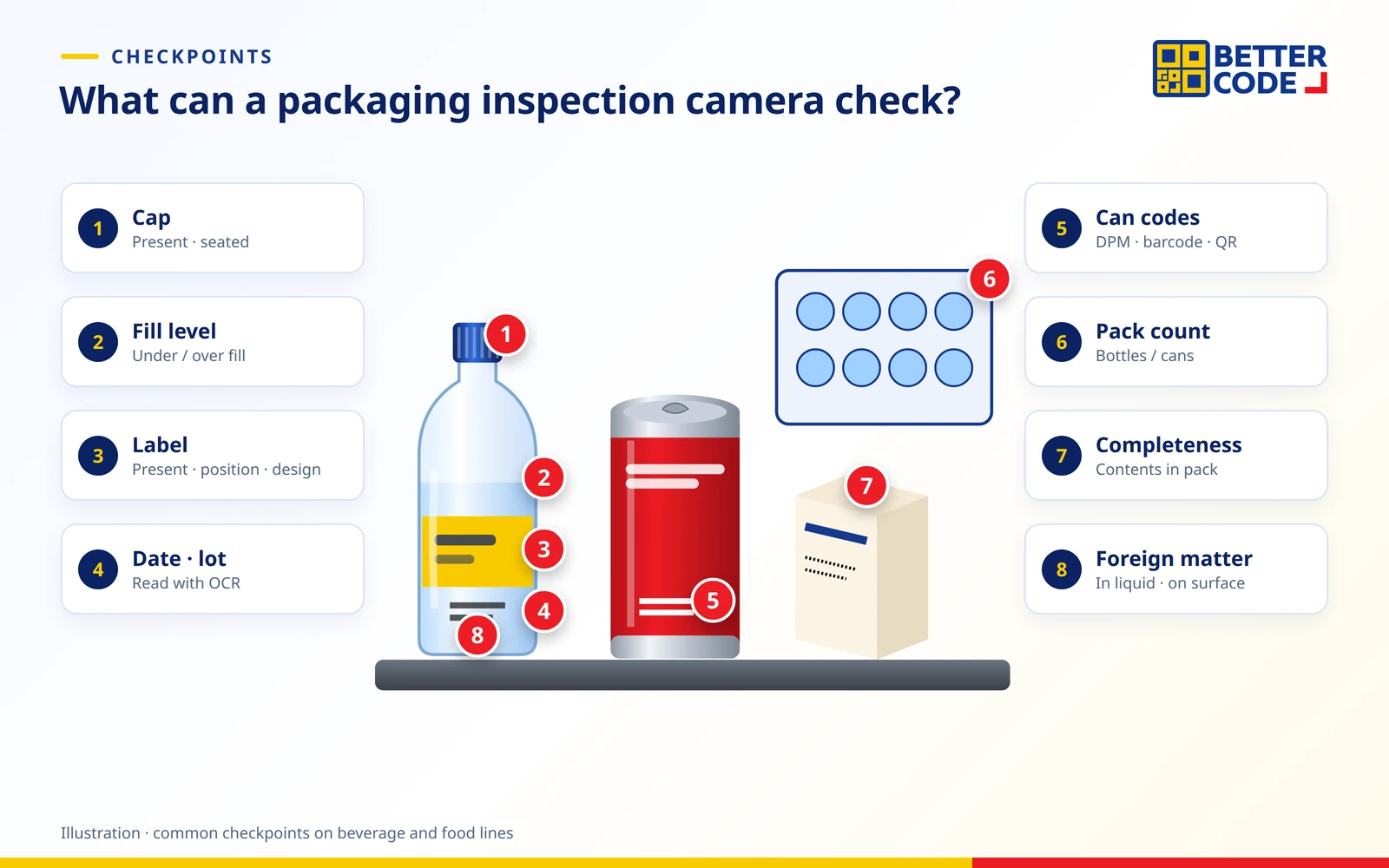
What can a packaging inspection camera check?
| Check | Example from HIKROBOT cases | Suitable hardware / tool |
|---|---|---|
| Cap present and seated | Bottle cap inspection on a high-speed conveyor with an external trigger | Smart camera · pattern existence + greyscale size |
| Fill level | Checking liquid level in medicine bottles against the standard | Smart camera · line tool · backlight |
| Label and bottle count | Label inspection on every bottle on a high-speed conveyor and counting bottles per pack | Smart camera |
| Date, lot code, dot-matrix text | Milk cartons on a filling line at 7 pieces/s · chocolate wrappers · wrinkled rice bags | Smart camera OCR or deep learning OCR |
| Codes on can ring pulls | Reading DPM codes on reflective metal, 2×6 codes at once | High-resolution code reader · low-angle bar light |
| QR codes on food packs | Reading QR on the conveyor and dozens of codes at once during case packing, with date OCR | Code reader with OCR |
| Completeness of contents | Fork present in instant noodle cups · warped shims in milk cartons before sealing | Deep learning |
| Foreign matter in liquid | Impurities in liquid medicine, separated from bubbles | Deep learning segmentation |
If your main task is reading expiry dates and lot codes, see date code inspection cameras (OCR), and for barcode reading see machine vision inspection and barcode reading.
How do bottles, cans, cartons and pouches differ?
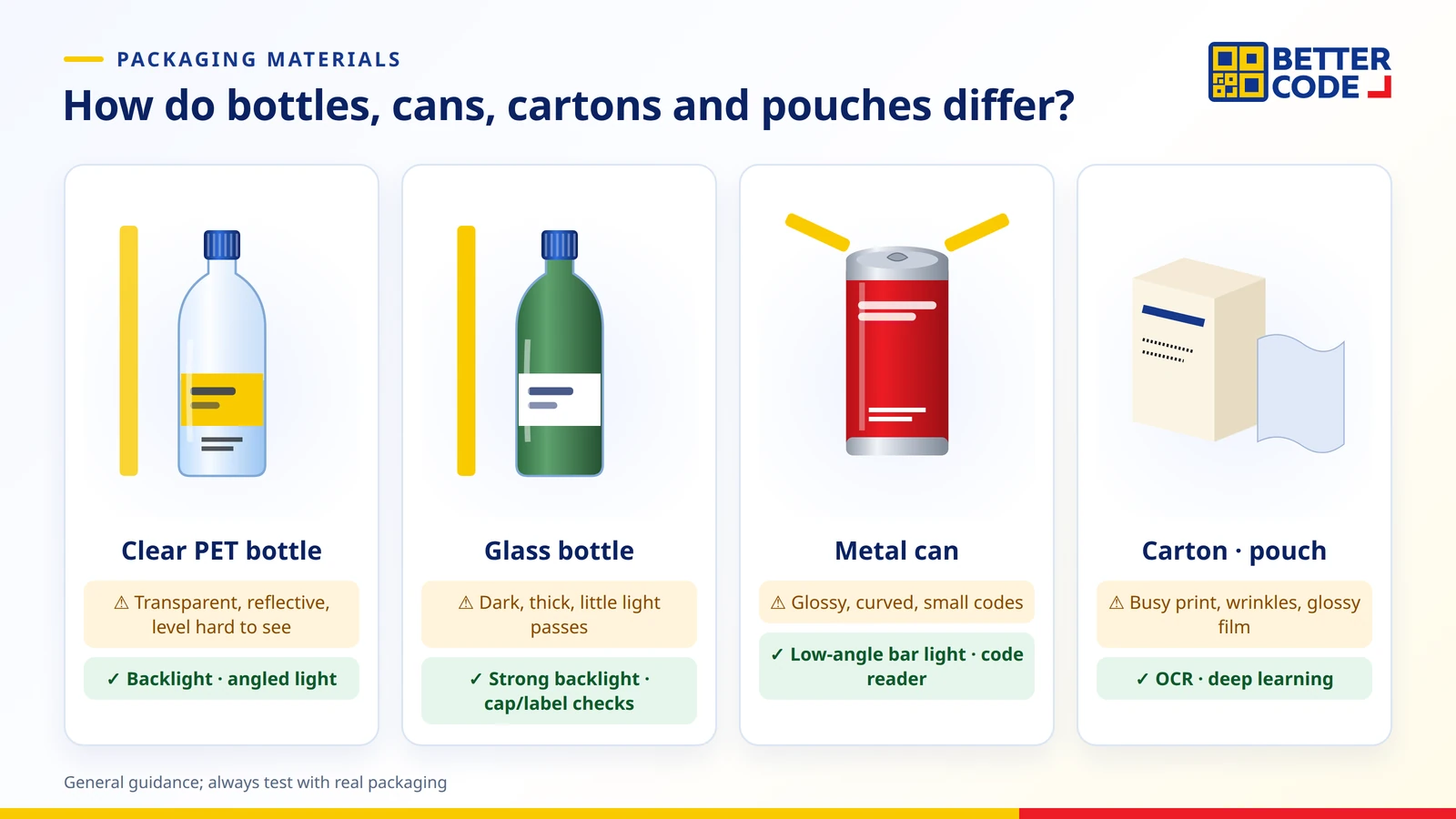
| Packaging | Challenge | Approach |
|---|---|---|
| Clear PET / glass bottles | Transparent material, reflections, fill level hard to see | Backlight for fill level · light angles that avoid reflections |
| Metal cans | Highly reflective, curved surface, small codes on ring pulls | Low-angle bar light · high-resolution code reader |
| Paper cartons | Text position varies with printing, busy backgrounds | OCR · deep learning when character size and position change often |
| Pouches, bags, film | Wrinkles, varied backgrounds, reflective film | OCR that copes with varied backgrounds (rice bag case: 29 cm field of view, 8 mm characters) |
Where should cameras be installed on a packaging line?
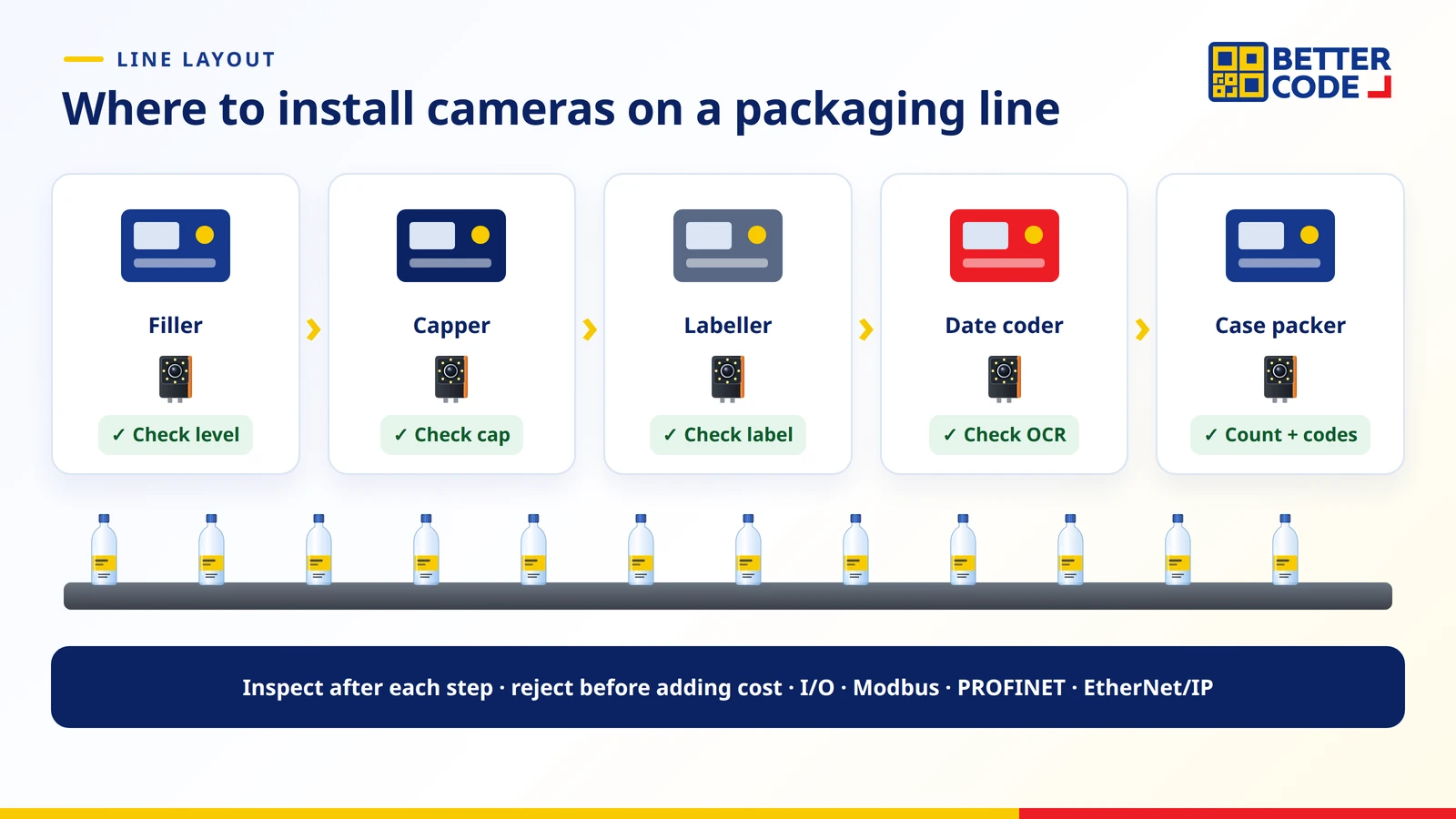
- After the filler: check fill level, under-fill or over-fill.
- After the capper: check cap present, skewed or loose caps.
- After the labeller: check label present, position and correct design for the product.
- After the date coder: check date and lot code with OCR (if you are still choosing a coder, see bottle cap date coding and date coding printers for beverages).
- Before case packing: count items per pack and read every code in the case at once for traceability.
What do high-speed lines need?
- External trigger: a sensor tells the camera when a bottle arrives. HIKROBOT’s bottle cap, bottle label and chocolate wrapper cases all specify external trigger support.
- On-camera processing: a smart camera processes on embedded hardware and decides quickly without waiting for a PC.
- Machine communication: send results via I/O, serial, Modbus, PROFINET, EtherNet/IP or FTP to the PLC and rejecter.
- Rejecter: a pusher or air blast synchronised with bottle position removes only NG items from the line. See signalling and reject timing in vision OK/NG sorting and PLC signals.
Real results: figures from HIKROBOT cases
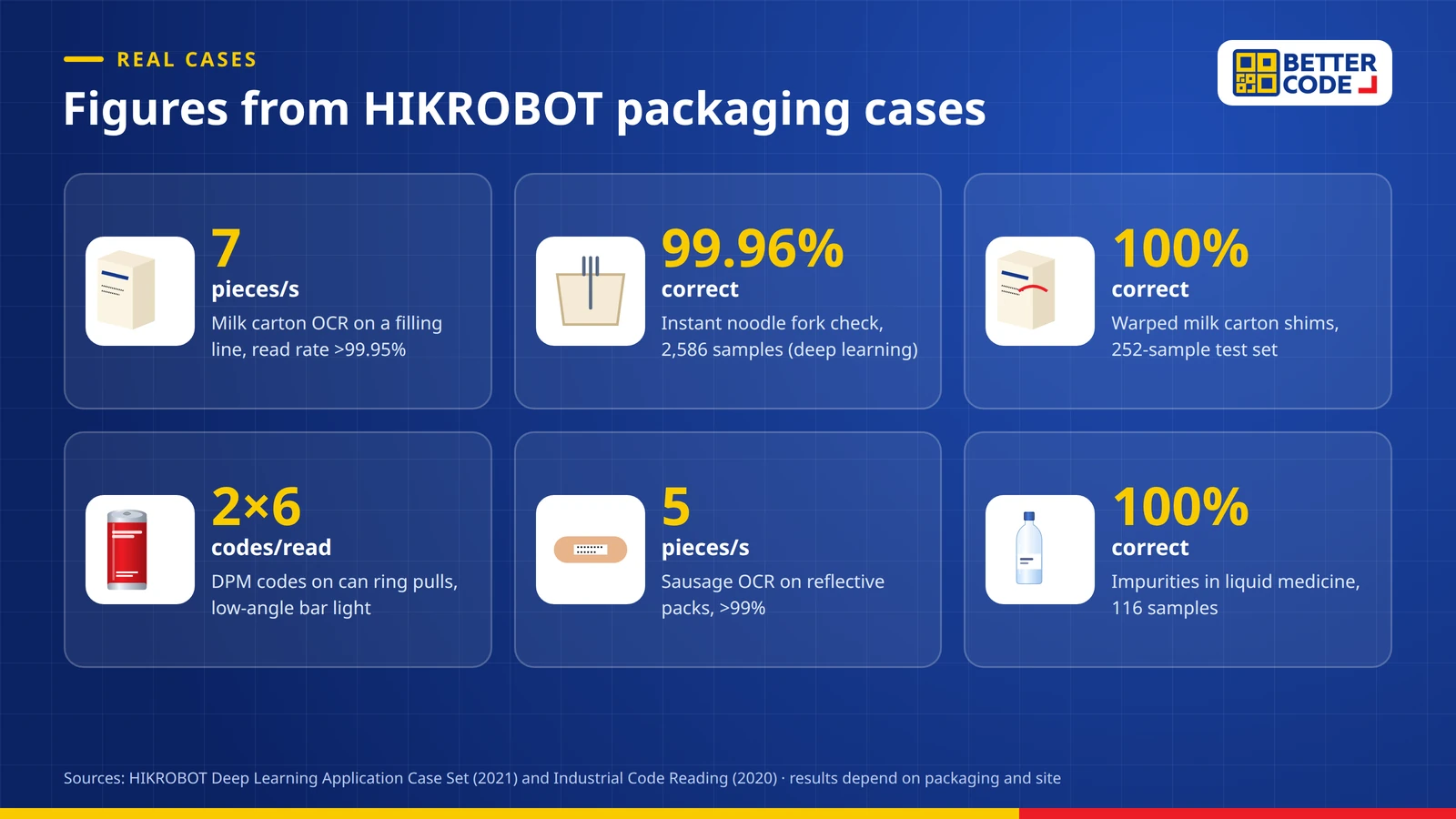
- Milk filling line (cartons): dot-matrix characters whose size and position change each time the print head is cleaned, read with deep learning OCR at 7 pieces per second, with a production read rate above 99.95%.
- Sausages: dot-matrix characters on reflective packaging across several pack types at 5 pieces per second, read rate above 99%.
- Instant noodle cups: fork presence checked with deep learning, 2,586 samples tested, 99.96% correct (1 missed).
- Milk cartons: warped shims detected before sealing, 252-sample test set, 100% correct with a smart camera and external lights.
- Can ring pulls: DPM codes on reflective metal read 2×6 codes at a time with a low-angle bar light.
- Bottles on conveyors: cap, label and bottle count checks on high-speed conveyors with smart cameras; the label case needed no extra light source.
- Liquid medicine: impurity detection on 116 samples, 100% correct · fill level checked in medicine bottles with a line tool.
Smart camera, code reader or deep learning?
| System | Best packaging applications |
|---|---|
| Smart camera | Caps, fill level, labels, counting and OCR without training; easy to install per checkpoint |
| Code reader | Barcodes, QR, Data Matrix and DPM codes on cans; reading many codes at once during case packing |
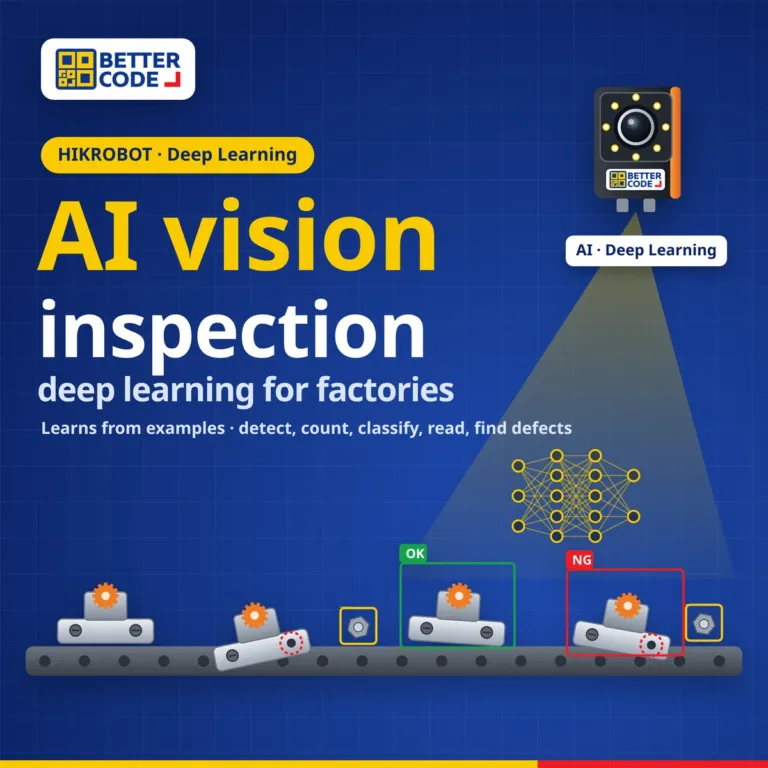
| Deep learning (supported smart camera or PC) | Text that changes size or position, completeness of contents, foreign matter and variable defects |
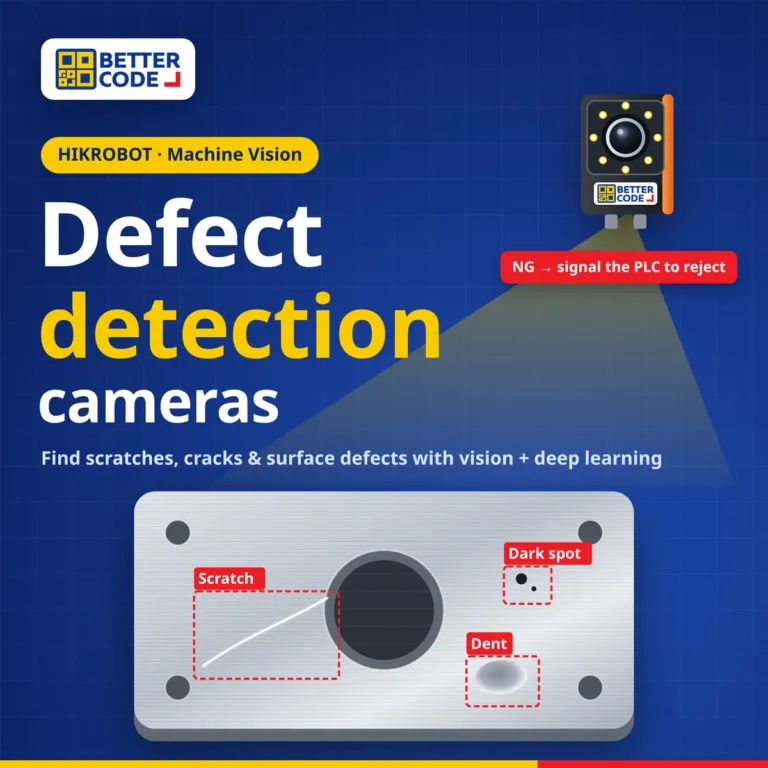
For dents, scratches or stains on packaging, see defect detection cameras.
How to start a packaging inspection project
- Define checkpoints: what to inspect (cap, level, label, date, code or count) and where on the line.
- Line data: speed (items per minute), item spacing and installation space.
- Packaging samples: real good and defective items of every type, including all models and label colours.
- Test lighting and camera: capture at real speed and confirm each feature is clearly visible.
- Connect and reject: define PLC signals, the rejecter and image or data logging.
Summary
A packaging inspection camera checks caps, fill level, labels, dates and lot codes, can codes, pack counts, completeness and foreign matter on every item on beverage and food lines. Choose lighting for bottles, cans, cartons or pouches, install cameras after each step, and pick a smart camera, code reader or deep learning by task. Better Code, the official HIKROBOT distributor in Thailand, tests with your real packaging, installs and provides after-sales support.
Packaging inspection camera FAQ
What can a packaging inspection camera check?
Cap present and seated, fill level, label present and positioned, date and lot code (OCR), barcodes, QR and codes on cans, count per pack, completeness of contents and foreign matter, then OK / NG to the PLC for rejection.
How does a bottle cap inspection camera work?
The camera images the cap as the bottle passes, triggered by a sensor, then checks that the cap is present and at the right position and height. In a HIKROBOT case, a smart camera with pattern existence and greyscale size tools was used on a high-speed conveyor.
Can a camera check fill level in clear bottles?
Yes, with lighting that shows the liquid surface clearly, often a backlight for clear bottles, and a tool that measures the level line. A HIKROBOT case checks liquid level in medicine bottles with a line tool on a smart camera.
Can a camera read codes on reflective metal cans?
Yes, with a high-resolution code reader and a low-angle bar light to reduce glare. In a HIKROBOT case, DPM codes on can ring pulls were read 2×6 at a time.
Can cameras keep up with high-speed beverage lines?
Yes, with an external trigger, on-camera processing and a rejecter synchronised with bottle position. For example, a HIKROBOT case reads characters on milk cartons on a filling line with deep learning at 7 pieces per second and a read rate above 99.95%.
Do I need deep learning?
Not for every job. Clear-cut cap, level, label and counting checks work with a standard smart camera. Use deep learning when text changes size or position often, when checking overlapping contents, or when looking for foreign matter.
Where can I buy a HIKROBOT packaging inspection camera in Thailand?
Contact Better Code (Better Code Co., Ltd.), the official HIKROBOT distributor in Thailand, via LINE @bettercode or +66 2-170-9611. The team tests with your real bottles, cans or cartons, selects the camera and lighting, and provides installation and after-sales support.
Sources
- HIKROBOT – Smart Product Application Cases (Dec 2021): food and pharmaceutical cases for bottle caps, liquid level, bottle labels and counting, chocolate wrapper OCR, rice bag OCR and communication protocols
- HIKROBOT – Deep Learning Application Case Set (2021): milk filling line OCR at 7 pieces/s, sausage OCR at 5 pieces/s, instant noodle forks, milk carton shims and liquid medicine impurities
- HIKROBOT – Industrial Code Reading (2020): DPM codes on can ring pulls, QR codes on food packs and medicine box codes in cases
Want to inspect every bottle, can or carton?
Send photos of your packaging, the checks you need and your line speed. The Better Code team will test HIKROBOT cameras and lighting with your real packaging and recommend the right system for your line.