Laser Date Coder Price: 8 Cost Factors and Whether to Buy or Rent
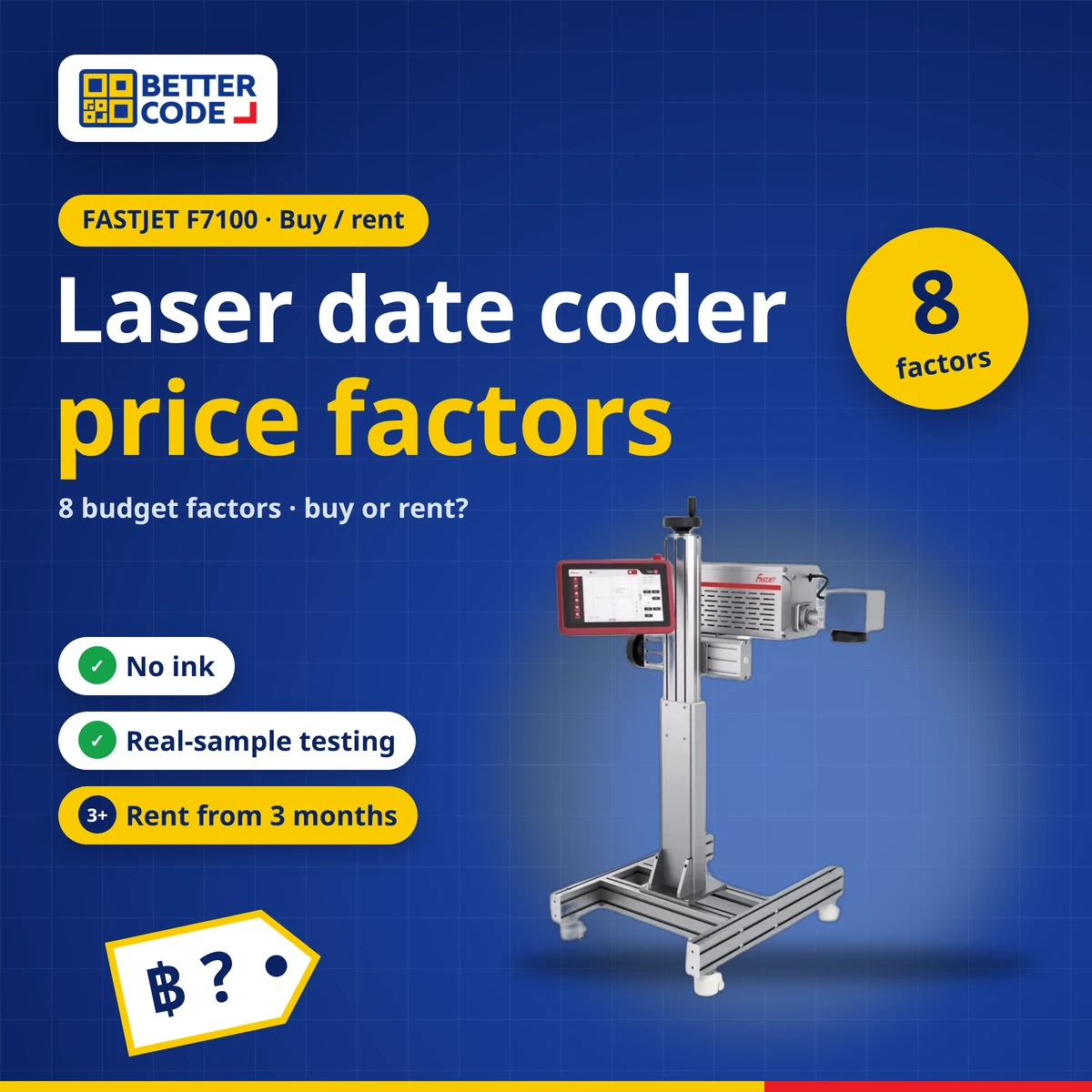
There is no single price for a laser date coder, because it depends on eight factors: laser type (CO2, UV or fiber) · laser power and the sub-model’s wavelength · lens and marking area · line speed and how much content is marked · accessories such as the stand, sensor and encoder · fume extraction · integration with factory systems · and installation, training and after-sales service. Lasers use no ink. Whether to buy or rent depends on your production plan: all-year production usually justifies buying, while seasonal work or a trial on your line can be rented from a 3-month minimum.
Why is there no single laser date coder price?
Laser coders come in several technologies and sub-models matched to materials, and the real budget covers more than the machine: lens, stand, sensors, fume extraction and installation that keeps up with your line speed. Two quotations can differ widely if their scope differs. For an overview of every coding technology, see date coding printer price factors.
Eight factors that set a laser date coder price
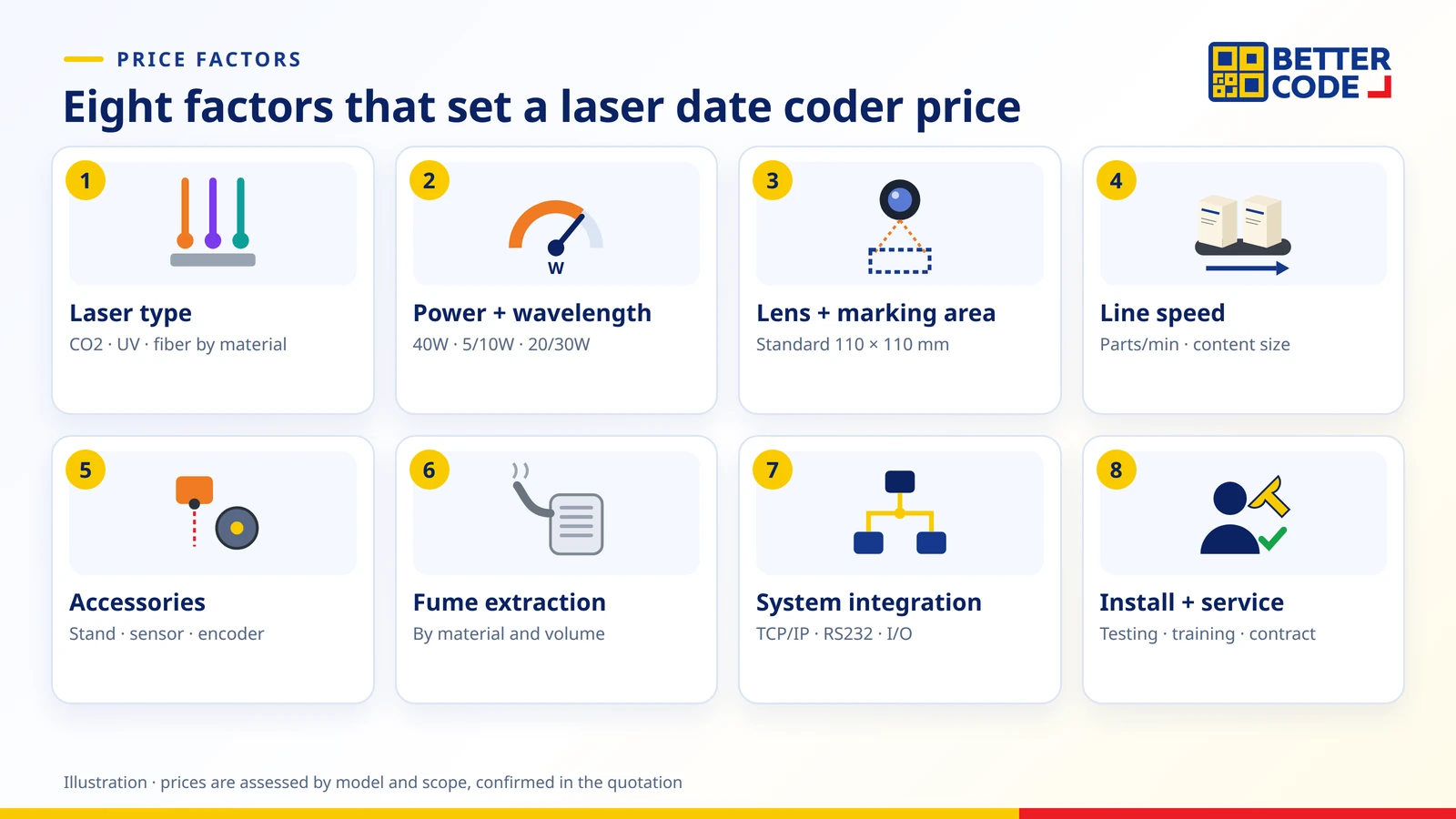
- Laser type: CO2 for paper, labels and PET bottles, UV for plastics and PCBs, fiber for metals; chosen by material. See CO2 vs fiber vs UV.
- Laser power and sub-model wavelength: for example CO2 40W in 10.6 / 10.2 / 9.3 µm, UV in 5W and 10W, fiber in 20W and 30W; each suits different work.
- Lens and marking area: the standard lens gives a 110 × 110 mm marking area, with other lenses available for larger text or areas.
- Line speed and content: long text, barcodes or QR codes take longer to mark, so the model must keep up with parts per minute.
- Accessories: adjustable stand, product sensor, encoder for belt speed, or changes to the existing conveyor.
- Fume extraction: removes smoke and dust from the marking head; size and type depend on material and volume.
- System integration: the coder supports TCP/IP, RS232 and I/O; receiving data from other systems or working with inspection cameras adds scope.
- Installation, training and service: sample testing, on-site installation, operator training and service contracts.
What does a laser date coder budget include?
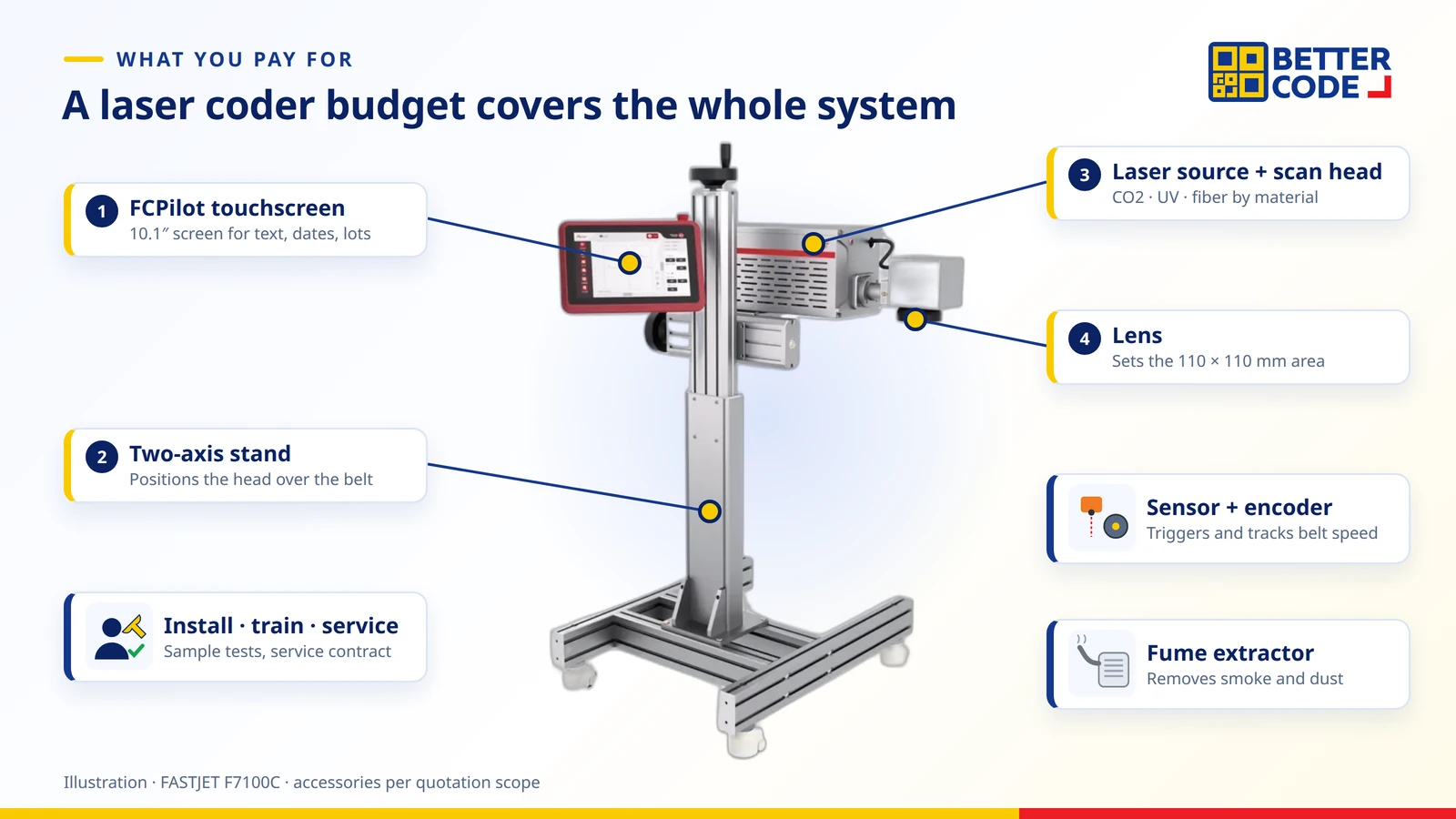
| System part | What it covers | Budget rises when |
|---|---|---|
| Laser coder | Laser source, scan head and FCPilot controller with 10.1-inch screen | Higher power or a material-specific technology is needed |
| Lens | Sets the marking area | Large areas or long text must be marked |
| Stand and installation | Two-axis aluminium stand, position on the conveyor | Conveyor modifications or special brackets are needed |
| Sensor and encoder | Trigger marking and compensate for belt speed | Fast or variable lines, or several lines |
| Fume extraction | Removes smoke and dust from marking | Materials produce a lot of fumes, or marking runs all day |
| Service | Sample testing, installation, training, service contract | Several lines or sites, or ongoing support |
Running costs: laser vs inkjet
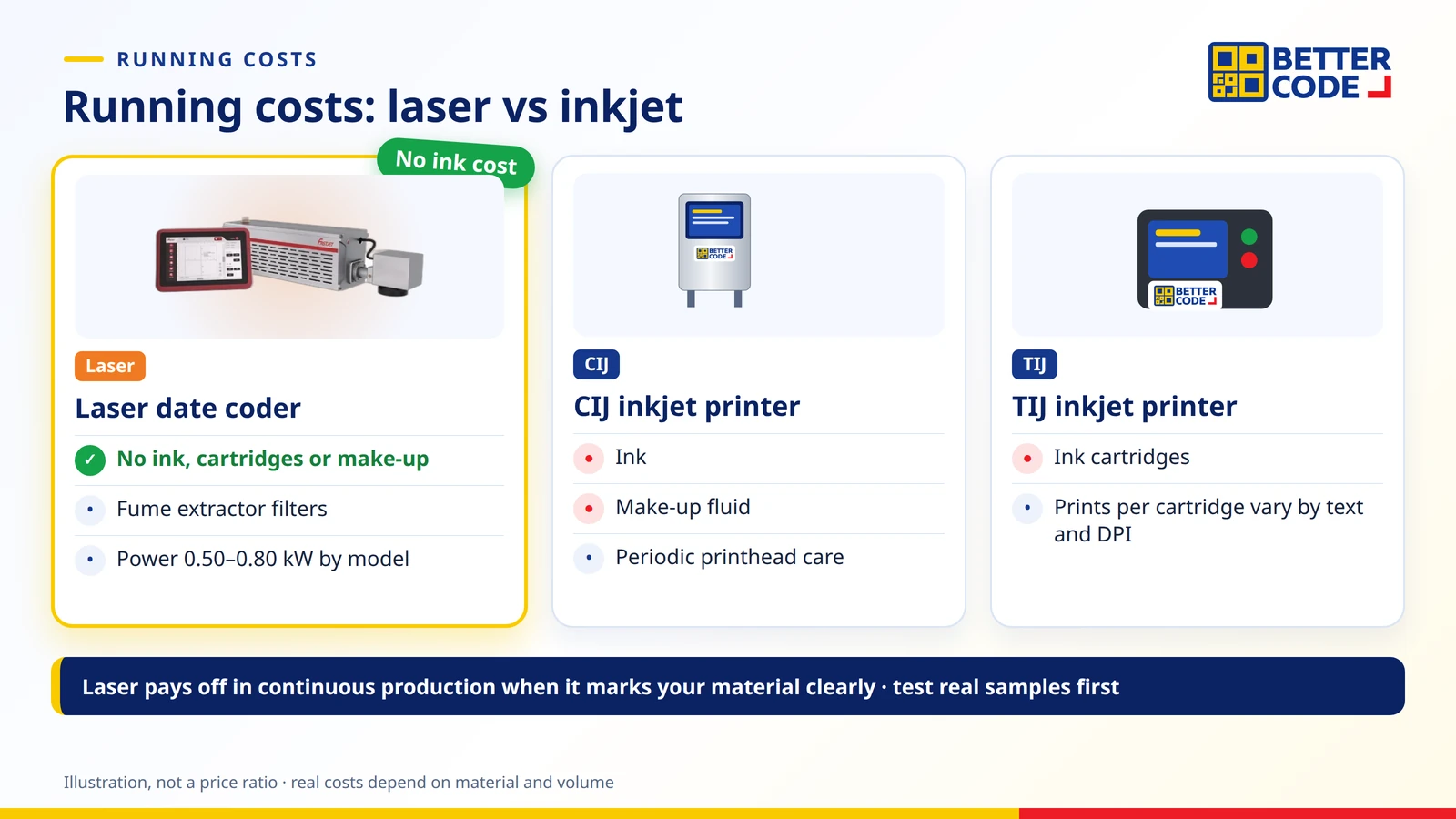
- Laser: no ink, cartridges or make-up fluid. Ask about fume extractor maintenance such as filters, and electricity (the F7100 draws 0.50–0.80 kW depending on model).
- CIJ: ink and make-up fluid according to actual use.
- TIJ: ink cartridges; prints per cartridge depend on text size and resolution.
For high-volume continuous production, not buying ink is a key reason many factories choose laser, provided the laser marks the material clearly. See the full CIJ, TIJ and laser comparison.
Should you buy or rent a laser date coder?
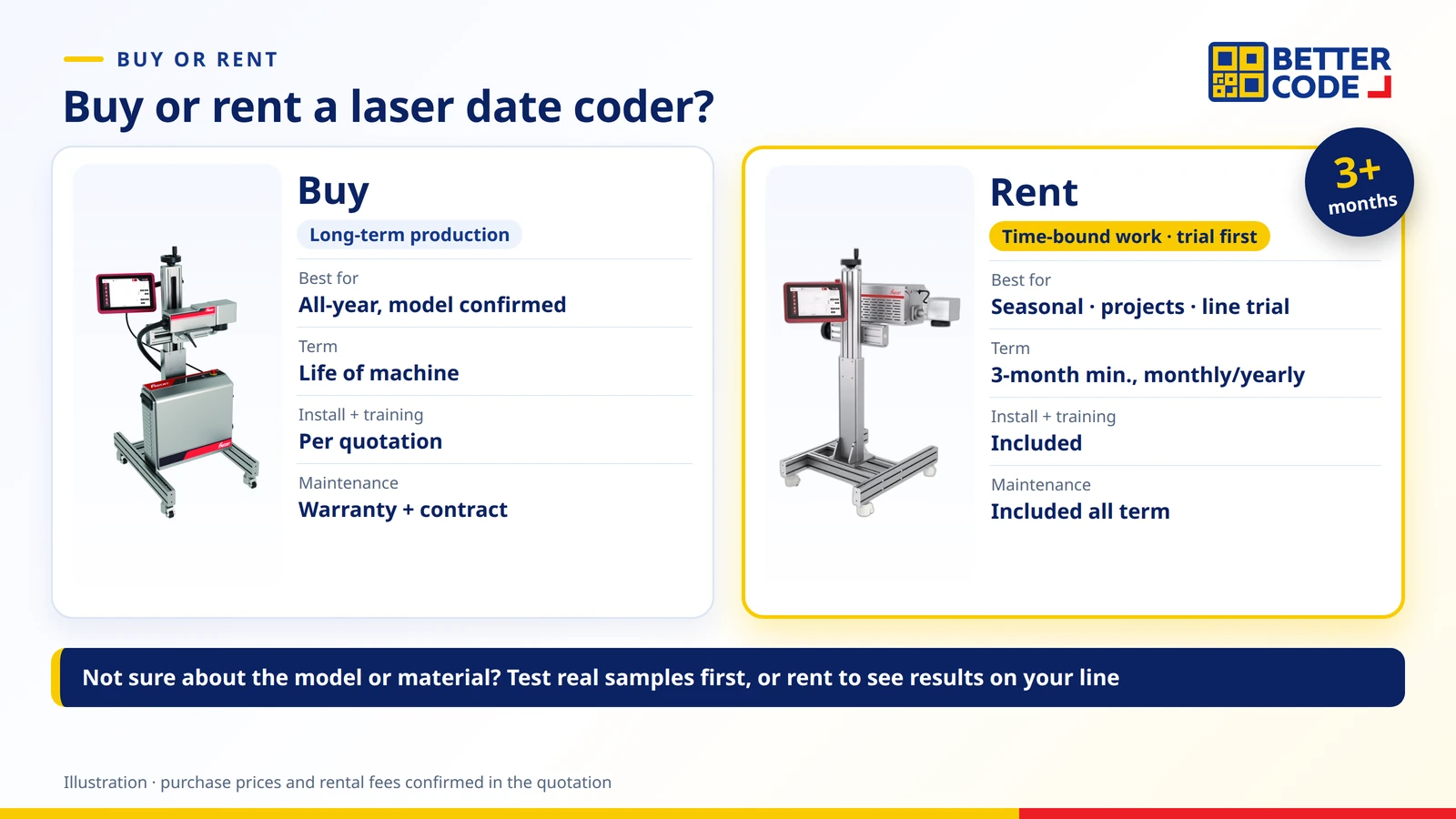
| Item | Buy | Rent |
|---|---|---|
| Best for | All-year production with a confirmed model and material | Seasonal work, projects, capacity peaks, or a trial before investing |
| Term | Life of the machine | 3-month minimum, monthly or yearly |
| Installation and training | Per quotation | Included in the rental fee |
| Maintenance | Warranty and service contract | Repairs and maintenance for the full term |
| Consumables | By use | Billed separately by actual use |
See date coder rental: CIJ, TIJ and laser for details. Rental fees and purchase prices are assessed by model, term and scope and confirmed in the quotation.
How to control the budget without losing mark quality
- Choose the technology by material, not the highest power; a matched model usually marks more clearly.
- Use the standard lens if the text fits within 110 × 110 mm.
- Keep product position steady with guides on the conveyor for consistent marks.
- Test before buying on every colour and coating to avoid changing models later.
- Rent first if unsure to see real results on your line before investing.
What to prepare for a laser coder quotation
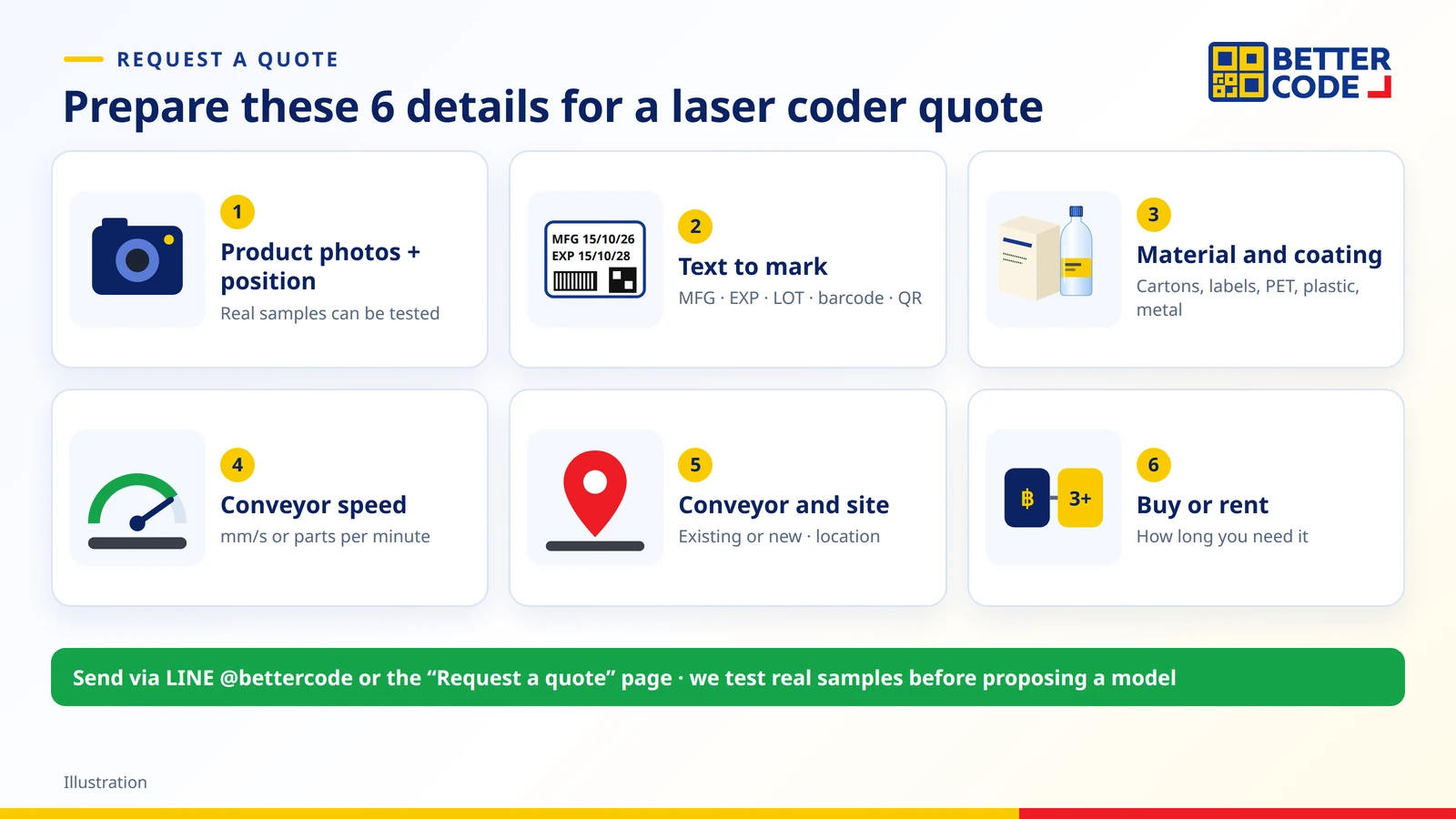
- Product photos and the marking position (real samples for testing are even better)
- Text to mark, such as MFG, EXP, LOT, barcode or QR code
- Material and coating, such as coated cartons, labels, PET bottles, plastics or metal
- Conveyor speed or parts per minute
- Existing or new conveyor, and installation site
- Buy or rent, and how long you need it
Summary
A laser date coder price depends on the whole system, not just the machine. The main factors are laser type, power and wavelength, lens, line speed, accessories, fume extraction, integration and service. Lasers use no ink, so there is no ink cost in operation. Long-term continuous production usually justifies buying, while time-bound work or a trial can be rented from a 3-month minimum.
Frequently asked questions about laser date coder prices
How much does a laser date coder cost?
It depends on laser type (CO2, UV, fiber), power, lens, line speed, accessories, fume extraction and installation, so it must be assessed from your products and line before quoting.
What costs are there besides the laser coder itself?
Lens, stand, sensor, encoder, fume extraction, installation, training and service contracts. There is no ink cost in operation, but ask about fume extractor maintenance such as filters.
Is laser more cost-effective than inkjet?
It depends on material and volume. Lasers use no ink and give permanent marks, which suits continuous production, but the laser must mark the material clearly. Inkjet is flexible across many materials through ink choice.
Can I rent a laser date coder?
Yes. Better Code rents FASTJET F7100 laser coders monthly or yearly with a 3-month minimum, including installation, training, and repairs and maintenance for the full term.
Should I buy or rent a laser coder?
If you produce all year and the model is confirmed, buying is usually better value long term. For seasonal work, projects or a trial on your line before investing, renting fits better.
Do CO2, UV and fiber lasers cost differently?
Yes, by technology, power and cooling, but choose by material first, because a laser that does not match the material will not mark clearly even at higher power.
What information is needed for a laser coder quotation?
Product photos and marking position, text to mark, material, conveyor speed, existing or new conveyor, installation site, and whether you want to buy or rent.
Sources
- FASTJET manufacturer brochures F7100C, F7100U and F7100F (laser, lens, interface and power specifications)
- Better Code – date coder rental terms and date coding printer pricing guidance
Get a laser date coder quote, to buy or rent
Send product photos, material, the text to mark and conveyor speed. Better Code will test on real samples and propose a CO2, UV or fiber model, to buy or to rent.