CO2 vs Fiber vs UV Laser Date Coders: How to Choose by Packaging Material
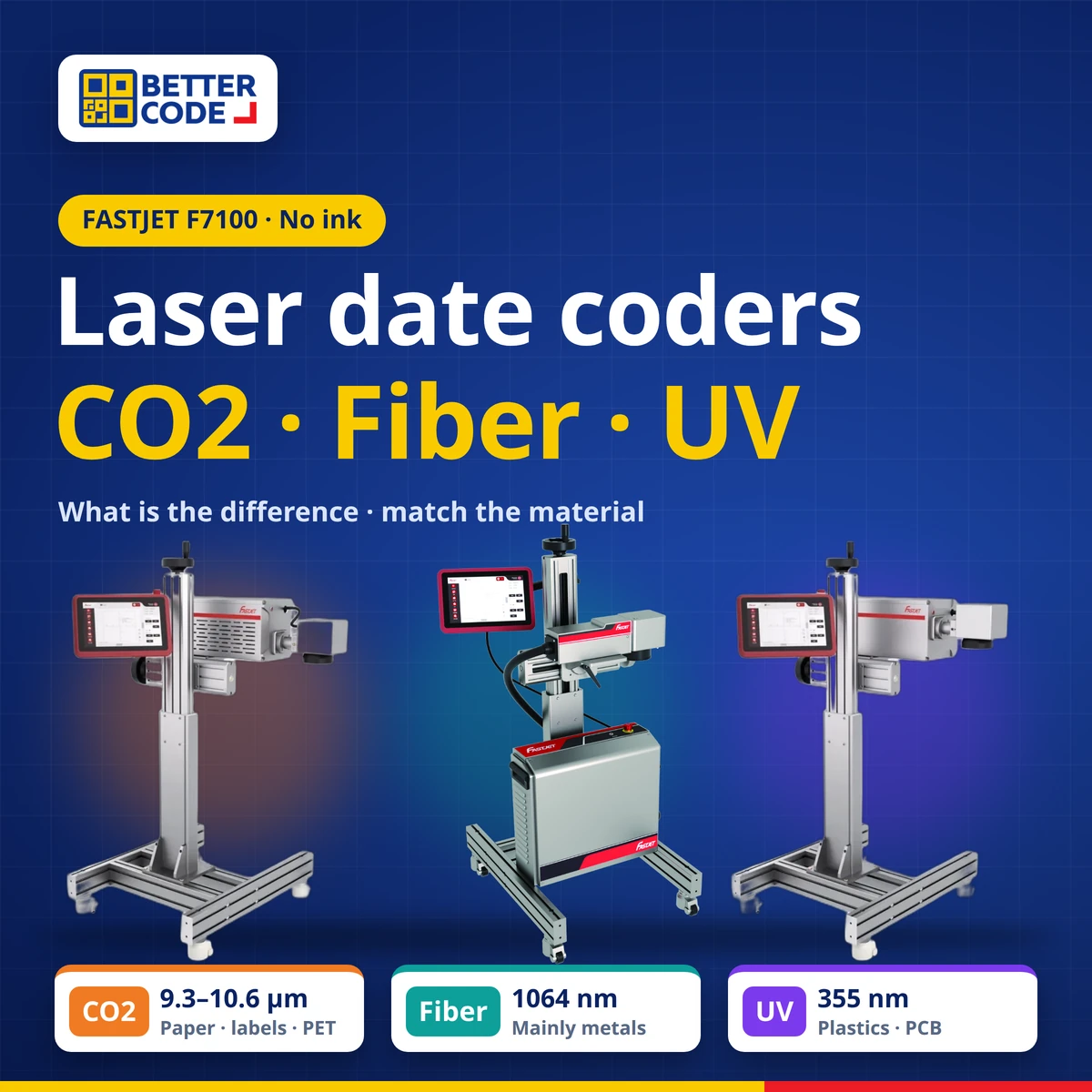
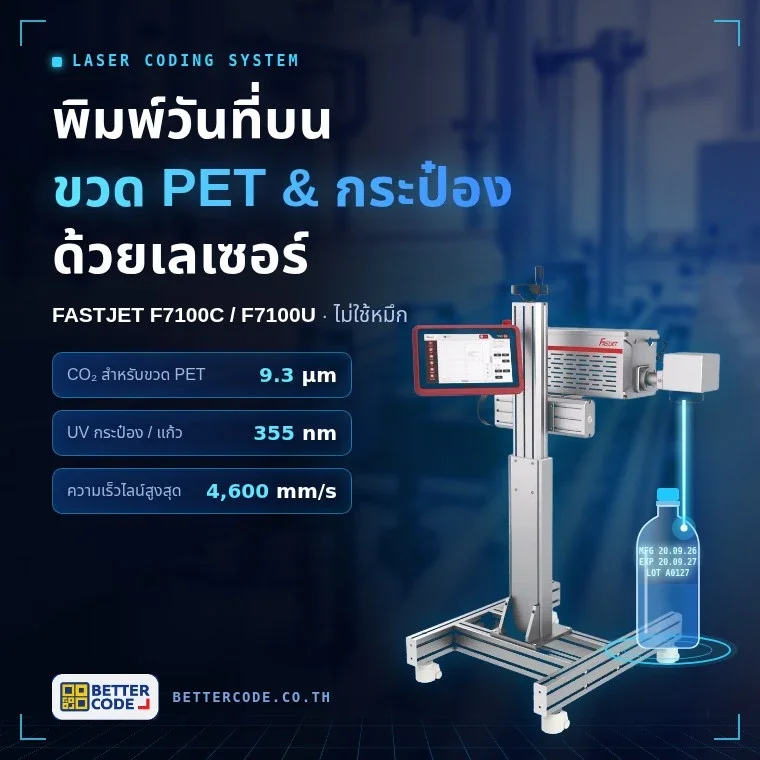
CO2, fiber and UV laser date coders differ in laser wavelength, which decides how well each material absorbs the beam: CO2 (9.3–10.6 µm) suits non-metals such as cartons, labels and PET bottles · UV (355 nm) suits many plastics, PCBs and fine-detail marking · Fiber (1064 nm) suits metals such as aluminium and steel, plus some plastics. All three mark production dates, expiry dates, lot numbers, barcodes and QR codes without ink. The most reliable way to choose is to test-mark your real product before selecting a model.
Why does each laser suit different materials?
A laser leaves a mark when the surface absorbs the light energy and changes colour, is etched, or melts very slightly. Each material absorbs each wavelength differently, so wavelength is the main factor that decides which laser marks a material clearly.
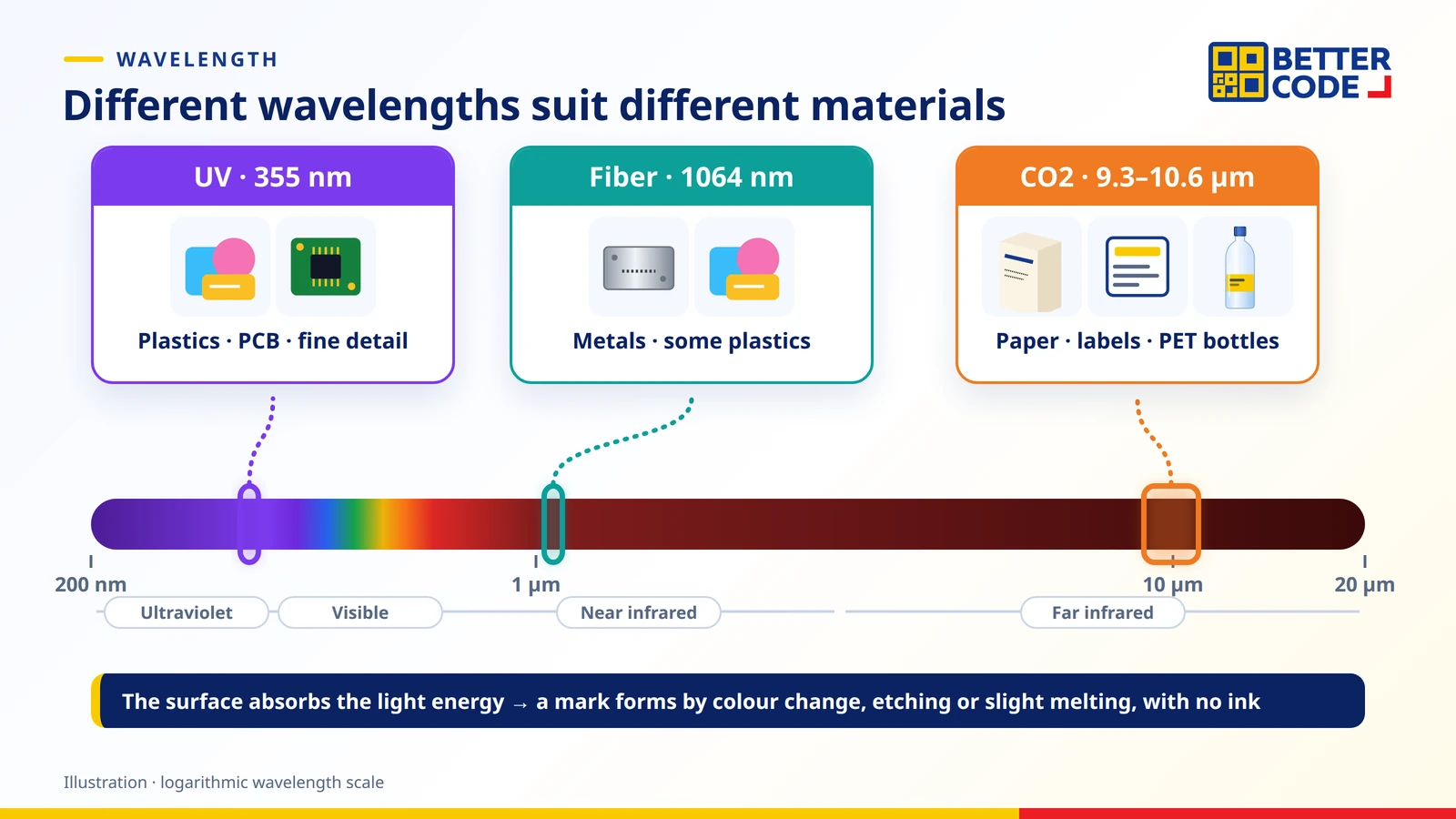
- CO2 (far infrared): absorbed well by non-metals such as paper, labels, many plastics, rubber and ceramics, so it is common on food, beverage and pharmaceutical packaging.
- Fiber (near infrared): absorbed well by metals, so it suits metal parts, aluminium, steel and plastics that pass testing.
- UV (ultraviolet): a short wavelength that gives crisp marks on plastics, polymers and small details such as flexible PCBs.
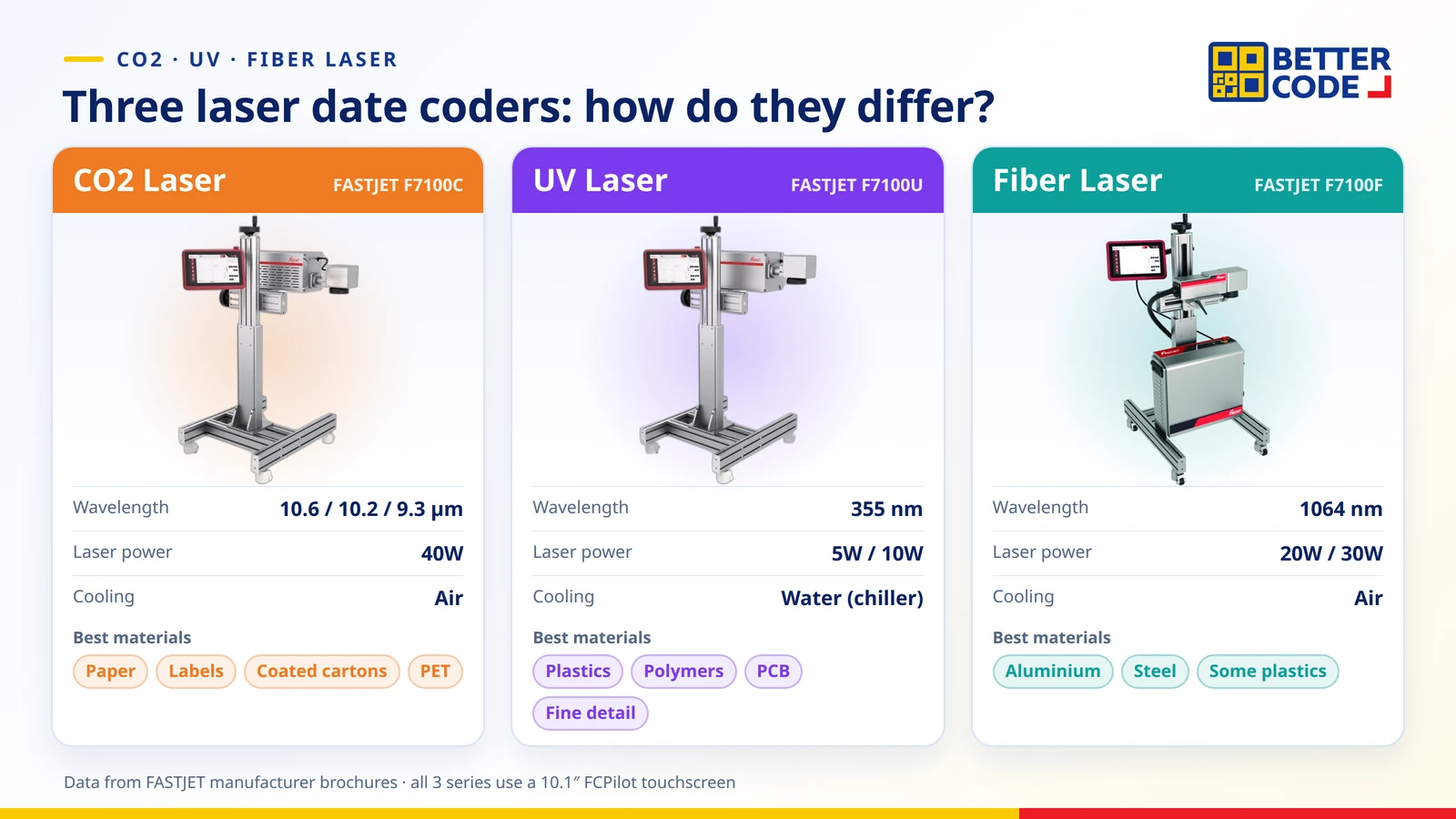
CO2 vs UV vs fiber: FASTJET F7100 compared
| Item | CO2 (F7100C) | UV (F7100U) | Fiber (F7100F) |
|---|---|---|---|
| Laser type | Sealed CO2 | Solid-state UV | Pulsed fiber |
| Wavelength | 10.6 / 10.2 / 9.3 µm | 355 nm | 1064 nm |
| Laser power | 40W | 5W / 10W | 20W / 30W |
| Cooling | Air | Water (chiller supplied) | Air |
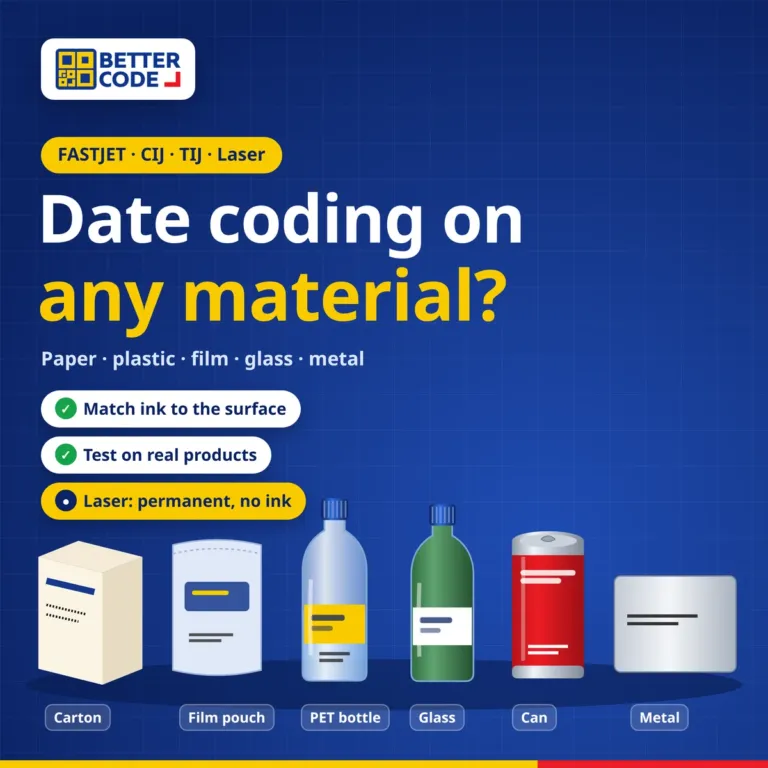
| Suitable materials | Paper, labels, coated cartons, PET bottles, rubber, ceramics, acrylic, PVC | Plastics (PE, PP, PVC, PS, PC, etc.), flexible PCBs, metals, glass | Aluminium, steel and plastics such as HDPE, PP, PVC, PS |
| Typical use | Food, beverage and pharma packaging | Electronics, plastics, fine detail | Metal parts and products |
All three series use the FCPilot control system with a 10.1-inch touchscreen, a galvo scanning speed of up to 9,000 mm/s and line speeds of up to 4,600 mm/s (depending on material and content, per the manufacturer’s brochure). See full specifications on the FASTJET laser marking page.
Choosing a laser by packaging material
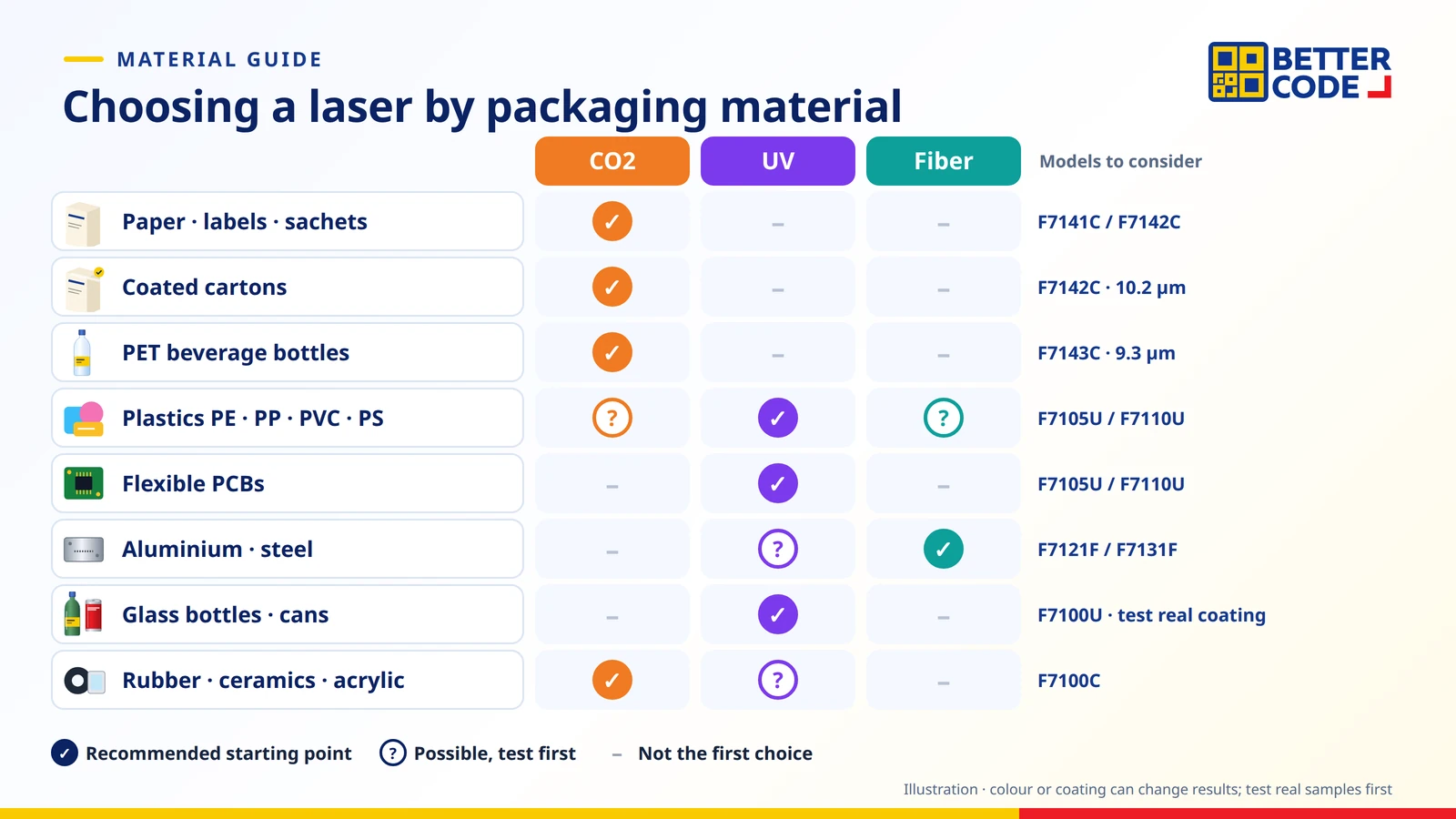
- Cartons, labels, paper sachets: start with CO2; the F7142C (10.2 µm) suits coated cartons.
- PET beverage bottles: CO2 F7143C (9.3 µm), which the manufacturer states gives good marks on PET. See laser date coding on PET bottles and cans.
- Plastics, polymers and PCBs: UV 355 nm (F7105U / F7110U) for crisp marks on many plastics.
- Metal parts, aluminium, steel: fiber 1064 nm (F7121F / F7131F).
- Glass bottles and aluminium cans: consider UV and test on the actual coating.
The same material in a different colour, coating or formulation can behave differently. For an overview of coding on every material, see date coding on different materials.
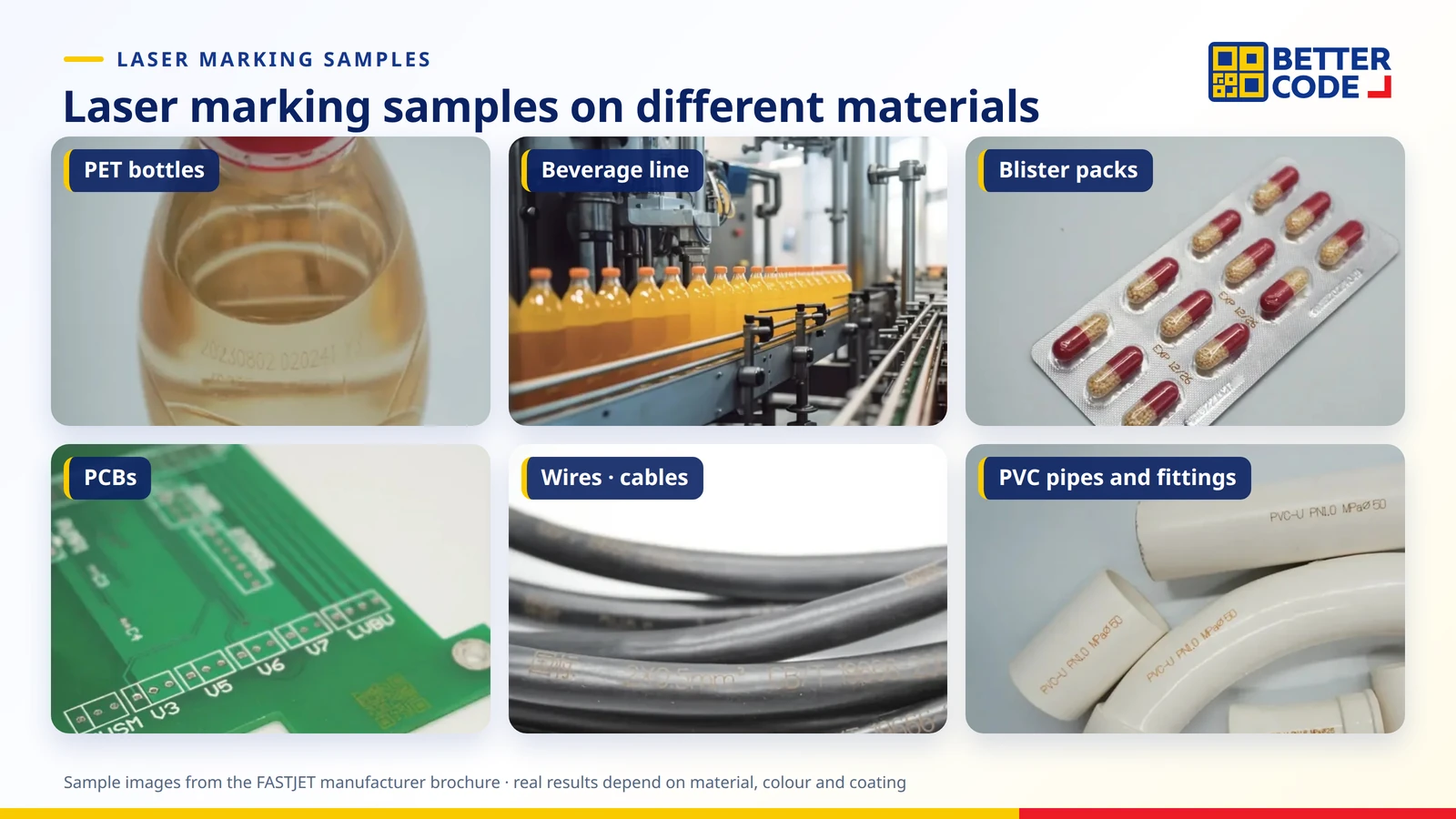
Laser marking samples on different materials
How does a laser mark products on a moving conveyor?
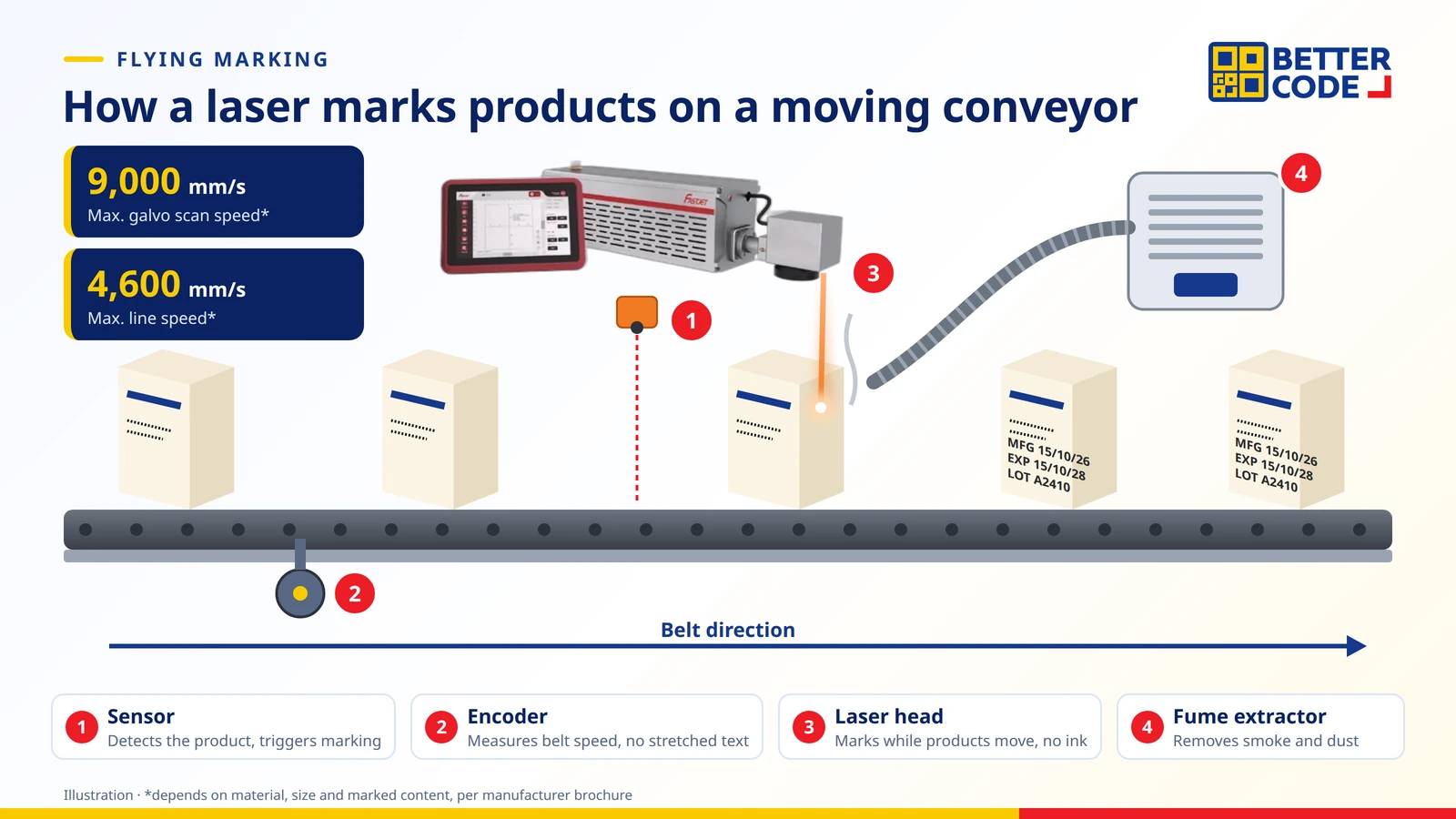
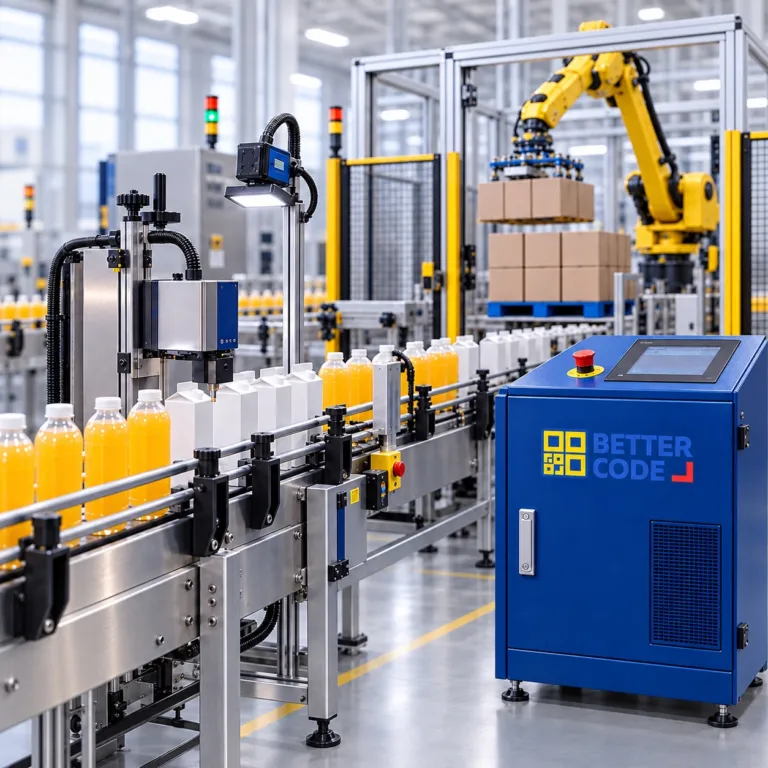
Laser coders on production lines usually use flying marking, which codes products while they move. A sensor detects each product to trigger marking and an encoder measures belt speed so the scan head compensates for movement and characters are not stretched or squashed. A fume extractor removes smoke and dust from the marking area. For installation on a line, see conveyor date coding.
How is laser different from inkjet?
- No ink: no ink, cartridges or make-up fluid to order and replace.
- Permanent marks: the mark is on the material surface itself, not a layer of ink on top.
- Chosen by material: you match wavelength to material, whereas inkjet is matched by ink type.
Still deciding between laser and inkjet? Read CIJ, TIJ or laser: a practical comparison.
Summary
CO2, UV and fiber laser date coders differ in wavelength, which decides which materials absorb the beam well: CO2 for paper, labels and PET bottles, UV for plastics, PCBs and fine detail, fiber for metals. All of them mark dates, lot numbers and QR codes permanently without ink, and should be tested on real products before choosing a model.
Frequently asked questions about CO2, UV and fiber laser coders
What is the difference between CO2, UV and fiber laser date coders?
Wavelength. CO2 (9.3–10.6 µm) suits non-metals such as paper, labels and PET bottles; UV (355 nm) suits plastics, PCBs and fine detail; fiber (1064 nm) suits metals and some plastics.
Which laser is best for coding PET bottles?
Start with a 9.3 µm CO2 laser such as the FASTJET F7143C, which the manufacturer states gives good marks on PET, then test on your actual bottles before installation.
Which laser should I use to mark metal?
A 1064 nm fiber laser such as the FASTJET F7121F (20W) or F7131F (30W) for aluminium and steel. UV can also mark some metals; test on the real surface.
Can a fiber laser mark plastic?
Yes, some plastics such as HDPE, PP, PVC and PS, but results depend on formulation and colour, so test first. For many different plastics or fine detail, UV is often the better choice.
How is a UV laser different from CO2?
UV uses a short 355 nm wavelength for fine marks on plastics, polymers and PCBs and is water-cooled. CO2 uses a long 9.3–10.6 µm wavelength suited to paper, labels and PET bottles and is air-cooled.
Does a laser date coder need ink?
No. It needs no ink, cartridges or make-up fluid because the beam marks the surface directly, but a fume extractor should be used to remove smoke and dust.
Can a laser mark products on a moving conveyor?
Yes, with flying marking using a product sensor and an encoder for belt speed. The FASTJET F7100 supports line speeds of up to 4,600 mm/s, depending on material and content.
Sources
- FASTJET manufacturer brochures F7100C (EF7100C24001), F7100U (EF7100U24001) and F7100F (EF7100F24001)
- Better Code – FASTJET F7100 Series laser marking page and material selection guidance
Send samples for a laser marking test
Send product photos, material, the text to mark and your line speed. Better Code will test on real samples and recommend the right CO2, UV or fiber model for your job.