
Industrial Conveyor Systems Guide: Belt Conveyor vs Roller Conveyor vs Food-Grade Stainless Steel & Modular Belts for Production Lines
What Are the Main Types of Industrial Conveyors, How Does a Belt Conveyor Differ from a Roller or Stainless Conveyor, and How Should You Specify a Line for Date Coding & Vision Inspection?
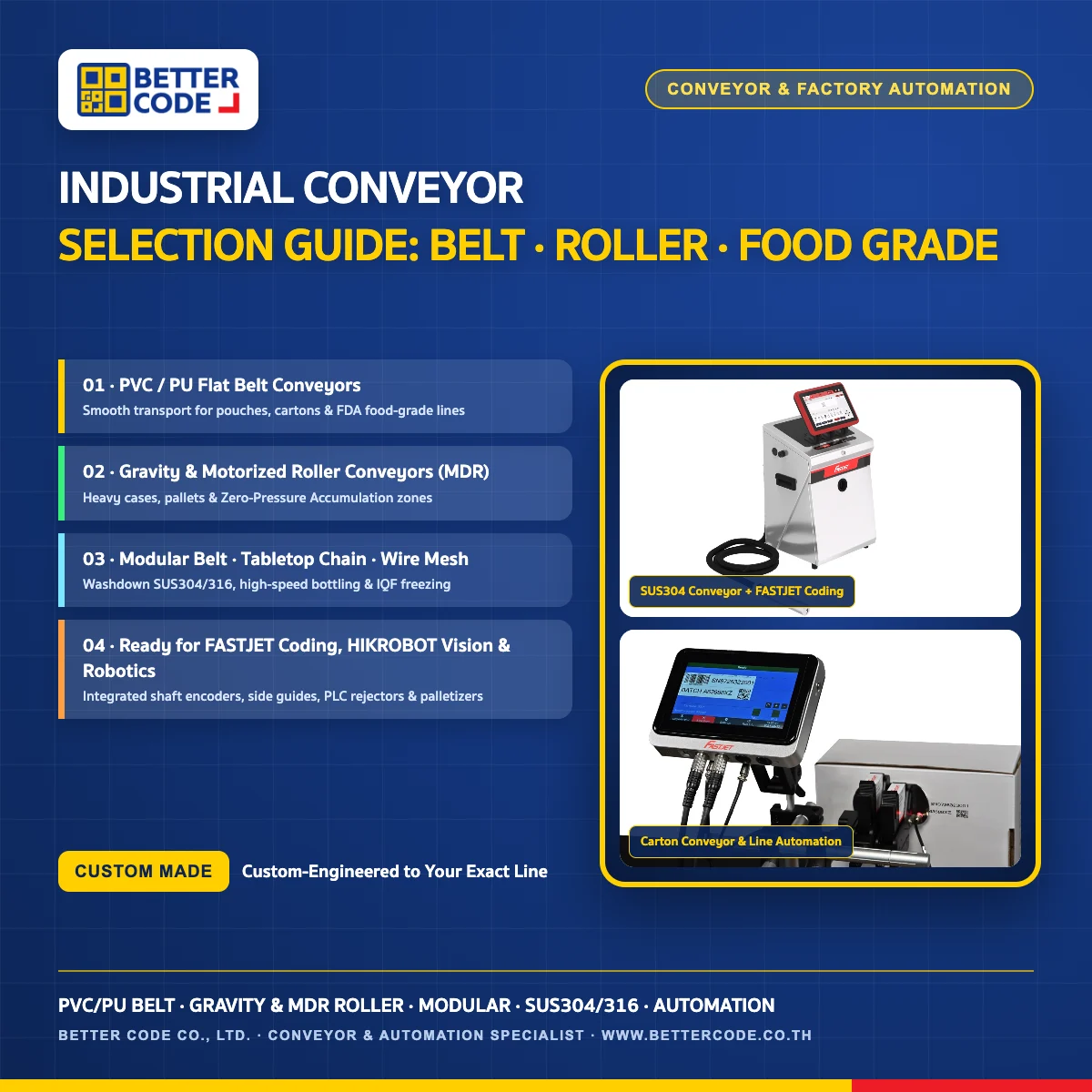
Industrial factory conveyors fall into 6 primary categories: PVC/PU Flat Belt Conveyors excel at transporting pouches and cartons with smooth velocity; Roller Conveyors (Gravity & Motorized MDR) handle heavy cases, totes, and zero-pressure accumulation; while Food-Grade Stainless Steel & Modular Belts serve wet washdown and bottling lines. When integrating inline date coding and machine vision inspection, specify vibration-free custom conveyors with side guides and shaft encoders from Better Code Co., Ltd.
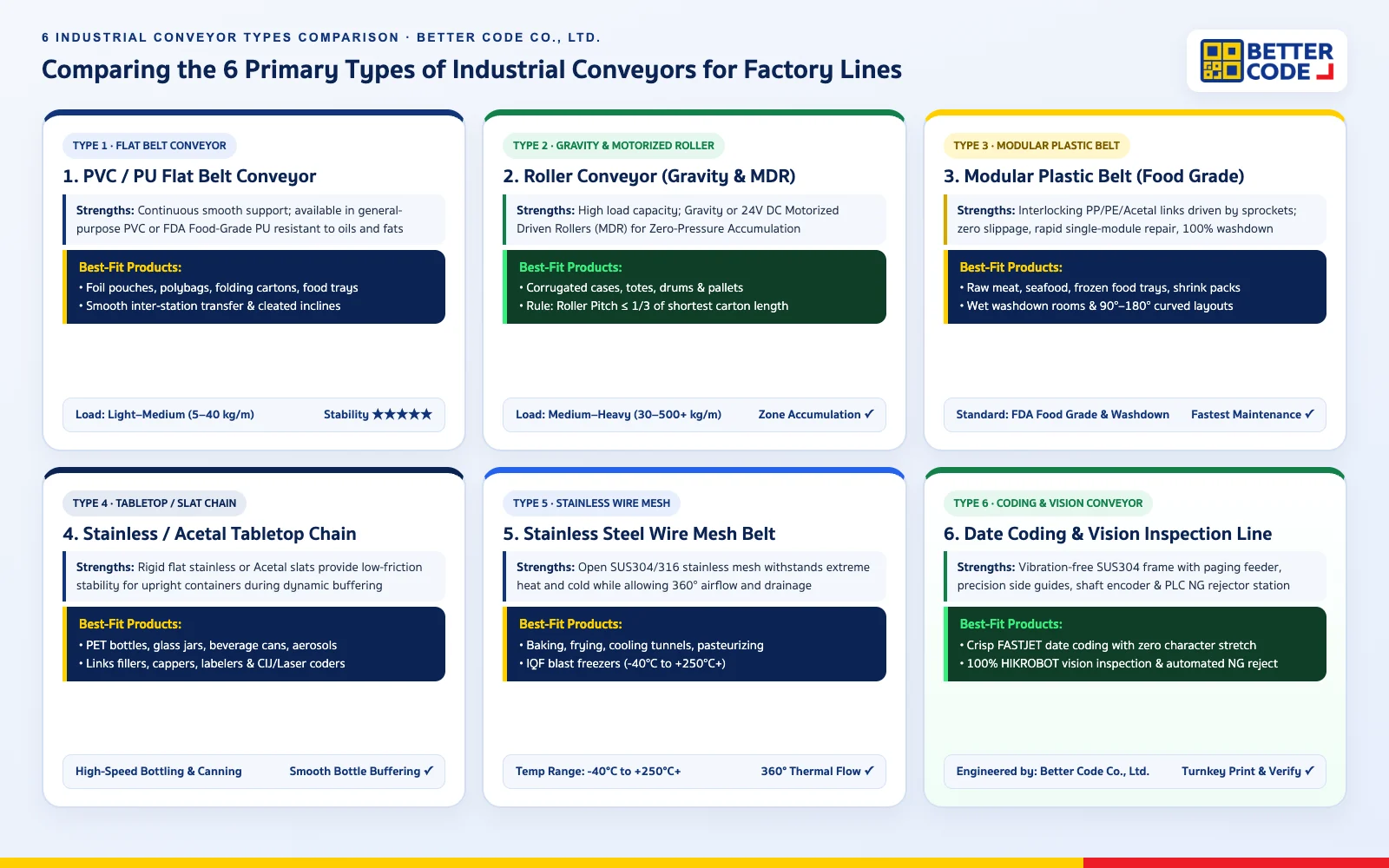
6-Type Industrial Conveyor Comparison Matrix: Matching Conveyor Technology to Your Product & Environment
Selecting an industrial conveyor system requires matching belt mechanics to package geometry, hygiene rules, and downstream automation. The engineering matrix below compares the 6 core industrial conveyor types across 7 critical operational dimensions:
| Conveyor Type | 1. Best-Fit Products | 2. Load Capacity | 3. Moisture / Chemical / Food-Grade Rating | 4. Surface Stability for Date Coding & Vision | 5. Maintenance & Serviceability | 6. Factory Automation Integration |
|---|---|---|---|---|---|---|
| 1. PVC / PU Flat Belt Conveyor (Standard Continuous Flat Belt) | Foil pouches, polybags, folding cartons, food trays, and small-to-medium items requiring continuous bottom support | Light to Medium Duty (5–40 kg/m); supports horizontal runs and cleated inclines | FDA PU Belts handle direct food contact, oils, and fats; PVC Belts suit dry secondary packaging | Excellent (★★★★★) Smooth, ripple-free travel ideal for inline date coding and OCR/barcode scanning | Periodic belt tensioning and tracking adjustment; endless or mechanical splice replacement | Links seamlessly with flow wrappers, Top Seal tray sealers, Cobot pick-and-place cells, and pneumatic NG rejectors |
| 2. Roller Conveyor (Gravity vs Motorized / MDR) (Free-Rolling or Driven Rollers) | Corrugated cases, plastic totes, drums, and pallets with rigid flat bottoms (not for soft pouches) | Medium to Heavy Duty (30–500+ kg/m); highest impact resistance for heavy cases and pallet handling | Available in zinc-plated steel (dry warehouse) or SUS304 stainless steel (cold rooms and humid zones) | Very Good for Side Case Coding (★★★★☆) when engineered with Roller Pitch ≤ 1/3 of shortest box length | Minimal upkeep; individual rollers, O-rings, or drive chains can be swapped in minutes without dismantling the line | Best choice for Zero-Pressure Accumulation, Carton Erectors, Case Sealers, Robot Palletizers, and AGV/AMR handoffs |
| 3. Modular Plastic Belt Conveyor (Interlocking Engineering Plastic Links) | Frozen food trays, raw meat/seafood, shrink-wrapped bottle packs, and wet or curved transport paths | Medium to Heavy Duty (40–150+ kg/m); positive sprocket drive eliminates belt slippage under heavy loads | Superior Washdown & Food Grade (PP / PE / Acetal); resists hot water, caustic cleaners, and sub-zero cold | Very Good (★★★★☆) Flat, positive-tracked surface with zero side-to-side belt wandering | Fastest Repair: Damaged plastic modules can be unpinned and replaced locally in minutes, minimizing downtime | Integrates with washing tunnels, Top Seal lines, shrink tunnels, metal detectors, and 90°–180° tight-radius turns |
| 4. Tabletop / Slat Chain Conveyor (Stainless Steel or Acetal Slat Top) | PET bottles, glass bottles, beverage cans, personal care containers, and cylindrical jars | Medium to High Duty; low-friction slats allow smooth backline bottle accumulation while the chain keeps running | Excellent (SUS304/316 Stainless or Acetal); resistant to beverage spills, moisture, and conveyor lubricants | Excellent for Bottle & Can Coding (★★★★★) when paired with precision side guide rails for CIJ/Laser marking | Long service life; simple routine cleaning and periodic inspection of UHMW-PE wear strips | Backbone of liquid filling, capping, labeling, FASTJET date coding, vision inspection, and case packing lines |
| 5. Stainless Wire Mesh Conveyor (Open Metal Mesh Belt) | Baking, frying, roasting, pasteurizing, seasoning, cooling tunnels, and IQF blast freezing | Medium to High Duty; open mesh geometry allows 360° airflow, heat transfer, or oil drainage | Extreme Temperature Rating (-40°C to +250°C+) constructed from sanitary SUS304 / SUS316 stainless steel | Designed for thermal processing (date coding and vision scanning are typically positioned downstream after primary packaging) | High-pressure spray washdown passes straight through the open mesh with zero food particle trapping | Connects industrial ovens, fryers, and IQF freezers directly to downstream automated packaging stations |
| 6. Specialized Coding & Vision Inspection Conveyor (Precision Paging & Print-Verify Line) | Flat pouches, unfolded carton blanks, sleeves, bottles, trays, and packs requiring millimeter position accuracy | Light to Medium Duty (specifically engineered for velocity stability and repeatable pitch spacing) | Heavy-duty SUS304 stainless frame with anti-static PVC, high-grip friction belts, or FDA PU belts | Unmatched #1 Precision (★★★★★+) Built-in paging feeder, machined rollers, side guides, and shaft encoder | Tool-less handwheel adjustments for rapid SKU changeovers across different pouch or carton widths | Core of Closed-Loop Print & Verify: Integrates FASTJET coders + HIKROBOT vision cameras + PLC pneumatic NG rejectors |
Deep Dive: Belt Conveyor vs Roller Conveyor (Gravity & Motorized MDR)—How to Prevent Jams & Product Damage
One of the most frequent questions our engineers at Better Code Co., Ltd. answer when designing custom industrial conveyors is: “Should we use a Flat Belt Conveyor or a Roller Conveyor—and when do we need Motorized Driven Rollers (MDR) instead of Gravity Rollers?” Here is the engineering breakdown:
Unpowered Gravity Rollers (Manual Push / Slight Decline)
Constructed with low-friction ball-bearing SUS304 stainless or zinc-plated steel rollers mounted horizontally for manual operator pushing or set at a 1.5°–3° decline angle so rigid cartons glide forward naturally under gravity with zero motor power.
• Manual case packing stations and outfeed buffers after carton taping machines
• Truck loading bays and low-cost inter-station transfers requiring zero electrical consumption
Powered Driven Rollers & Zero-Pressure Accumulation
Driven either by a heavy-duty gearmotor with roller-to-roller chains/O-rings or by 24V DC Motorized Driven Rollers (MDR) divided into photo-sensor controlled accumulation zones.
• When a downstream machine pauses (e.g., waiting for a Robot Palletizer cycle), individual roller zones sleep sequentially so cartons queue cleanly without crushing or back-pressure collision!
Continuous PVC / PU Flat Belt (Maximum Velocity Stability)
Supports 100% of the product’s bottom surface on a continuous tensioned belt—ensuring flexible pouches, small cartons, and lightweight packs travel at a uniform speed without micro-bouncing over rollers.
• Flexible pouches, polybags, small pharma boxes, and uneven-bottomed containers
• Precision stations for inline date coding, checkweighing, labeling, and machine vision inspection
Engineering Formula: Calculating Roller Pitch to Prevent Carton Tipping & Jams
When specifying a Roller Conveyor, the golden mechanical rule is that at least 3 rollers must support the bottom of your shortest carton at all times. If rollers are spaced too far apart, cartons will rock, jam between rollers, or tilt during barcode scanning:
Practical Engineering Example: If the shortest corrugated case running on your line has a length of 300 mm, your maximum allowable Roller Pitch is 300 ÷ 3 = 100 mm (e.g., specifying Ø50 mm or Ø60 mm rollers at a 75 mm or 100 mm pitch guarantees rock-solid, vibration-free carton transport).
5 Critical Engineering Checkpoints When Integrating Conveyors with FASTJET Date Coders, HIKROBOT Vision & Robotics
Many factories purchase generic off-the-shelf conveyors only to discover stretched inkjet date codes, blurred vision camera images, or missed robot pick positions. When Better Code Co., Ltd. designs your conveyor system, we engineer around these 5 critical integration checkpoints:
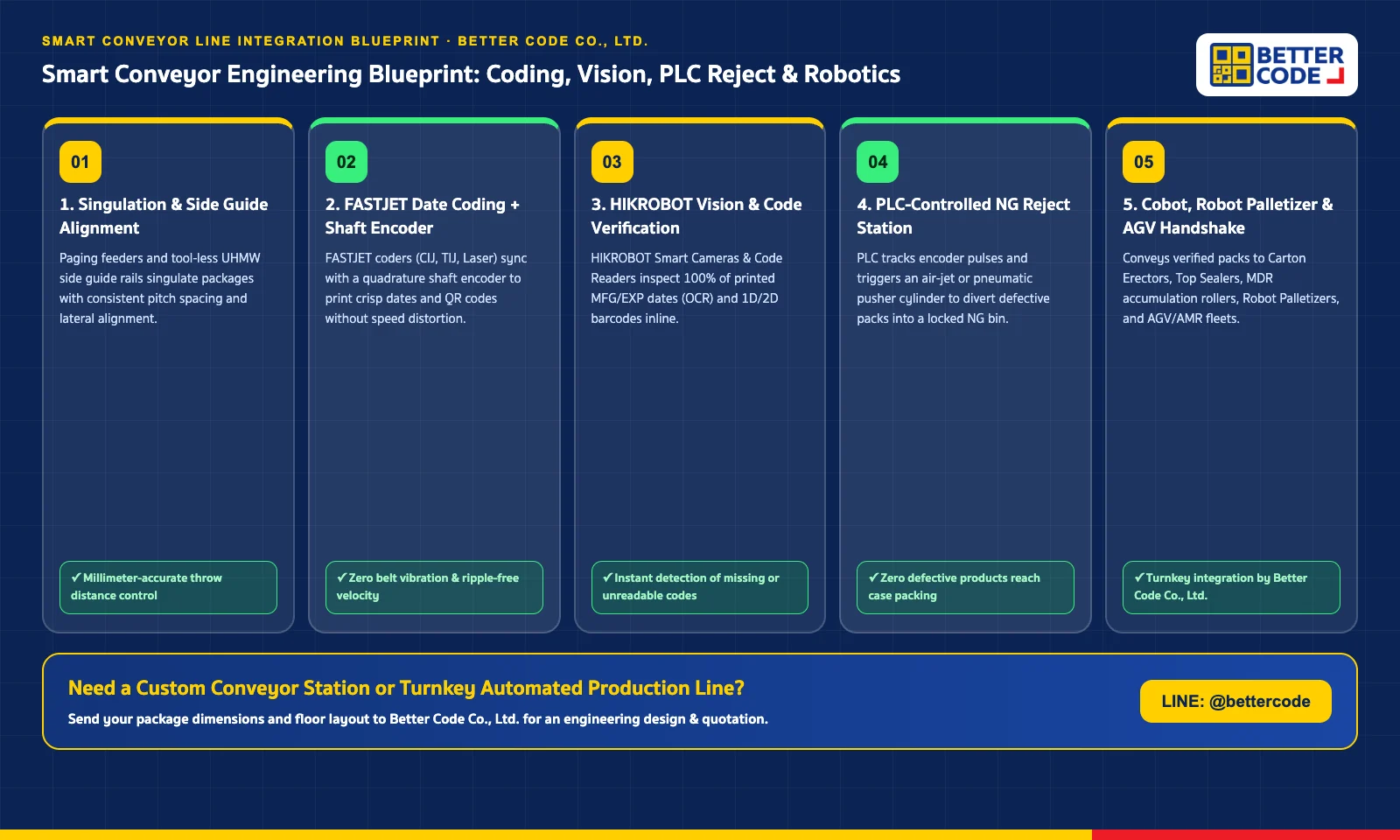
Checkpoint 1: Velocity Stability & Shaft Encoder Mounting (Preventing Stretched Codes & Motion Blur)
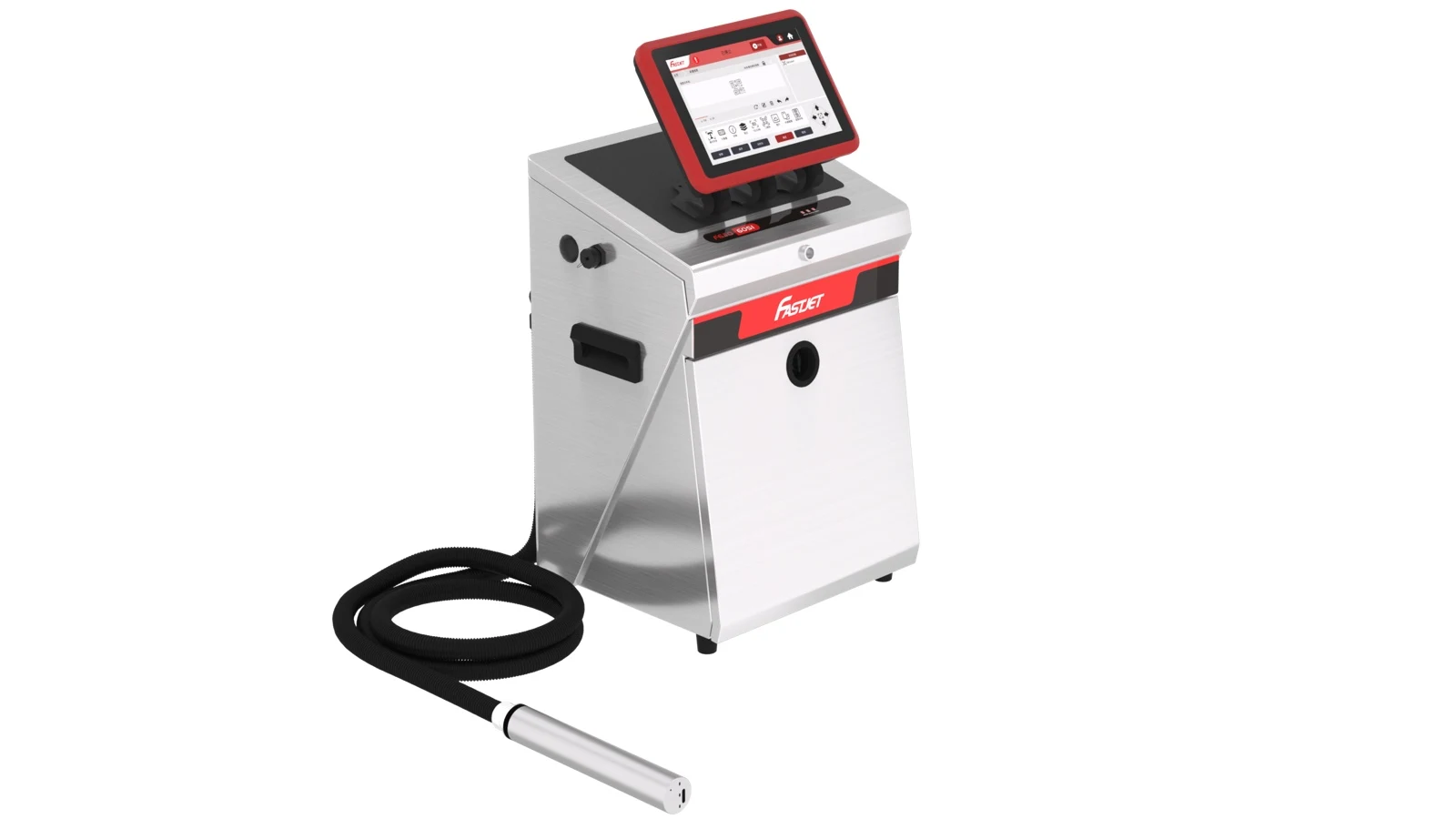
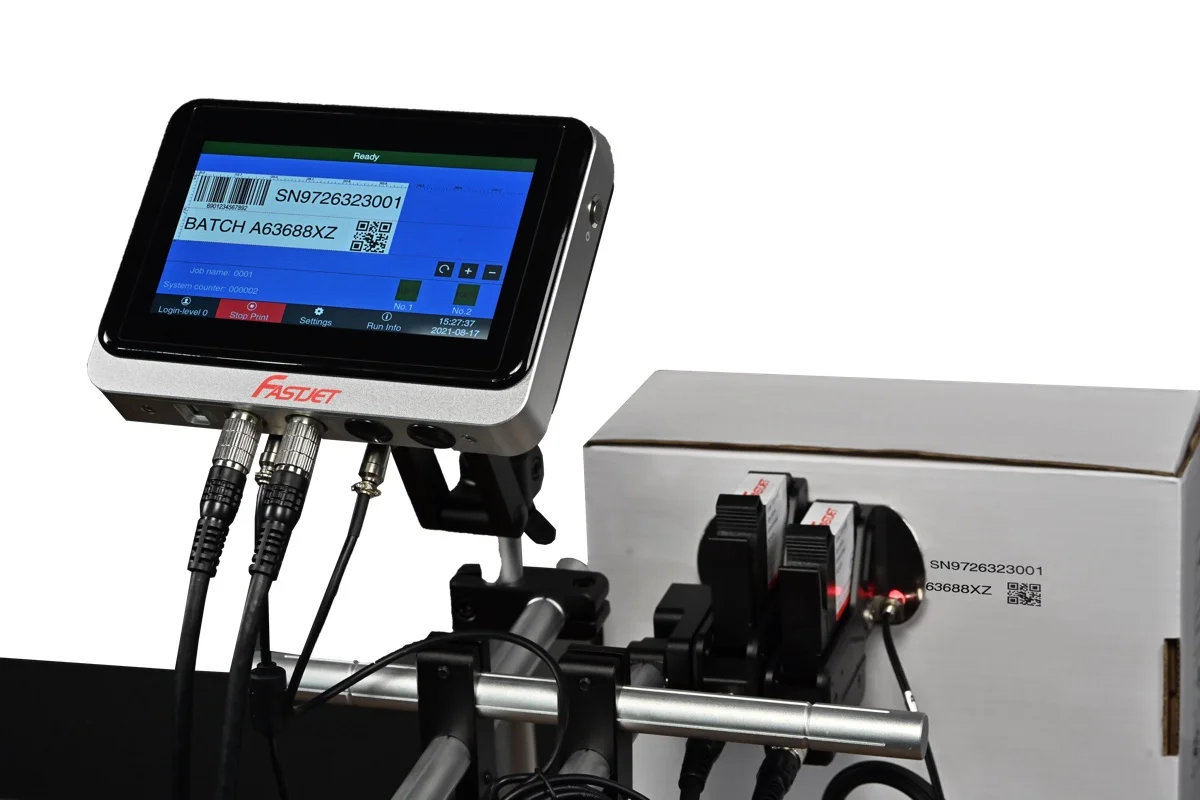
When mounting a FASTJET CIJ printer or TIJ thermal inkjet coder on a conveyor, eccentric drive rollers or motor speed ripple will stretch or compress printed characters and barcodes. Better Code engineers specify precision-machined drive rollers, fine-tuned VFD Inverters, and spring-loaded quadrature Shaft Encoder brackets so printheads and vision cameras track real-time belt velocity down to the millimeter (see our Conveyor Date Coding Installation Guide).
Checkpoint 2: Tool-Less Side Guide Rails & Paging / Spacing Feeders
High-resolution TIJ printheads (requiring a 2–5 mm throw distance) and HIKROBOT Vision & Code Readers require every package to pass at a repeatable lateral position with a clean gap between items. We integrate friction paging feeders (to singulate stacked pouches or carton blanks) and UHMW-lined stainless Side Guide Rails with tool-less handwheel adjustments.
Checkpoint 3: Sanitary Stainless Steel Grades (SUS304 vs SUS316) & FDA Food-Grade PU Belts
In food, beverage, meat, and seafood plants, painted carbon steel frames quickly rust and flake under washdown chemicals. We fabricate open-frame sanitary chassis using SUS304 or marine/acid-grade SUS316 stainless steel paired with FDA-compliant PU belts or Modular Plastic Belts engineered for daily high-pressure sanitation.
Checkpoint 4: Engineered PLC Rejector Stations (Air-Jet, Pneumatic Pusher, or Drop-Flap)
When a HIKROBOT camera flags a missing date code or unreadable barcode (NG), the conveyor must provide a dedicated downstream Reject Station controlled by a PLC—whether a high-speed air-blast nozzle for lightweight pouches, a pneumatic side-pusher cylinder for cartons and bottles, or a retracting nosebar/drop-flap for food trays into a locked NG bin (detailed in our Vision OK/NG PLC Sorting Guide).
Checkpoint 5: Turnkey Handshake with Carton Erectors, Top Sealers, Cobots, Robot Palletizers & AGVs
Your conveyor system is the mechanical and electrical backbone of Factory Automation. We engineer exact pass-line elevations, pneumatic alignment stoppers, and PLC interlock signals to link Carton Erectors, Top Seal tray sealers, Collaborative Robots (Cobots), heavy-duty Robot Palletizers, and autonomous AGV / AMR transfer stations.
7-Point Engineering Checklist Before Ordering or Requesting a Custom Conveyor Quote
To help our engineering team at Better Code Co., Ltd. design and price your custom industrial conveyor system accurately and rapidly, share these 7 key parameters (or photos of your current line) via LINE @bettercode or our Request a Quote page:
Are you conveying corrugated cases, flexible pouches, polybags, bottles, thermoformed food trays, or pallets? Is the bottom rigid or flexible?
Specify Width × Length × Height (mm) of both the smallest and largest SKU, plus unit weight (kg), to size belt width and roller pitch.
How many packs or cases per minute (PPM / CPM) must the line handle, or what belt velocity (m/min) is required?
Total conveyor length, pass-line height from the floor, and geometry (straight, 90°/180° curve, or incline/decline).
Dry warehouse/packing room, cleanroom, chilled/frozen room, or daily high-pressure caustic washdown (requiring SUS304/316 Food Grade)?
Will the conveyor host a FASTJET CIJ coder, TIJ printer, HIKROBOT vision camera, labeler, checkweigher, or PLC NG rejector?
Which machines feed into and receive from this conveyor (e.g., Carton Erector, Top Seal tray sealer, Cobot, Robot Palletizer, or AGV/AMR)?
Frequently Asked Questions: Industrial Belt, Roller & Food-Grade Conveyors (FAQ)
What is the difference between a PVC belt and a Food-Grade PU conveyor belt?
PVC (Polyvinyl Chloride) belts offer high abrasion resistance and cost efficiency, making them ideal for secondary packaging such as sealed pouches,shrink-wrapped packs, and corrugated cartons. PU (Polyurethane) belts are FDA food-grade compliant, resistant to animal fats, vegetable oils, and slicing cuts, and are engineered for direct contact with unpacked food, meat, bakery items, and pharmaceutical products.
When should we choose a Roller Conveyor over a Flat Belt Conveyor?
Choose a Roller Conveyor (Gravity or Motorized MDR) when transporting rigid, flat-bottomed loads such as corrugated cases, plastic totes, drums, or pallets—especially where zone accumulation (buffering boxes without back-pressure), side-push diverting, or ergonomic manual packing stations are required. For flexible pouches, polybags, small vials, or unstable containers, use a PVC/PU Flat Belt or Tabletop Chain Conveyor so items never tip between rollers.
How do we calculate the correct Roller Pitch so cartons do not tip or jam?
The fundamental engineering rule is that at least 3 rollers must support the bottom of the shortest package at all times. Therefore, the center-to-center Roller Pitch must be less than or equal to one-third of your shortest carton length (Roller Pitch ≤ Shortest Carton Length ÷ 3). For example, a 300 mm carton requires a roller pitch of 100 mm or less to ensure smooth travel and stable barcode scanning.
What special conveyor specifications are required when mounting an inline date coder or machine vision camera?
Four critical engineering features are required: (1) Precision machined drive rollers with a VFD inverter for ripple-free constant velocity, (2) A spring-loaded shaft encoder mount to synchronize FASTJET printheads and HIKROBOT cameras with real-time belt speed, (3) Rigid, tool-less adjustable Side Guide Rails to maintain a constant millimeter-accurate throw distance, and (4) Downstream space for a PLC-controlled pneumatic air-jet or pusher NG rejector.
Which conveyor type is best for wet washdown areas, cold rooms, or IQF freezing lines?
Specify an open-frame sanitary SUS304 or SUS316 stainless steel chassis paired with an FDA-approved Modular Plastic Belt (PP, PE, or Acetal) or a Stainless Wire Mesh Belt. Positive sprocket drive eliminates belt slippage in wet or greasy conditions, open-grid links allow 100% water drainage and air circulation, and IP65/IP67 washdown gearmotors withstand daily high-pressure sanitation.
Does Better Code Co., Ltd. custom-manufacture conveyors integrated with printers, vision systems, and factory automation?
Yes. Better Code Co., Ltd. designs, fabricates, and integrates custom industrial conveyors—from standalone paging and date-coding conveyors to heavy-duty roller lines, food-grade washdown conveyors, FASTJET date coders, HIKROBOT vision inspection stations, Carton Erectors, Top Seal machines, Cobots, and Robot Palletizers—under single-vendor engineering accountability.
Consult Our Engineers & Request a Custom Conveyor Quotation from Better Code Co., Ltd.
Whether you need a standalone custom industrial conveyor (date-coding conveyor, paging feeder, PVC/PU belt, Roller Conveyor, or SUS304/316 food-grade line) or a turnkey Factory Automation system integrated with FASTJET coders and HIKROBOT vision cameras, Better Code Co., Ltd. is ready to survey your line and deliver an itemized engineering proposal.
Request Custom Conveyor Quote ↗Explore Custom Conveyor Systems ↗Explore Factory Automation ↗Send Line Photos on LINE @bettercode ↗Engineering References & Design Standards
- Industrial conveyor mechanical design standards (PVC/PU Flat Belt, Gravity & Motorized MDR Roller Conveyor, Modular Plastic Belt, Tabletop Chain, and Sanitary SUS304/SUS316 Food-Grade Conveyors): Conveyor & Factory Automation Engineering Division, Better Code Co., Ltd.
- Inline integration standards for synchronizing conveyors with FASTJET industrial date coders (CIJ, TIJ, Laser), HIKROBOT machine vision cameras, quadrature shaft encoders, and PLC-controlled pneumatic rejectors.