How to Calculate Date Coder Cost Per Print: CIJ Ink & Make-Up vs TIJ Cartridge vs Laser TCO Guide
How Do CIJ, TIJ, and Laser Date Coders Calculate Cost Per Print—and Which Saves More?
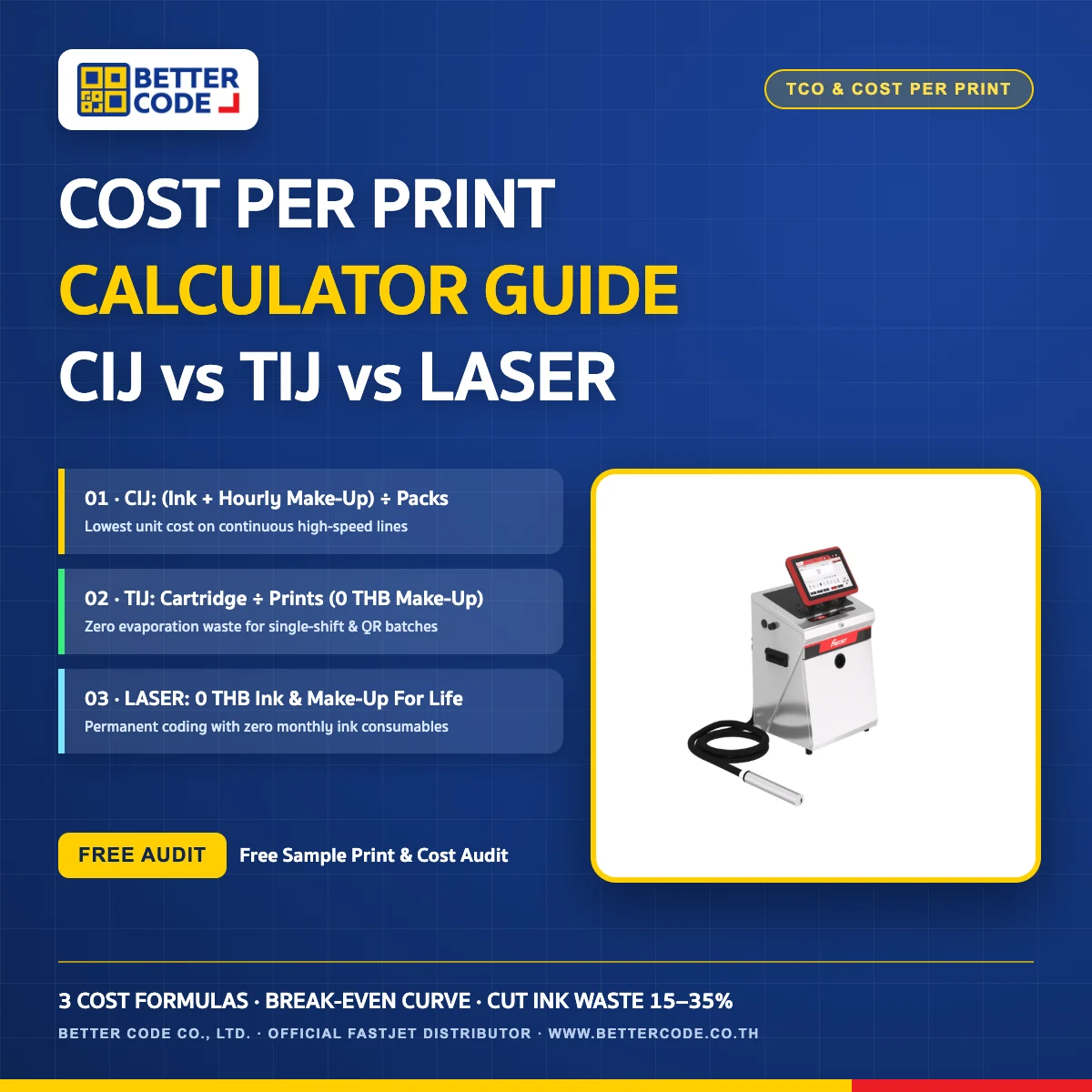
Date coder cost per print depends on technology: CIJ printers divide (ink drops fired + hourly make-up solvent evaporation) by total packs printed, delivering the lowest unit cost on high-speed continuous lines. TIJ printers divide cartridge price by prints per cartridge with zero make-up evaporation, ideal for intermittent batches. Laser coders use zero ink or make-up (0 THB), incurring only electricity and fume filter costs.
The 3 Engineering Formulas for Date Coder Cost Per Print: CIJ vs TIJ vs Laser
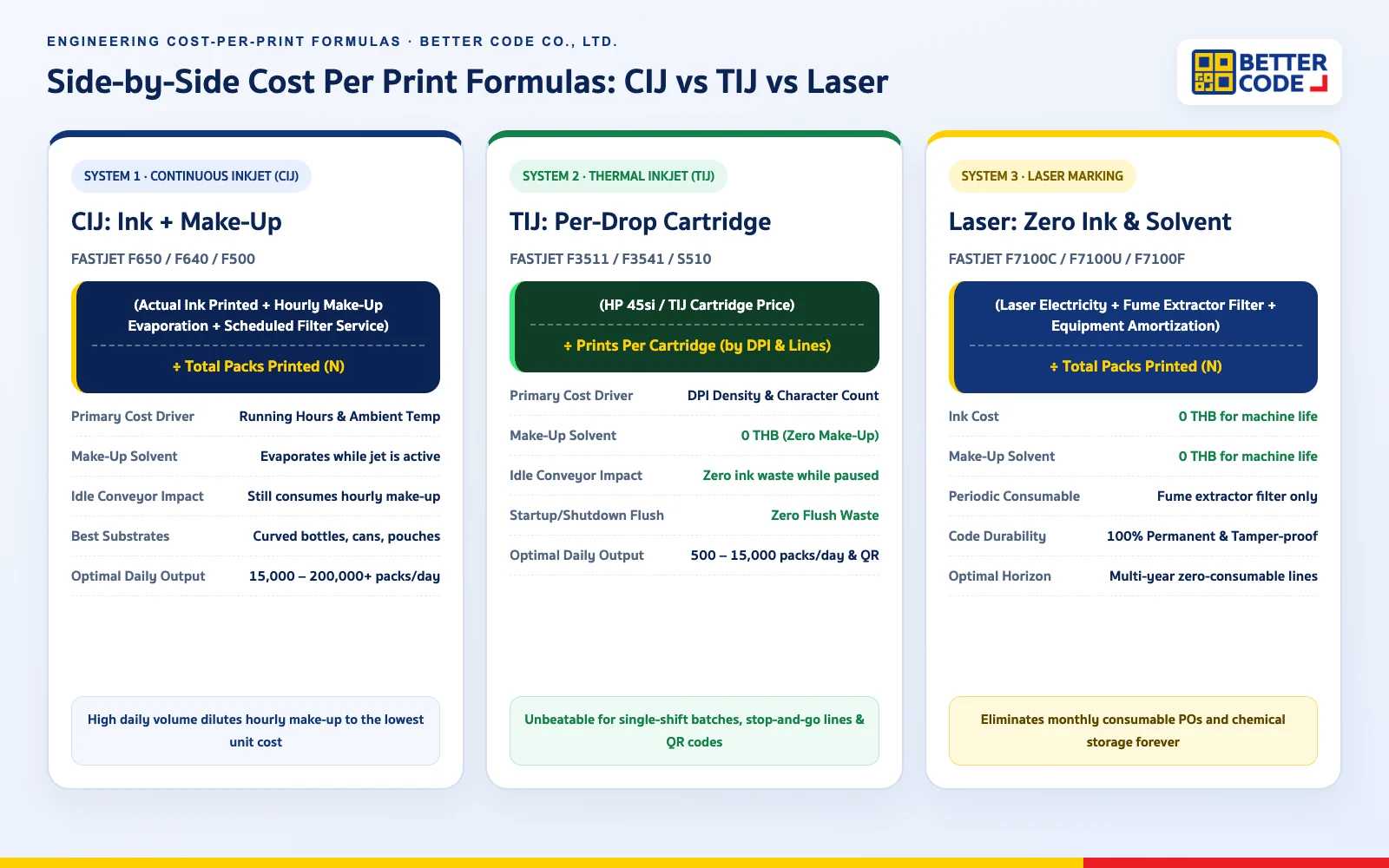
The most common mistake in factory procurement is comparing ink bottle prices against cartridge prices without factoring in solvent evaporation and line operating hours. In reality, the three primary industrial date coding technologies follow completely different mathematical cost equations:
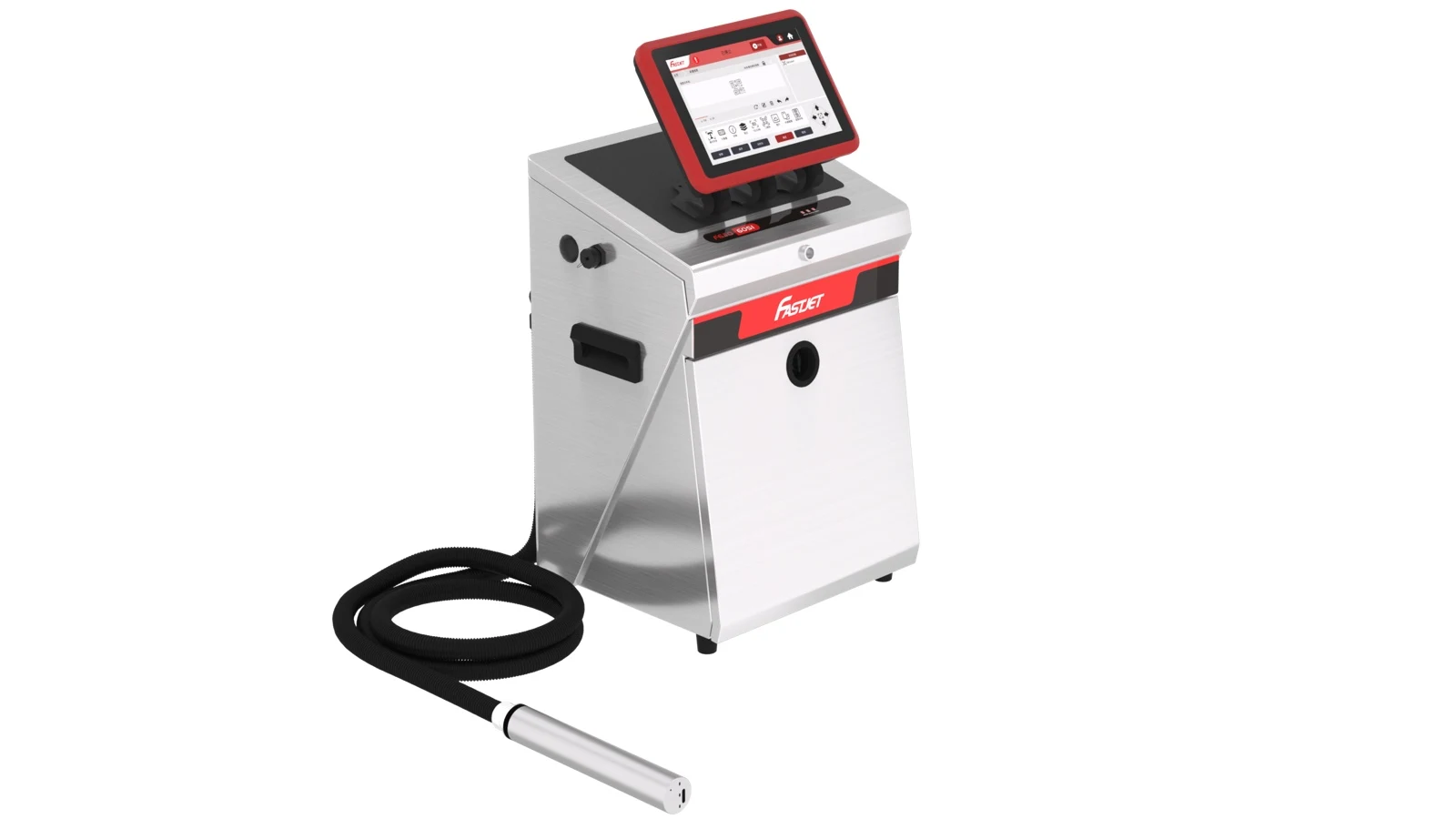
CIJ Date Coders (FASTJET F650 / F640)
In a CIJ system, coding ink scales with printed characters, whereas Make-Up solvent evaporates continuously whenever the ink stream is circulating to regulate viscosity.
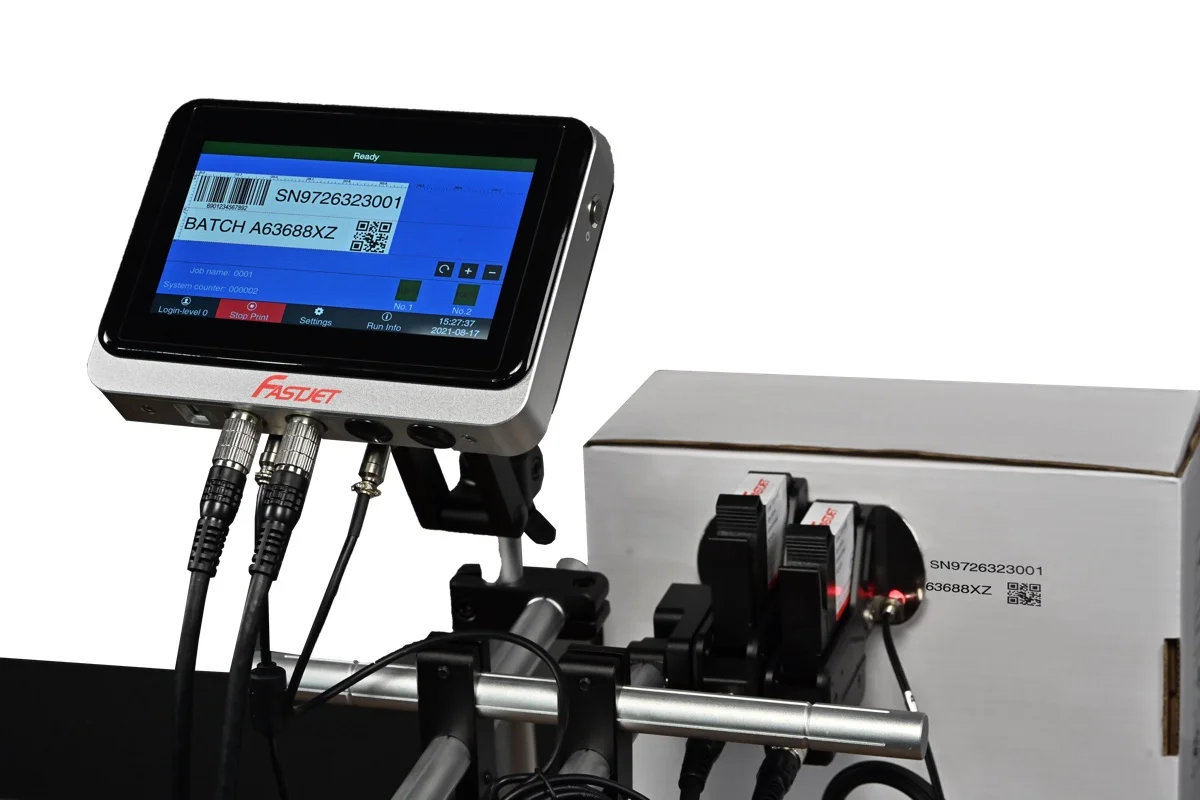
TIJ Date Coders (FASTJET F3500 / S510)
TIJ cartridges keep ink sealed until the exact millisecond a product triggers the photo sensor.
Laser Date Coders (FASTJET F7100 Series)
Uses a focused CO₂, UV, or Fiber laser beam to etch or color-change the packaging surface permanently without fluids.
7-Dimension Consumable Cost Structure Comparison: CIJ vs TIJ vs Laser
To understand why two factories with different shift schedules experience very different running costs, review this 7-dimension consumable breakdown across CIJ, TIJ, and Laser technologies:
| Consumable Cost Dimension | CIJ Date Coder (Continuous Inkjet) | TIJ Date Coder (Thermal Inkjet) | Laser Date Coder (CO₂ / UV / Fiber) |
|---|---|---|---|
| 1. Primary Ink Cost | Bottled reservoir ink consumed per printed dot matrix; available in MEK, pigment, moisture-resistant, and thermochromic formulas (view date coder inks ↗) | Sealed 42 mL cartridge with integrated printhead; consumed strictly per drop fired based on DPI density and character count | 0 THB (Zero ink required for life) |
| 2. Make-Up Solvent Evaporation During Operation | Requires Make-Up fluid. Consumption scales primarily with active operating hours and ambient temperature, continuing even during brief conveyor pauses | 0 THB (Zero Make-Up). Sealed cartridge prevents solvent evaporation when the conveyor stops | 0 THB (Zero solvents or chemical fluids) |
| 3. Startup/Shutdown Flush & Cleaning Solvent | Automated nozzle auto-flush during scheduled startup/shutdown plus periodic wash bottle usage for printhead cleaning | Zero startup/shutdown flush waste. Quick lint-free wipe before production is all that is needed | 0 THB. Periodic optical lens wipe only |
| 4. Filters & Scheduled Wear Components | Periodic ink filter module replacement based on pump running hours | Zero internal ink filters or pumps. Replacing the cartridge gives you a brand-new printhead nozzle instantly | Periodic fume extractor filter replacement depending on substrate ablation dust |
| 5. Behavior on Intermittent / Stop-and-Go Lines | Make-up cost per pack increases if the jet stays on all day while few packs pass the sensor | Highly economical. Consumes zero ink during line changeovers or pauses | Zero consumable waste during idle standby |
| 6. Optimal Daily Production Volume | Best TCO at 15,000 – 200,000+ packs/day (continuous 8–24 hr high-speed lines) | Best TCO at 500 – 15,000 packs/day, multi-SKU batch lines, or high-res 2D QR/barcode jobs | Best TCO for multi-year continuous lines seeking to eliminate monthly consumable POs |
| 7. Recommended FASTJET Models from Better Code Co., Ltd. | FASTJET F650 / F640 / F500 ↗ | FASTJET F3511 / F3541 / Handheld S510 ↗ | FASTJET F7100C (CO₂) / F7100U (UV) / F7100F (Fiber) ↗ |
Step-by-Step Cost-Per-Print Worksheet: 3 Factory Production Scenarios
| Calculation Step / Line Variable | Factory Profile 1: High-Speed Continuous Line, 16–24 hrs/day (50,000–200,000+ packs/day) | Factory Profile 2: Single-Shift or Frequent Changeover Line (1,000–15,000 packs/day) | Factory Profile 3: Long-Term Line Eliminating Monthly Consumables (Zero Ink) |
|---|---|---|---|
| Packaging & Line Profile | Beverage bottles, cans, or flexible pouches running continuously at high speed | Pharma cartons, foil pouches, coffee bags, or corrugated cases with frequent SKU changeovers | PET bottles, laminated films, cartons, or metal parts running year-round over multi-year horizons |
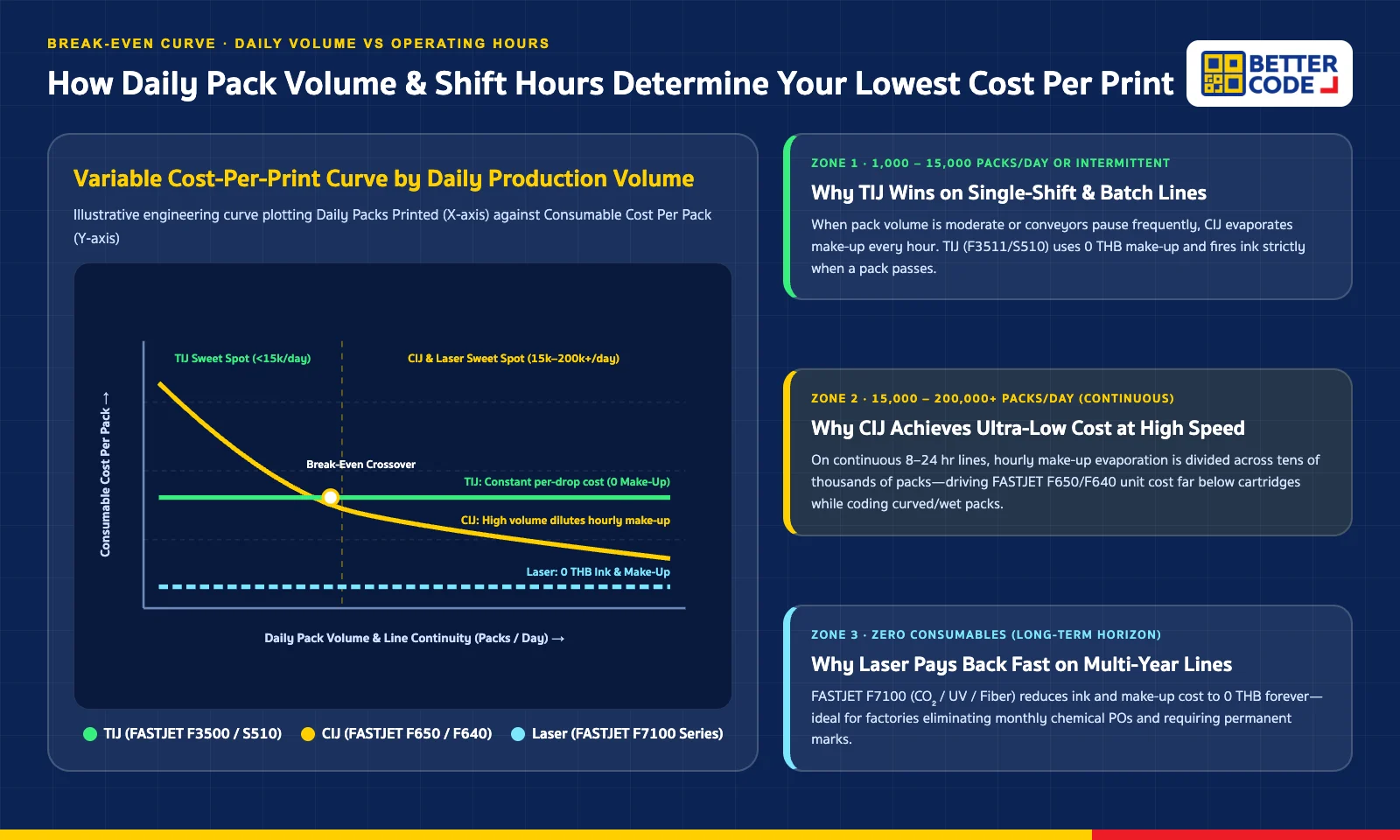
| Variable 1: Daily Pack Volume (N) | N = 50,000 to 200,000+ packs/day (Very large unit divisor) | N = 1,000 to 15,000 packs/day (Small-to-medium unit divisor) | N = Multi-year steady production |
| Variable 2: Active Running Hours (H) | H = 16–24 hrs/day with minimal idle conveyor time | H = 8 hrs powered on, but only 2–4 hrs of actual conveyor movement between batch changeovers | H = 8–24 hrs/day with zero solvent evaporation risk |
| CIJ Formula Application (Illustrative Calculation Example) | [(Bottle Price ÷ Prints/Bottle) × N + (Hourly Make-Up mL/hr × H × Price/mL)] ÷ N→ Lowest cost per pack: Huge divisor N dilutes hourly make-up evaporation to a tiny fraction per pack | If a CIJ stays running for 8 hrs to print only 2,000 packs, 8 hours of make-up evaporation is divided across just 2,000 units—making make-up cost per pack several times higher than ink | Requires recurring monthly ink/make-up purchase orders and scheduled filter maintenance |
| TIJ Formula Application (Illustrative Calculation Example) | TIJ Cartridge Price ÷ Prints Per Cartridge→ Fixed per-drop cost becomes higher than CIJ at ultra-high daily volumes or on recessed curved containers | TIJ Cartridge Price ÷ Prints Per Cartridge (hundreds of thousands of 2-line codes per cartridge)→ Winner for this profile! 0 THB make-up waste during line stops; you pay strictly for drops printed | Clean and maintenance-free, though cartridges are still ordered proportional to output |
| Laser Formula Application (Illustrative Calculation Example) | (Laser Power Cost + Periodic Fume Filter) ÷ N→ 0 THB ink & make-up; rapid capital payback on 2–3 shift lines | 0 THB ink cost, though lower daily pack volume extends upfront CAPEX payback compared to TIJ (unless renting a laser coder) | Ink Cost = 0 THB + Make-Up Cost = 0 THB→ Best long-term TCO: Eliminates 100% of monthly ink/solvent POs with permanent codes |
| Winning FASTJET Solution | FASTJET F650 / F640 (CIJ) or FASTJET F7100 (Laser) | FASTJET F3511 / F3541 (TIJ) or S510 Handheld | FASTJET F7100C (CO₂) / F7100U (UV) / F7100F (Fiber) |
5 Shop-Floor Variables That Waste Ink & Make-Up (And How to Cut Costs by 15–35% Immediately)
Even with identical date coders, two production lines can experience vastly different monthly consumable bills. Better Code Co., Ltd. field engineers highlight the five biggest causes of ink and make-up waste—and how to cut costs by 15–35% immediately:
Leaving a CIJ Printer Running on an Idle Conveyor (Idle Make-Up Evaporation)
A Continuous Inkjet (CIJ) coder circulates pressurized ink stream continuously whenever the jet is running. Even when the conveyor pauses for material changeovers, make-up solvent continues evaporating based on active running hours. Keeping a CIJ unit idle all day for short batches makes make-up cost per pack several times higher than actual ink cost.
High Ambient Factory Temperature Accelerating Solvent Evaporation
CIJ make-up fluid uses fast-drying solvents (such as MEK or ethanol blends) so codes dry in under a second. When the printer cabinet sits near heat tunnels, ovens, or unventilated zones, hourly make-up evaporation rises sharply.
Oversized Drop Matrix, Bold Settings, and Redundant Characters
Enabling multi-dot bolding or printing lengthy prefixes increases the exact number of ink drops fired per pack in both CIJ and TIJ systems.
Running TIJ Cartridges at Maximum DPI When Standard Resolution Suffices
TIJ printers support up to 300–600 dpi, which is ideal for dense 2D QR codes. However, printing standard MFG/EXP text at maximum density consumes nearly double the ink drops compared to optimized 300×150 dpi or Eco density modes.
Mismatched Ink Formulation Causing Frequent Nozzle Flushes and Rework Waste
Using the wrong ink chemistry on condensation-wet bottles, laminated pouches, or retort packaging leads to smudged codes, rejected packs, and repeated printhead flushing.
For Purchasing & Engineering Teams: What You Receive with Better Code’s Free Cost-Per-Print Audit
Instead of relying on generic catalog estimates, send your actual packaging samples to Better Code Co., Ltd. Our engineering team provides a complete technical and commercial evaluation free of charge before you decide to rent a date coder or purchase outright (see our Rent vs Buy Industrial Date Coder Guide):
We test-print your exact MFG/EXP, lot code, and QR layout across CIJ, TIJ, and Laser systems, returning physical samples and high-resolution photos for QA and adhesion verification.
We calculate projected ink and make-up usage based on your exact character count, dot matrix, line speed, and shift hours so procurement can compare true unit costs.
Receive transparent pricing for both outright purchase (CAPEX) and flexible rental plans (3-month minimum with installation, training, and servicing included).
Frequently Asked Questions: Date Coder Ink, Make-Up & Cost Per Print
Why does a CIJ date coder consume more make-up fluid than ink?
A CIJ printer continuously circulates an ink stream in the printhead whenever the jet is switched on. Make-up solvent evaporates into the air based on operating hours and ambient temperature to maintain ink viscosity—even when the conveyor pauses—whereas ink is consumed only when drops are printed onto products.
How many prints does a TIJ ink cartridge yield, and how is cost per print calculated?
Prints per TIJ cartridge (typically 42 mL) depend on message character count, font height, line count, and DPI density. The formula is Cartridge Price ÷ Actual Prints per Cartridge. Because TIJ uses sealed cartridges with zero make-up evaporation or startup flush waste, every drop goes directly onto packaging.
For 1,000 to 15,000 packs per day, is CIJ or TIJ cheaper to run?
For single-shift or intermittent lines producing 1,000–15,000 packs per day, TIJ (such as FASTJET F3500 Series or S510 handheld) typically achieves a lower monthly consumable cost because it consumes ink strictly per printed pack without hourly make-up evaporation during line stops.
Does a laser date coder truly have zero cost per print?
Laser coders (CO2, UV, Fiber) have 0 THB ink and make-up cost for life. In a full engineering TCO calculation, unit cost consists only of electrical power, periodic fume extractor filter replacements, and equipment amortization divided by total packs marked.
How can our factory get an exact cost-per-print calculation before buying or renting?
Send your packaging samples, exact message layout (e.g., 2-line MFG/EXP or QR code), and daily output target to Better Code Co., Ltd. Our engineers will test-print your samples and provide a side-by-side CIJ vs TIJ vs Laser cost-per-print audit free of charge.
Is consumable cost different when renting vs buying a date coder?
Whether you rent a date coder (3-month minimum with installation and servicing included) or purchase outright from Better Code Co., Ltd., ink and make-up consumables are billed purely on actual usage.
Get a Free Sample Print & Custom Cost-Per-Print Calculation from Better Code Co., Ltd.
Share your packaging substrate, message lines, daily pack count, and shift hours. Better Code Co., Ltd. will prepare a side-by-side CIJ, TIJ, and Laser cost-per-print breakdown along with purchase and rental quotes.
Request Custom Cost-Per-Print Quote ↗Explore Date Coder Inks & Make-Up ↗Chat on LINE @bettercode ↗Technical References & Evaluation Scope
- Consumable usage and evaporation engineering equations: Application engineering standards of Better Code Co., Ltd., authorized FASTJET distributor in Thailand.
- Technical specifications for FASTJET F650 / F640 (CIJ), FASTJET F3500 Series / S510 (TIJ), and FASTJET F7100 Series (CO2 / UV / Fiber Laser).