Conveyor Date Coding: How to Install a Date Printer on Your Line and Choose CIJ, TIJ or Laser
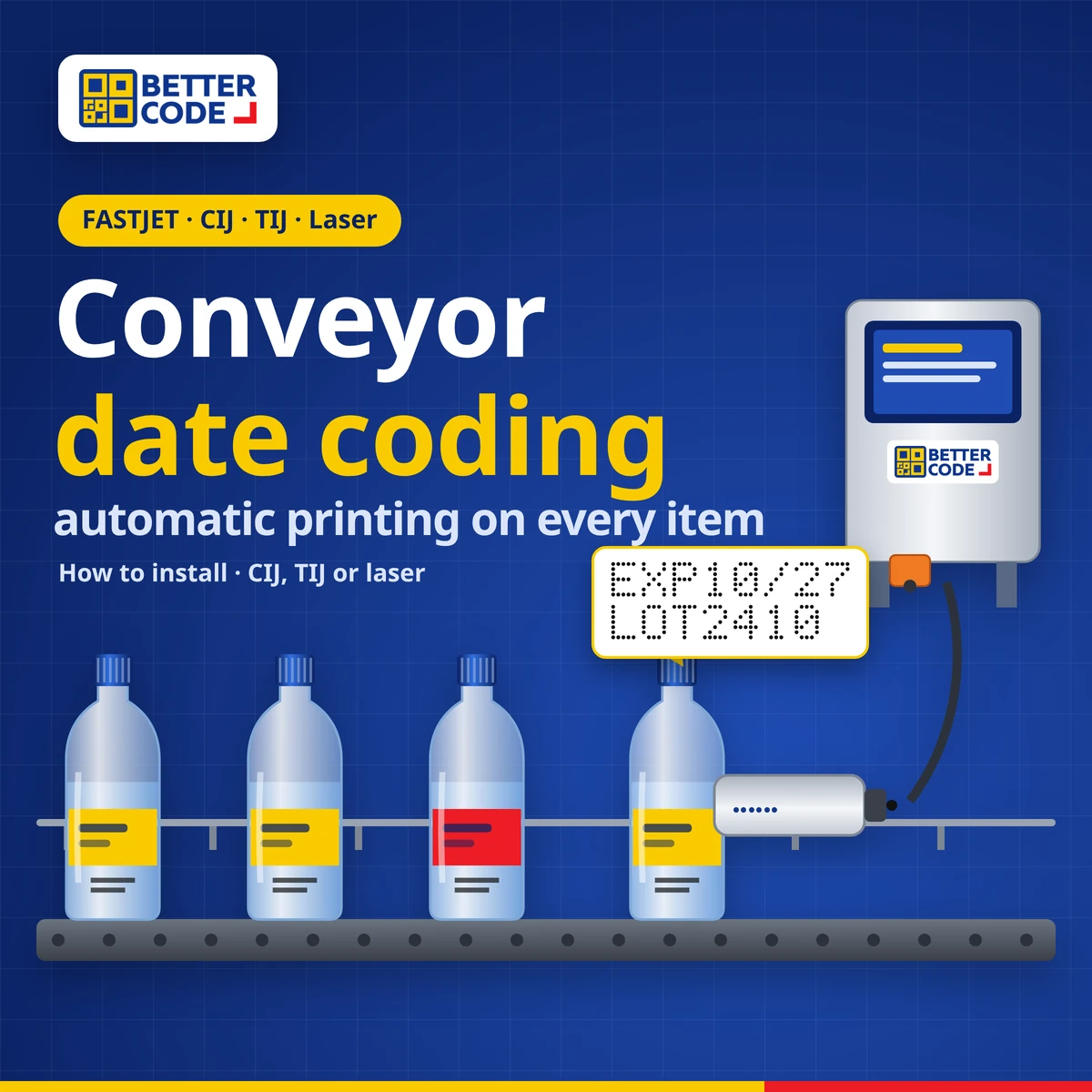
A conveyor date coding printer mounts its print head beside or above the conveyor and automatically prints production dates, expiry dates or lot numbers as products pass. The system consists of the printer, print head with bracket, product detection sensor and guide rails, plus an encoder when belt speed varies. Choose the technology by surface and print distance: CIJ for bottles, cans, bags and curved surfaces (5–40 mm print distance per the FASTJET F640 brochure), TIJ for cartons and labels needing sharp text (optimal print distance about 1 mm) and laser for permanent, ink-free codes.
What is a conveyor date coding printer, and how is it different from a handheld?
Conveyor date coding means fixing a print head at one point on the production line so every product passing it is printed without an operator. It suits lines running continuously all day, such as drinking water, beverages, food, pharmaceuticals and corrugated cartons. A handheld date printer, by contrast, is moved across the product by hand and suits batch work or changing print locations. If you are unsure which you need, read date coding machines explained or see the S510 handheld printer.
What does a conveyor date coding system include?
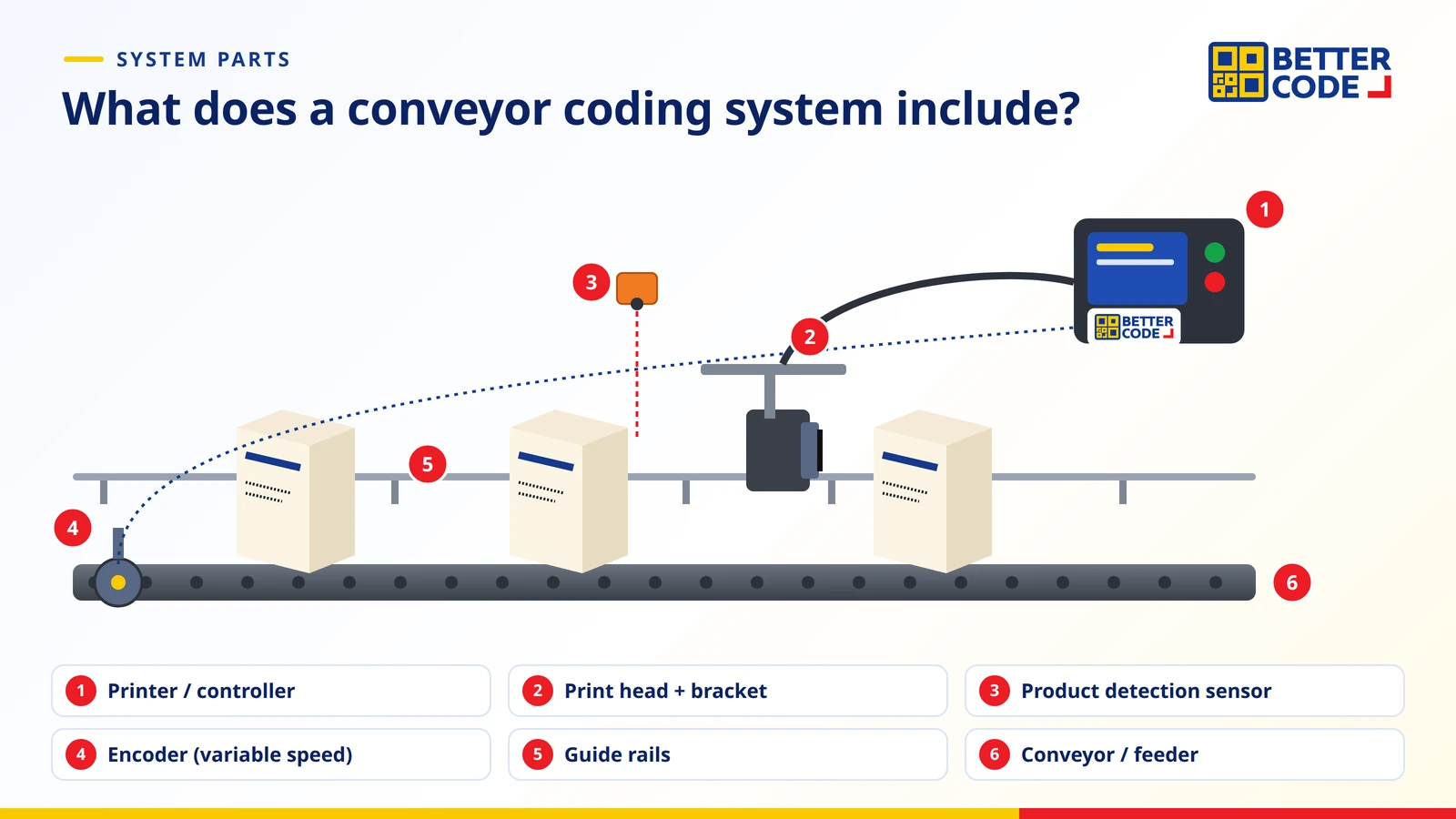
| Component | Role |
|---|---|
| Printer / controller | Sets text, automatic dates, lot numbers, counters, barcodes or QR codes |
| Print head + bracket | Holds the head steady and allows distance, height and angle adjustment |
| Product detection sensor | Tells the printer a product has arrived so printing starts at the same position every time |
| Encoder | Measures actual belt speed; used when speed varies so characters do not stretch or squash |
| Guide rails | Keep products running straight at a constant distance from the head |
| Conveyor / feeder | Moves products at steady speed and spaces them apart |
How does printing on a conveyor work?
- The product passes the sensor, which signals the printer immediately.
- The printer applies a delay matching the sensor-to-head distance, so the text lands in the same place on every item.
- It prints while the product moves. Character width depends on belt speed, or is controlled by the encoder.
- Inspect after printing (optional) with an OCR camera that checks the date is correct and legible; see date code OCR inspection cameras.
- Reject bad prints (optional) by sending the result to the PLC; see vision OK/NG sorting and PLC signals.
Choosing CIJ, TIJ or laser for your conveyor
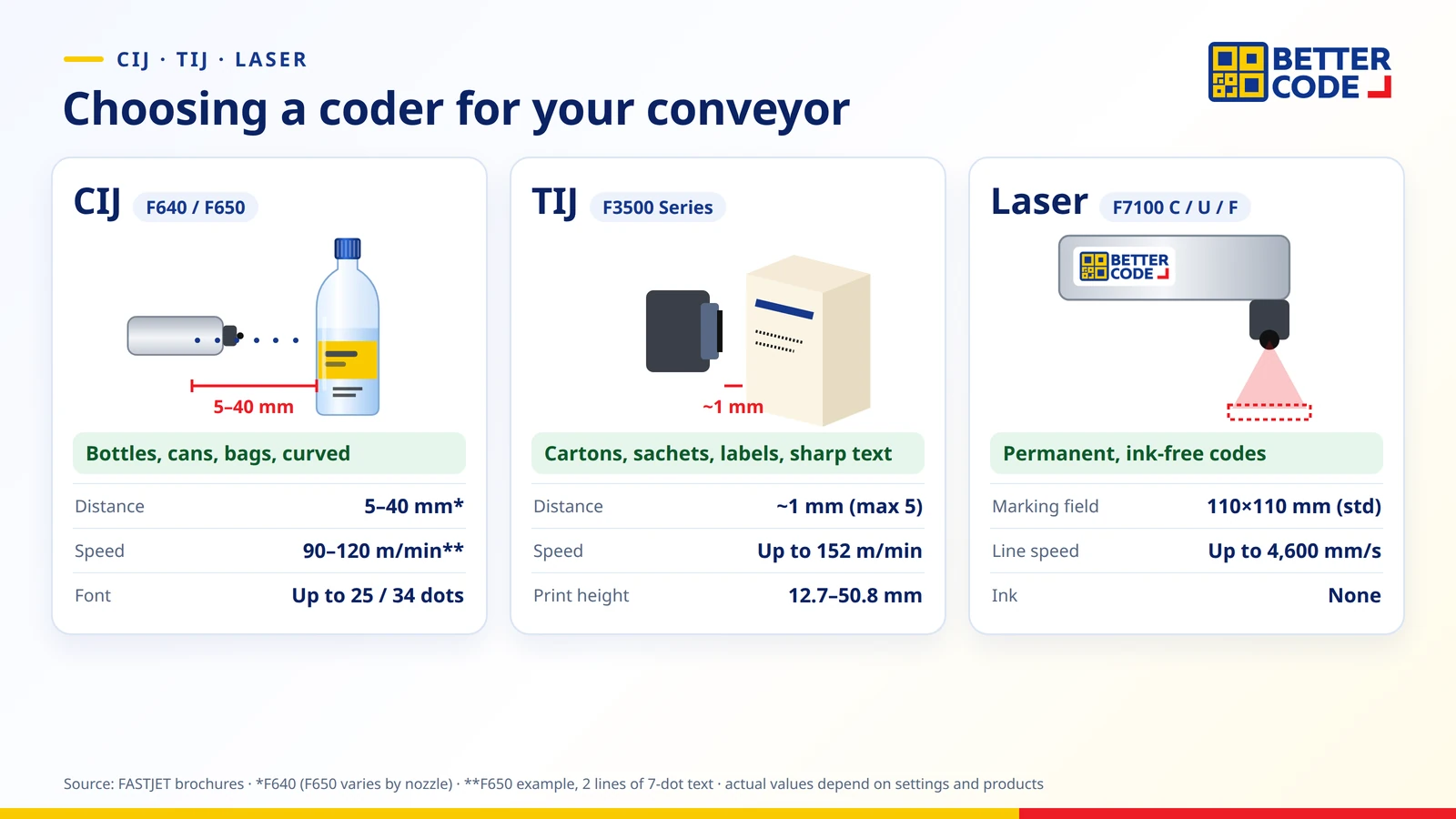
| Topic | CIJ (FASTJET F640 / F650) | TIJ (FASTJET F3500 Series) | Laser (FASTJET F7100) |
|---|---|---|---|
| Best for | Bottles, cans, bags, curved or uneven surfaces | Cartons, sachets, labels and film needing sharp text | Permanent, ink-free codes such as coated cartons, PET bottles and plastics |
| Head-to-product distance | F640: 5–40 mm · F650: 3–10 mm (40 µm nozzle), 5–25 mm (50 µm), 5–40 mm (60/70 µm) | Optimal about 1 mm, up to 5 mm per documentation | Per lens; standard marking field 110×110 mm |
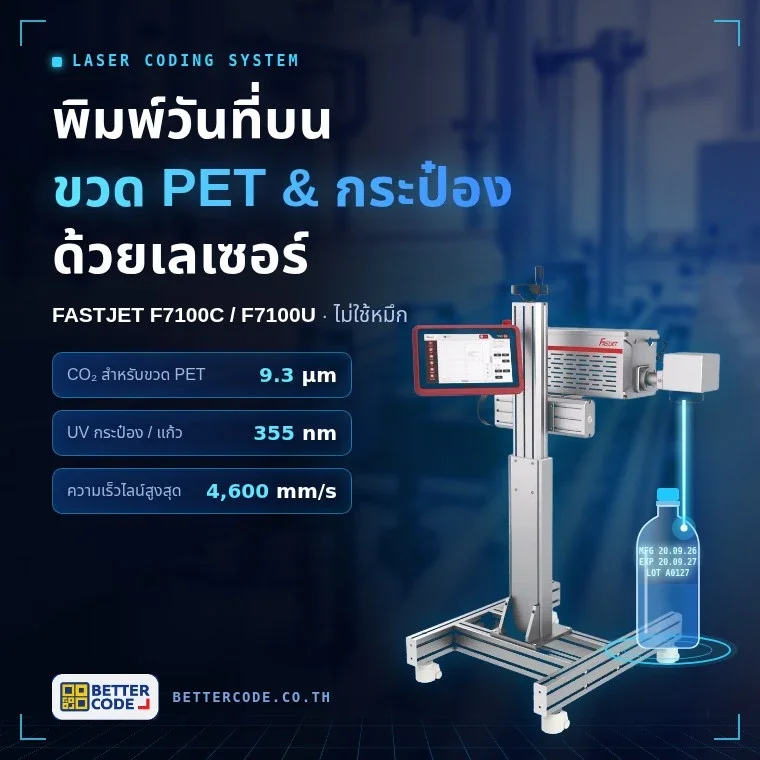
| Speed (per brochure) | F650 shows 2 lines of 7-dot text at 90–120 m/min | Up to 152 m/min, 76 m/min at 300 DPI | Production line speed up to 4,600 mm/s |
| Print height | F640 up to 25 dots · F650 up to 34 dots (4 lines) | 12.7 mm per head, up to 50.8 mm with 4 heads | Per lens marking field |
| Maintenance | Ink and solvent care, IP55 protection | Cartridge replacement, easy upkeep | No ink cost; test the mark on real material |
Speeds are brochure figures. Usable speed depends on the number of lines, character size and resolution, so test on real products at line speed. For a detailed three-way comparison, read CIJ vs TIJ vs laser date coders.
Where should the print head go on the conveyor?
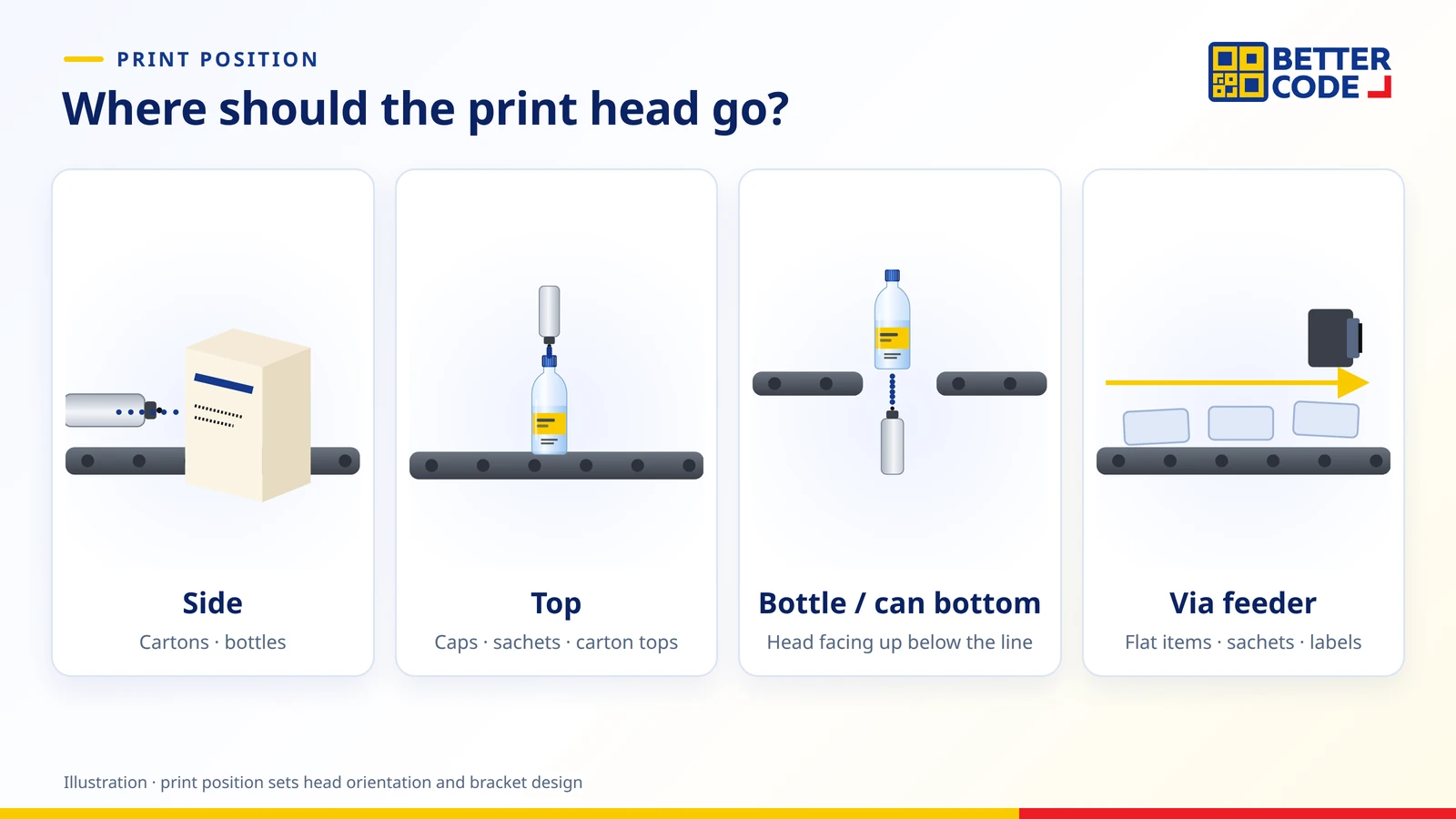
- Side printing is common for cartons and bottles. The head faces the product, and guide rails keep products at an even distance. Read carton date coding.
- Top printing marks caps, sachets or carton tops with the head facing down; watch for uneven product heights. Read bottle cap date coding.
- Bottle or can bottoms are printed with the head facing up from below the conveyor line, usually by CIJ because it prints at a distance without contact. Read where to print expiry dates on packaging.
- Flat items or sachets that are hard to line up use a feeder to pass items one by one at even spacing; see feeders and conveyors.
Tips for sharp, accurate printing on every item
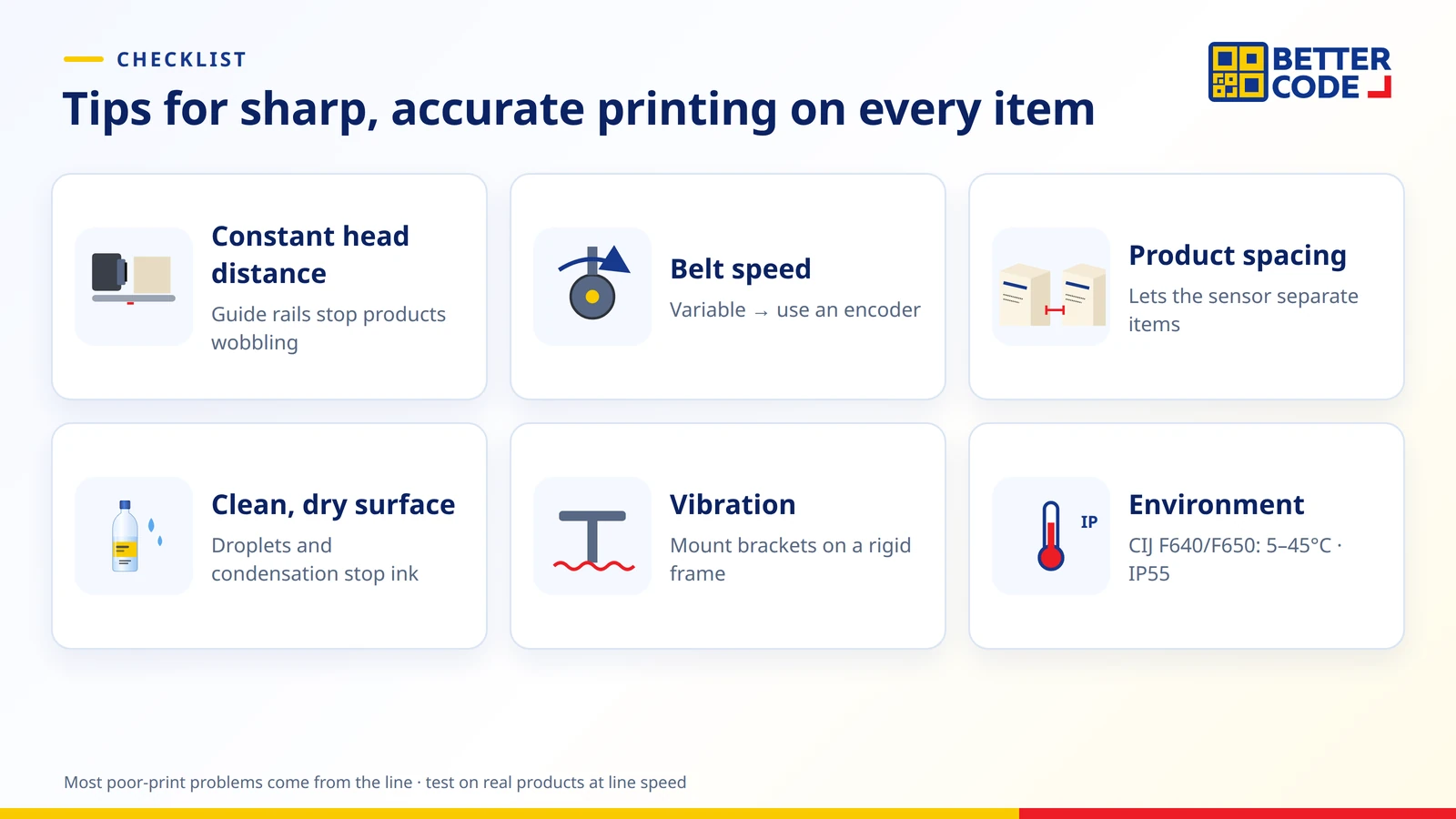
- Keep head distance constant, especially for TIJ with its optimal distance of about 1 mm. Products that wobble or sit unevenly blur the text, so use guide rails.
- Varying belt speed stretches or squashes characters; use an encoder so the printer follows actual speed.
- Space products apart so the sensor can separate items and printing finishes before the next one arrives.
- Surfaces must be clean and dry. Droplets, condensation or oil stop ink adhering; read PET bottle date code ink adhesion.
- Conveyor vibration can reach the head, so mount the bracket on a rigid frame.
- Check the environment. The CIJ F640/F650 brochures specify 5–45°C, up to 90% humidity non-condensing, and IP55 protection.
Connecting the printer to your line
FASTJET F640/F650 CIJ printers support TCP/IP, USB and RS232, and the TIJ F3500 Series supports Ethernet, RS232 and USB per its functions, so they can receive lot numbers or text from other systems and work with post-print inspection cameras. If your line needs printing, inspection and rejection together, see industrial automation.
Information to prepare before requesting a quote
- Product and material: photos, print surface material and desired print position.
- Print content: number of lines, character height, and whether barcodes or QR codes are needed.
- Conveyor data: speed (m/min or items/min), width, height and product spacing.
- Site conditions: temperature, humidity, condensation, dust and installation space.
- Sample products for print tests; see the checklist in preparing products for date coding.
Summary
Conveyor date coding printers automatically print production dates, expiry dates and lot numbers on every item on continuous lines. A good setup needs a trigger sensor, brackets and guide rails for constant distance, and an encoder when speed varies. Choose CIJ for curved surfaces and longer distances, TIJ for sharp text on cartons and labels, and laser for permanent codes. Better Code, the sole official FASTJET distributor in Thailand, tests on your real products, designs conveyors, installs and provides after-sales support.
Frequently asked questions about conveyor date coding
What is a conveyor date coding printer?
It is a printer whose head is fixed beside or above the conveyor, automatically printing production dates, expiry dates, lot numbers, barcodes or QR codes on every passing item, triggered by a sensor. It suits continuous production lines.
Should I choose CIJ, TIJ or laser for a conveyor?
CIJ suits bottles, cans, bags and curved surfaces because it prints from 5–40 mm away per the FASTJET F640 brochure. TIJ suits cartons and labels needing sharp text but needs the head about 1 mm from the product. Laser suits permanent, ink-free codes. Test on real products before choosing.
Do I need a sensor and an encoder?
A product detection sensor is needed in almost every application so printing starts at the same position each time. An encoder is recommended when belt speed varies so characters do not stretch or squash.
How fast can conveyor coders print?
It depends on technology and settings. Per FASTJET brochures, the F650 CIJ shows 2-line printing at 90–120 m/min, the TIJ F3500 reaches up to 152 m/min (76 m/min at 300 DPI) and the F7100 laser supports production line speeds up to 4,600 mm/s.
Can the head print on the side, top or bottom of bottles?
Yes. Side printing is common for cartons and bottles, top printing for caps and sachets, and bottle or can bottoms usually use CIJ with the head facing up from below the conveyor line. The chosen position determines the bracket and guide rails.
Do I need to buy a conveyor as well?
If products are not yet on a conveyor, or are flat items, sachets or labels that are hard to line up, a conveyor or feeder passes them one by one at even spacing. Better Code can design conveyors and feeders to suit the print job.
Where can I buy FASTJET conveyor date coders in Thailand?
Contact Better Code (Better Code Co., Ltd.), the sole official FASTJET distributor in Thailand, via LINE @bettercode or +66 2-170-9611. The team tests on your real products, designs the conveyor installation and provides after-sales support.
Sources
- FASTJET – F640 Series Continuous Inkjet Printer (EF64024001): 5–40 mm print distance, 25-dot font, TCP/IP USB RS232 interfaces, IP55 and 5–45°C operating range
- FASTJET – F650 Series Continuous Inkjet Printer (EF65024001): print distance by nozzle size, 90–120 m/min speed examples and 34-dot font
- FASTJET – TIJ F3500 Series and F7100 laser data as shown on Better Code product pages (from manufacturer brochures)
Want a date coder on your conveyor?
Send product photos, the print position and your belt speed. The Better Code team will help you choose CIJ, TIJ or laser, test print on real products and design an installation that prints sharply on every item.