EXP Meaning: How to Read Expiry Dates on Labels
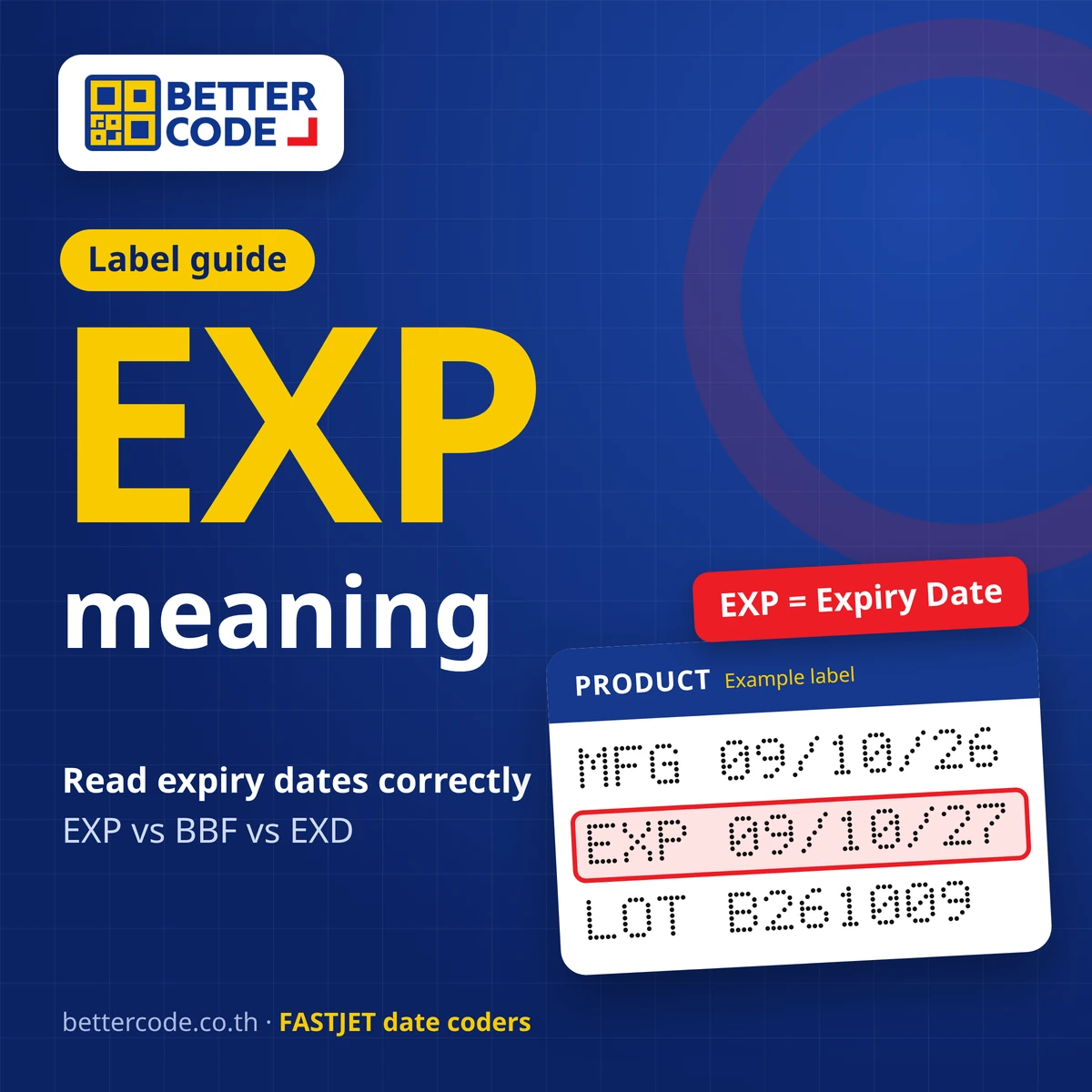
EXP stands for Expiry Date or Expiration Date. It is the last date on which the manufacturer says the product is safe to use or consume when stored as the label says. Do not consume or use a product after its EXP date, and shops should not sell it.
What does EXP mean on a label?
EXP is the abbreviation for Expiry Date or Expiration Date. Labels may print EXP, EXD, Exp. date or Use by; all mean the last date on which the product remains safe and of the quality the manufacturer guarantees, under the storage conditions shown on the label. On Thai food labels the Thai word is “หมดอายุ”.
The Codex General Standard for the Labelling of Prepackaged Foods (CXS 1-1985, revised 2018) says that after a use-by or expiration date the product should not be sold or consumed for safety and quality reasons, and that this type of date applies to foods that must be consumed by a certain date to ensure their safety.
EXP vs EXD vs Use by vs BBF
| On the label | Stands for | Meaning | After the date |
|---|---|---|---|
| EXP | Expiry / Expiration Date | Expiry date | Do not consume or use |
| EXD | Expiry Date | Expiry date (same as EXP) | Do not consume or use |
| Exp. date | Expiration Date | Common on medicines | Do not use |
| Use by | Use by | Safety-related last date | Do not consume or use |
| BBF / BB / BBE | Best Before | Best quality date | May still be fine if unchanged, but quality can decline |
For all common label abbreviations and month codes, see Label date abbreviations: MFG, EXP, BBF, LOT and more.
For a detailed comparison of expiry and best-before dates, read BBF meaning: best before vs BBE vs EXP, and for manufacturing dates see Manufacturing, expiry and best-before dates explained.
How to read EXP dates
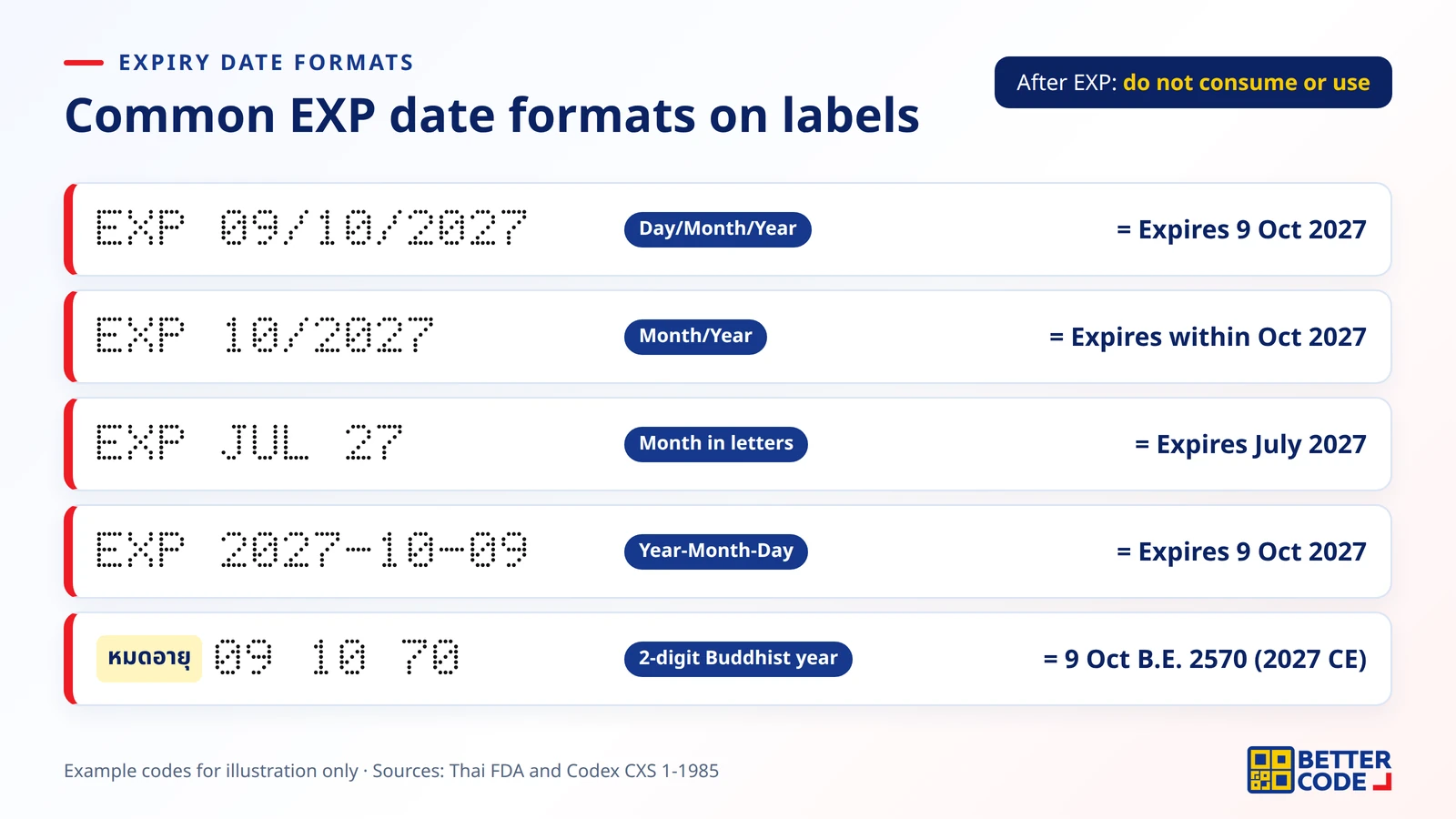
| Example on the label | How to read it |
|---|---|
EXP 09/10/2027 | Expires 9 October 2027 (day/month/year) |
EXP 10/2027 | Month and year only: expires within October 2027; use it before the month ends |
EXP JUL 27 | Month in letters: expires July 2027 |
EXP 2027-10-09 | Year-month-day order: expires 9 October 2027 |
หมดอายุ 09 10 70 | Two-digit Buddhist Era year: 70 = B.E. 2570 (2027 CE) |
For food, Thai FDA labelling rules allow the year in the Buddhist or Gregorian calendar with two or four digits, and the month in numbers or letters. If the date is not in day-month-year order, the label must explain the order. Products with a shelf life of 90 days or less must show day, month and year; longer-life products may show month and year only.
EXP on food, medicines and cosmetics
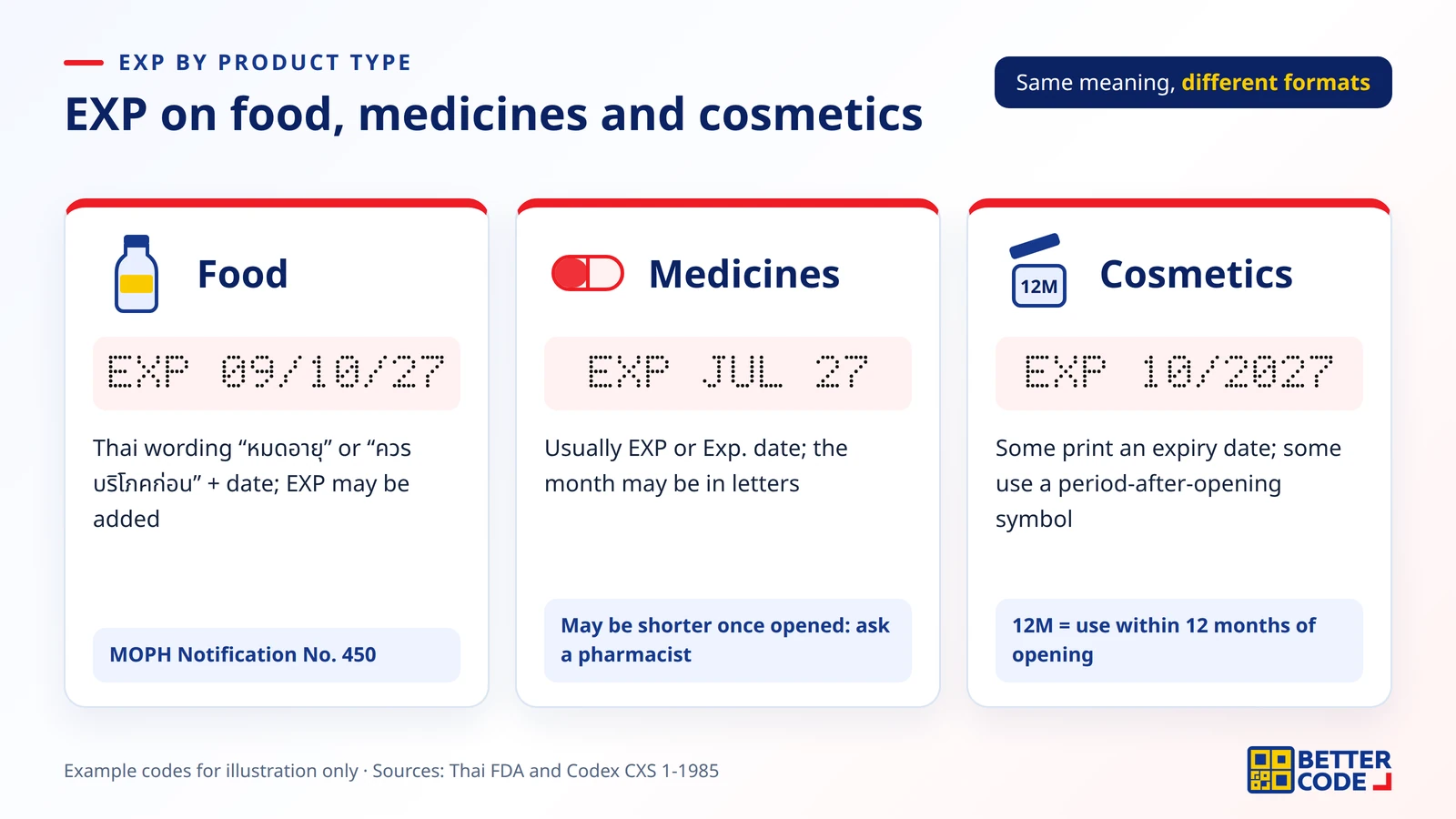
Food
Thai labels on prepackaged food must use the Thai wording “หมดอายุ” (expiry) or “ควรบริโภคก่อน” (best before) followed by the date, under Ministry of Public Health Notification No. 450 (B.E. 2567). English with the same meaning, such as EXP, may be added. The Thai FDA advises that short-life chilled foods such as pasteurised milk and pasteurised juice should not be consumed after the expiry date.
Medicines
Medicines usually show EXP or Exp. date, for example EXP JUL 27 for July 2027. The expiry date indicates the period in which the medicine should be used or dispensed. Some medicines have a shorter life once opened; follow the label or ask a pharmacist.
Cosmetics
Some cosmetics print an expiry date, while others use an open-jar symbol with a number such as 12M, meaning use within 12 months after opening. That is not the same as an expiry date on the pack. Cosmetic labelling has its own rules; manufacturers should check with the Thai FDA.
Can you use a product after its EXP date?
No. Expiry dates are about safety. After the date the product may have deteriorated or spoiled even if it looks normal. Throw it away or return it, and keep in mind:
- Products can spoil before the EXP date if stored incorrectly, for example chilled food left out of the fridge, or a swollen, leaking or bad-smelling pack.
- After opening, follow the opened-pack instructions, such as “refrigerate and consume within … days”.
- Shops should not sell past-date stock: Thai FDA labelling rules require the date shown to be no earlier than the date of sale.
For manufacturers: print expiry dates clearly on every pack
Manufacturers set the shelf life through shelf-life studies, then choose an expiry date (safety) or a best-before date (quality) according to the product and the applicable rules. Then the printing must be right on every pack:
- Use the label wording and date format, for example
หมดอายุ / EXP 09/10/2027, with the same order and separators on every lot. Avoid long unseparated digit strings that are hard to read. - Let the printer add the shelf life to its clock instead of editing digits by hand every day. Many industrial date coders support automatic date offsets; check what your model supports.
- Print the manufacturing date and LOT together for traceability. See the LOT number and batch coding guide.
- Choose a print position that is easy to read and protected from abrasion. See Where to print expiry dates on packaging.
- Choose an ink that adheres to the substrate and suits food packaging. See Date coding inks for food packaging.
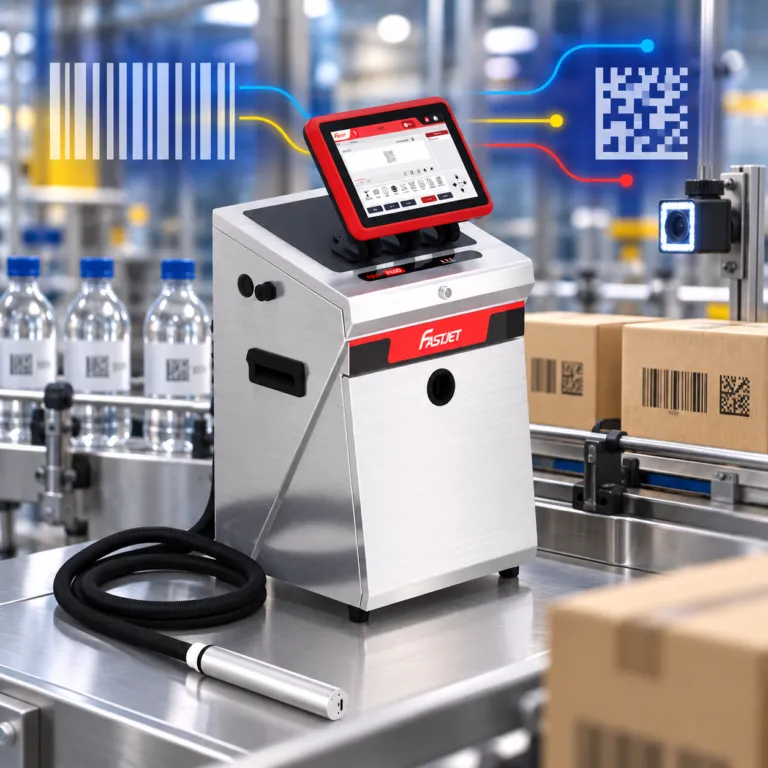
- Verify date codes automatically with vision inspection that reads the code (OCR) and rejects packs with wrong or missing dates, reducing the risk of wrong dates reaching customers.
| Application | Typical technology | Learn more |
|---|---|---|
| Bottles, pouches and cans on a moving conveyor | CIJ continuous inkjet | FASTJET CIJ printers |
| Cartons, labels and film needing sharp text | TIJ cartridge printing | FASTJET TIJ printers |
| PET bottles and cans needing permanent, ink-free codes | Laser | Laser marking |
| Small batches and frequently moved print points | Handheld printer | Handheld date printers |
For a summary of Thai food label rules, see Thai food labels: manufacturing dates, expiry dates and best before.
EXP frequently asked questions
What does EXP stand for?
EXP stands for Expiry Date or Expiration Date: the last date on which the product is safe to use or consume when stored as the label says.
Is EXD different from EXP?
No. Both mean expiry date. Manufacturers simply use different abbreviations; some print Exp. date or Use by.
What is the difference between EXP and BBF?
EXP (expiry) is about safety: do not consume after the date. BBF (best before) is about quality: after the date the food may still be fine if it is unchanged.
Can I eat food one day after the expiry date?
It is not recommended. The expiry date is the last date the manufacturer guarantees safety. After it, do not consume the food even if it looks normal, especially short-life chilled foods.
When does EXP 10/2027 expire?
A month-and-year date means the product expires within October 2027. To be safe, use it before the end of that month. For medicines, ask a pharmacist.
How do I read EXP JUL 27?
It means the product expires in July (JUL) 2027. Month-in-letters formats are common on medicines and imported goods.
Why do some products have no EXP date?
Some products use a best-before date (BBF) instead, because after the date only the quality declines. Manufacturers choose based on the product and the applicable rules. Some cosmetics use a period-after-opening symbol such as 12M.
References
- Thai FDA Food Division – Food labelling rules and label examples (MOPH Notification No. 450, B.E. 2567)
- Thai FDA – Consumer guidance on expiry and best-before dates (Thai)
- Faculty of Pharmacy, Mahidol University – Manufacturing and expiry dates of medicines (Thai)
- FAO/WHO Codex Alimentarius – CXS 1-1985 General Standard for the Labelling of Prepackaged Foods (revised 2018)
Need expiry dates printed clearly and correctly on every pack?
Send us photos of your packaging and the date format you need. Better Code will help you choose a date coder, set up automatic date offsets and run print tests on your real products.