Inkjet Date Coders: CIJ, TIJ and Handheld Types Compared
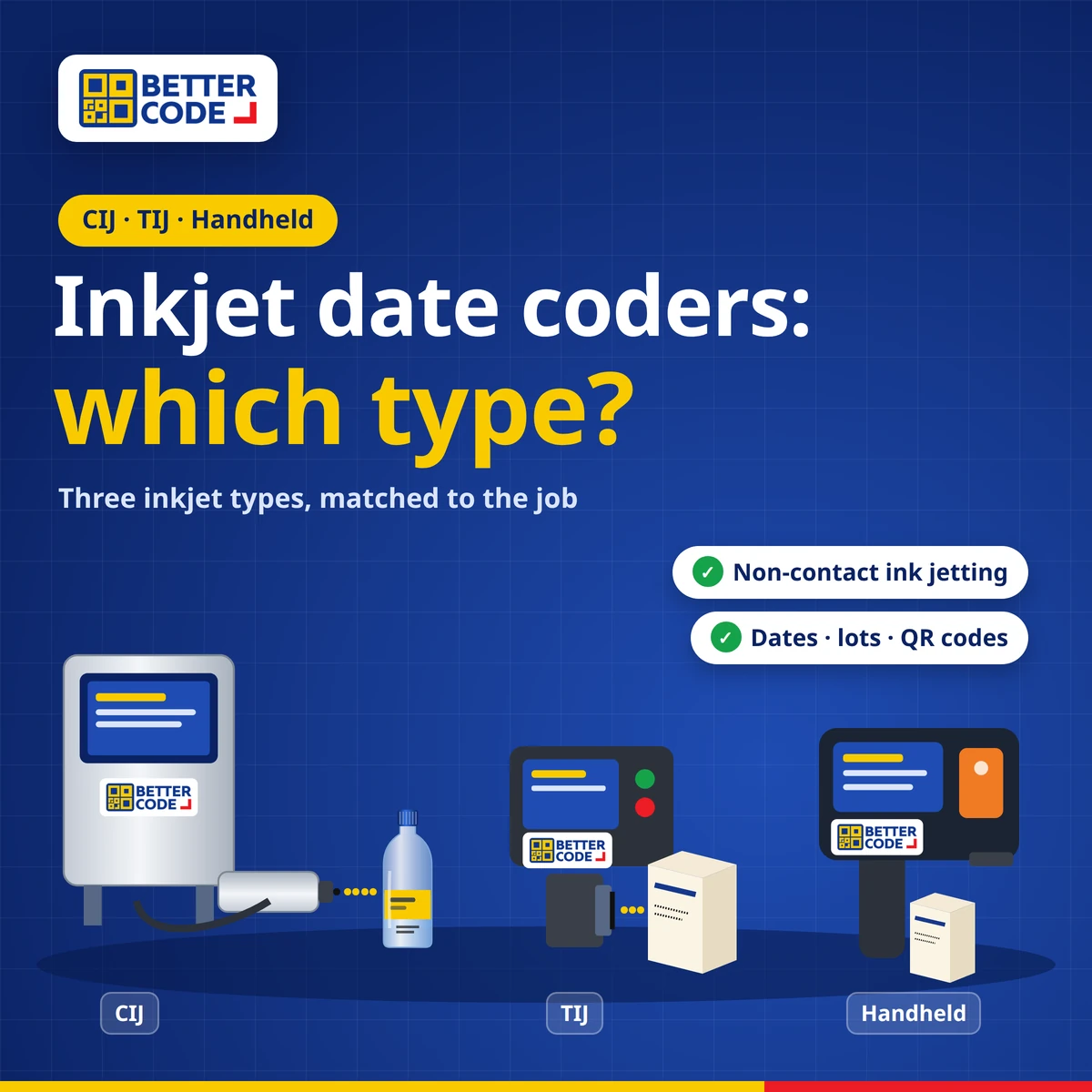
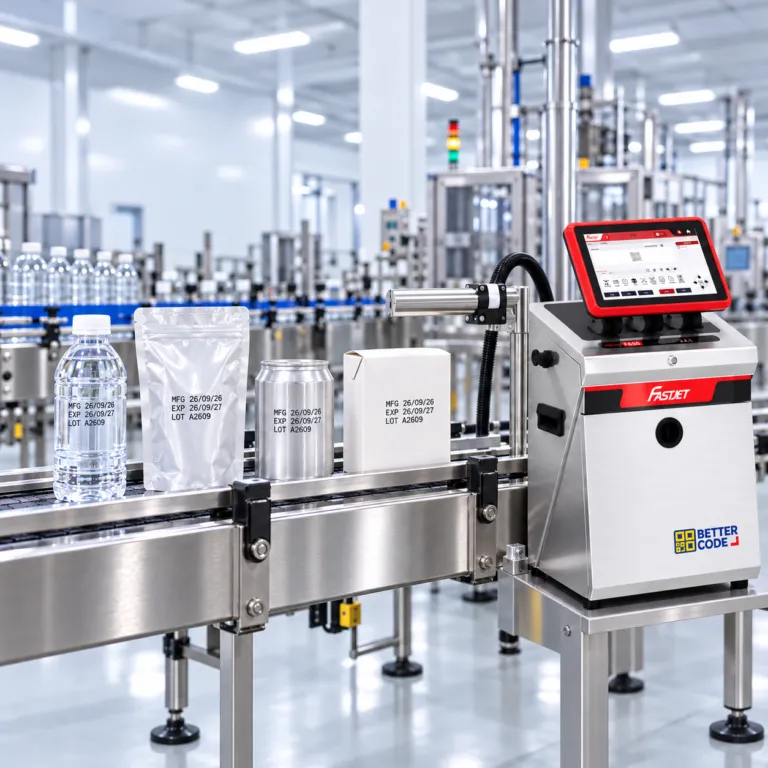
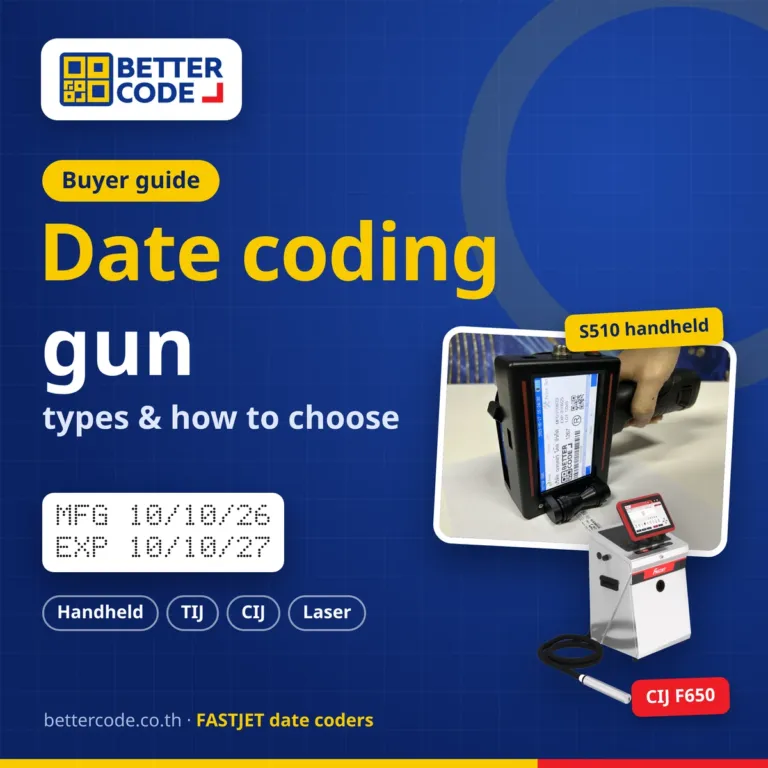
An inkjet date coder prints manufacturing dates, expiry dates, lot numbers, barcodes and QR codes by jetting ink droplets onto products without touching them. Factories use three main types: CIJ (continuous inkjet), which circulates ink continuously and prints from a longer distance, suiting bottles, cans, pouches and curved surfaces on production lines · TIJ (thermal inkjet), which uses cartridges with a built-in print head for sharp text on cartons, labels and flat film · and handheld coders, mostly TIJ-based, carried to the product for batch work. Laser coders are not inkjet, because they mark without ink.
How is an inkjet date coder different from an office inkjet printer?
An office printer prints on paper fed through the machine. An industrial inkjet date coder prints on products moving past the print head on a production line, or is carried to the product. It uses fast-drying inks designed to adhere to many packaging materials, works with sensors and encoders to print in the right place, and updates dates or lot numbers automatically from its clock and shift settings.
How do CIJ and TIJ work?
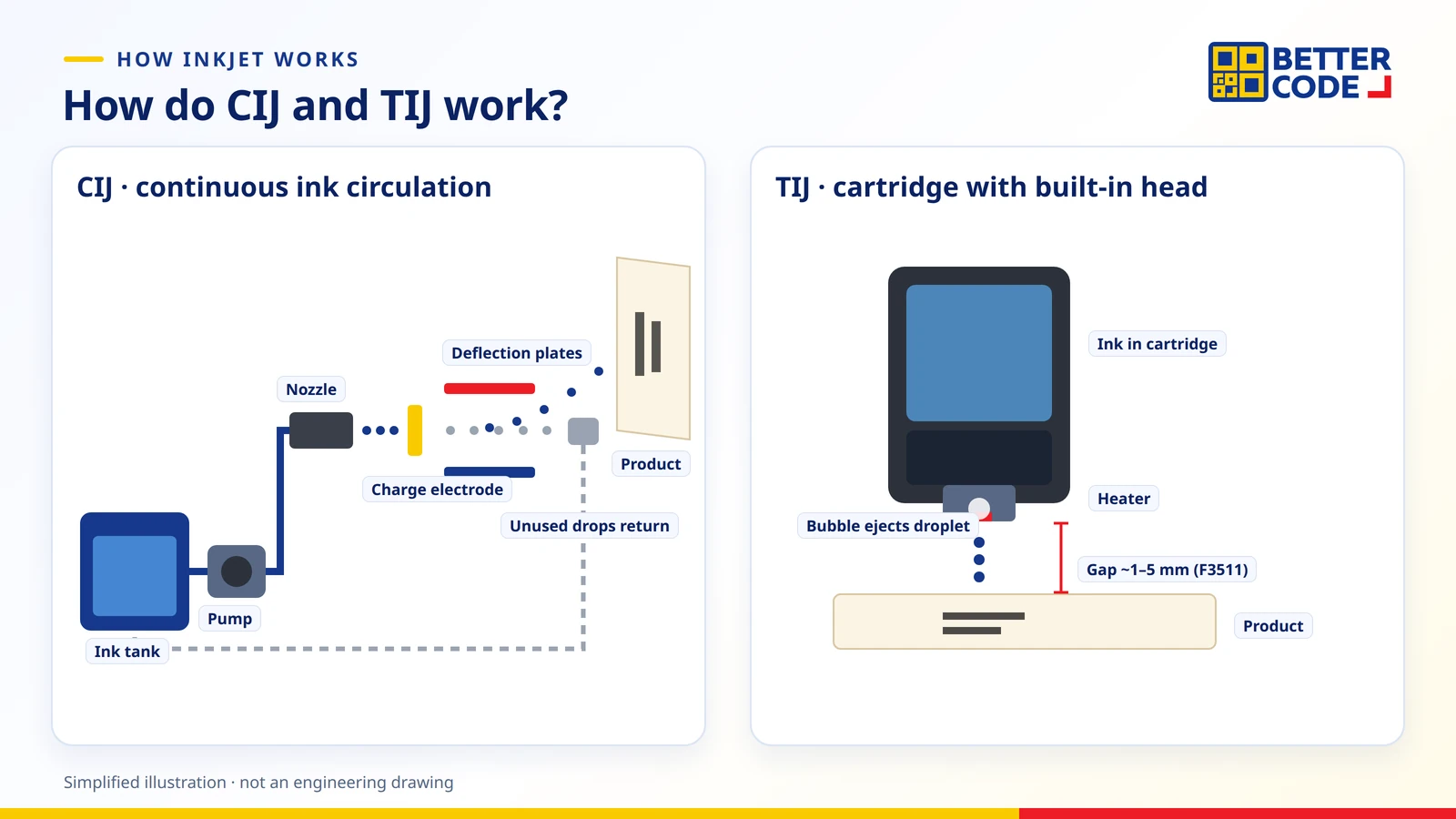
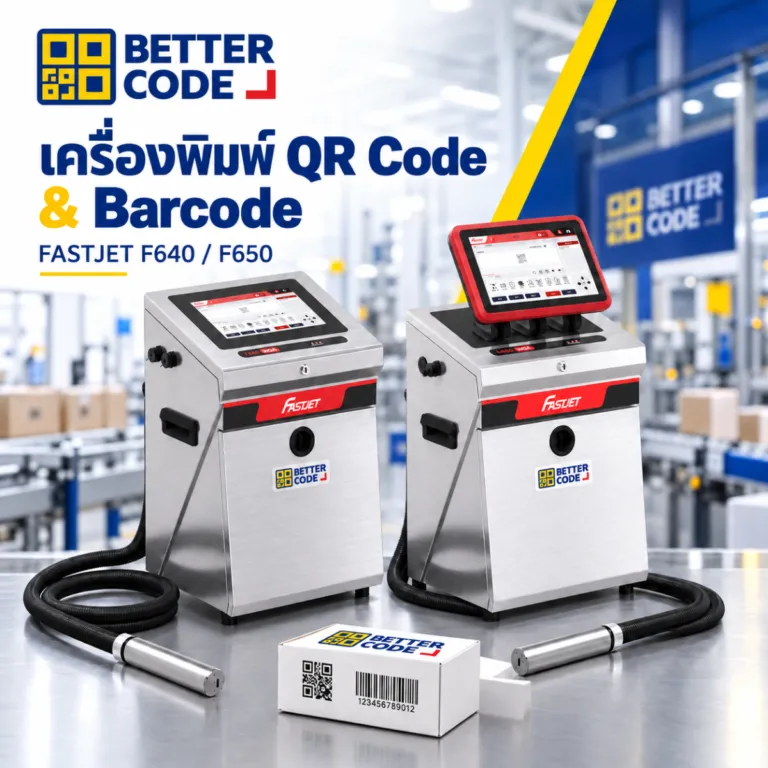
- CIJ (continuous inkjet): a pump pushes ink through a nozzle as a continuous stream of droplets. Droplets used for printing are electrically charged and deflected to form characters on the product; unused droplets return to the ink system. This allows longer print distances and printing on curved surfaces. The printer uses both ink and solvent (the F640/F650 use 750 ml cartridges).
- TIJ (thermal inkjet): the print head is built into the ink cartridge. A tiny heater creates a bubble that pushes a droplet out of each nozzle. Text is sharp and cartridges are easy to change, and every new cartridge brings a new print head. Water-based and solvent-based cartridges are available for different materials, but the head must sit close to the surface.
Comparing three types of inkjet date coder
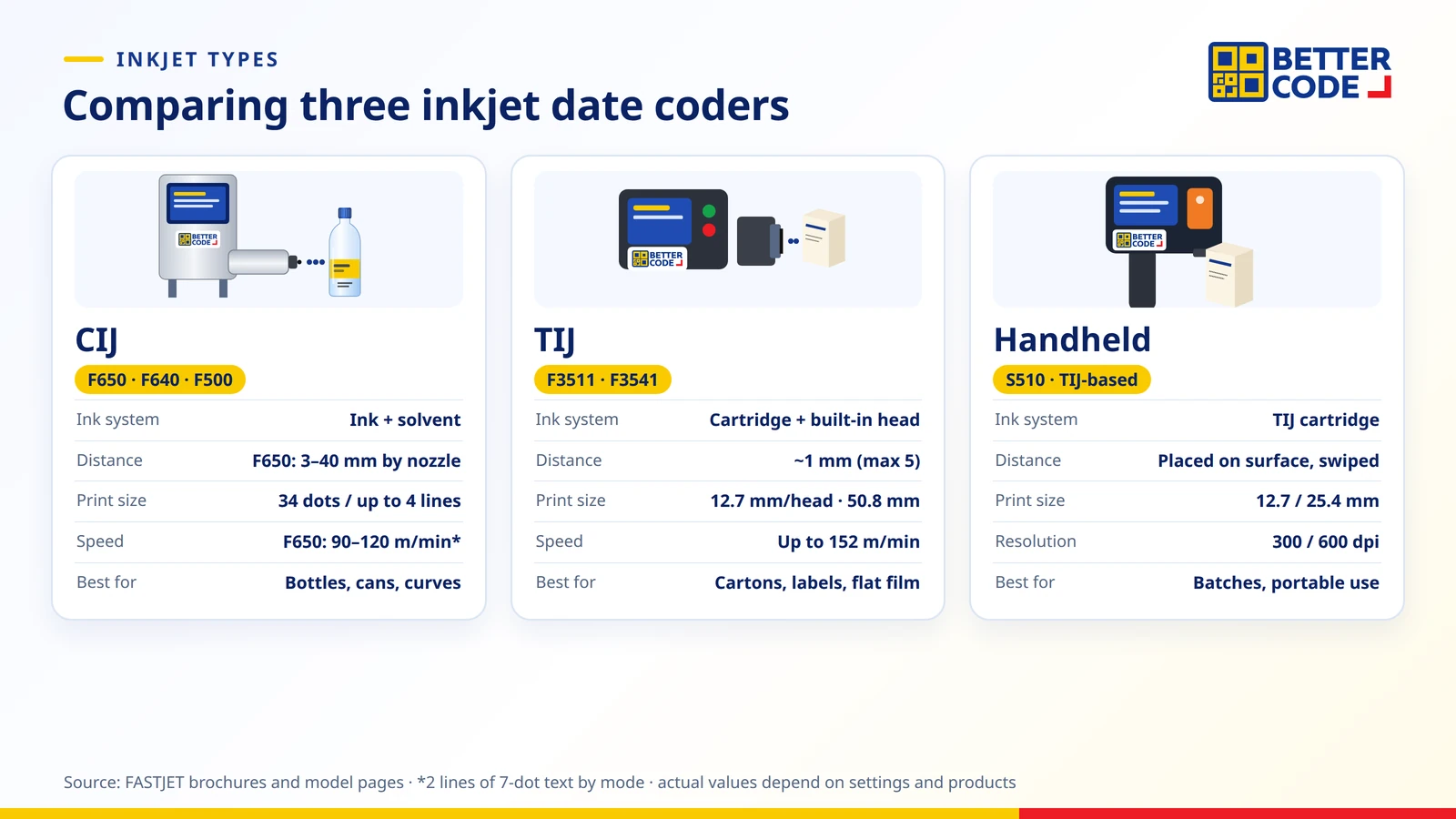
| CIJ | TIJ | Handheld | |
|---|---|---|---|
| Ink system | Ink + solvent, continuous circulation | Cartridge with built-in print head | TIJ cartridge |
| Head-to-product distance | F650: 3–10 mm up to 5–40 mm depending on nozzle | F3511: about 1 mm ideal, up to 5 mm | Placed against the surface and swiped |
| Print size | F650: 1 line of 34 dots or up to 4 lines of 7×5 | 12.7 mm per head · F3541 up to 50.8 mm (4 heads) | S510: 12.7 or 25.4 mm by head |
| Speed | F650: 2 lines of 7-dot text at 90–120 m/min by mode | F3511: up to 152 m/min by resolution | Set by the operator’s hand |
| Best for | Bottles, cans, pouches, bags, curved surfaces, continuous lines | Cartons, labels, sachets, flat film, sharp text and QR codes | Batch work, large items, moving between locations |
| FASTJET models | F650, F640, F500 Series | F3511, F3541 | S510 |
Figures come from FASTJET brochures and model pages; real values depend on settings, nozzle, ink and product.
Which inkjet date coder should you choose?
- Continuous lines, curved surfaces or variable distance such as bottles, cans and bags → start with CIJ
- Cartons, labels or flat film needing sharp text or QR codes with easy upkeep → start with TIJ
- Batch printing, no conveyor, or large items that are hard to move → S510 handheld, or read handheld date coders for SMEs
- Permanent codes without ink → not inkjet; see laser date coders
The material affects which ink you need; see date coding on different materials, and compare all three technologies including laser in CIJ vs TIJ vs laser.
Running costs and maintenance
- CIJ: uses ink and solvent; the ink system and print head need care according to the manual. Suits lines that run continuously.
- TIJ and handheld: the main cost is cartridges; daily care is lighter because the print head is replaced with each cartridge.
- Actual costs depend on message size, output and running hours. See what determines date coder prices.
Summary
Inkjet date coders jet ink onto products without contact. CIJ suits continuous lines and curved surfaces because it prints from further away; TIJ gives sharp text on cartons, labels and flat film with easy cartridge upkeep; handheld coders suit batch work. Choose by job type, material, head distance and message size, then test on real products.
Frequently asked questions about inkjet date coders
What is an inkjet date coder?
A machine that jets ink droplets onto products or packaging without touching them to print manufacturing dates, expiry dates, lot numbers, barcodes and QR codes. Types include CIJ, TIJ and handheld.
How many types of inkjet date coder are there?
Factories mainly use three: CIJ with continuous ink circulation, TIJ with cartridges that include the print head, and handheld coders, which are mostly TIJ-based.
What is the difference between CIJ and TIJ?
CIJ prints from a longer distance and on curved surfaces, using ink and solvent. TIJ gives sharp text with easy cartridge upkeep but needs the head close to the surface, for example about 1 mm ideal and up to 5 mm on the F3511.
Is a handheld date coder an inkjet printer?
Yes. Most handheld date coders use TIJ technology, such as the FASTJET S510 with a 12.7 or 25.4 mm print height depending on the head.
Is a laser date coder an inkjet printer?
No. A laser marks the code into the material without ink, suiting permanent codes. Choose CO2, UV or fiber according to the material.
Can inkjet date coders print Thai text and QR codes?
The FASTJET CIJ and TIJ models sold by Better Code support dates, lot numbers, barcodes and QR codes, and the CIJ (F640, F650, F500) and TIJ (F3511) model pages state Thai text support. See each product page for details.
Can an office inkjet printer replace a date coder?
Not for production. Office printers print on paper fed through the machine, while industrial date coders print on products moving along the line with fast-drying packaging inks and automatic date updates.
Sources
- FASTJET – F640 / F650 Series Continuous Inkjet Printer brochures (ink type, 750 ml cartridges, print distance and speed examples)
- FASTJET – F3500 Series user manual and F3511 / F3541 model information
- FASTJET – S510 handheld printer information (print height and resolution)
Need help choosing CIJ, TIJ or handheld?
Send product photos, the material, the message to print and your line speed. Better Code, the official FASTJET distributor in Thailand, will help choose a model and test-print on your real products.