Vision Inspection for Automotive Parts: What Cameras Check, from Metal Parts and Gears to Tyres
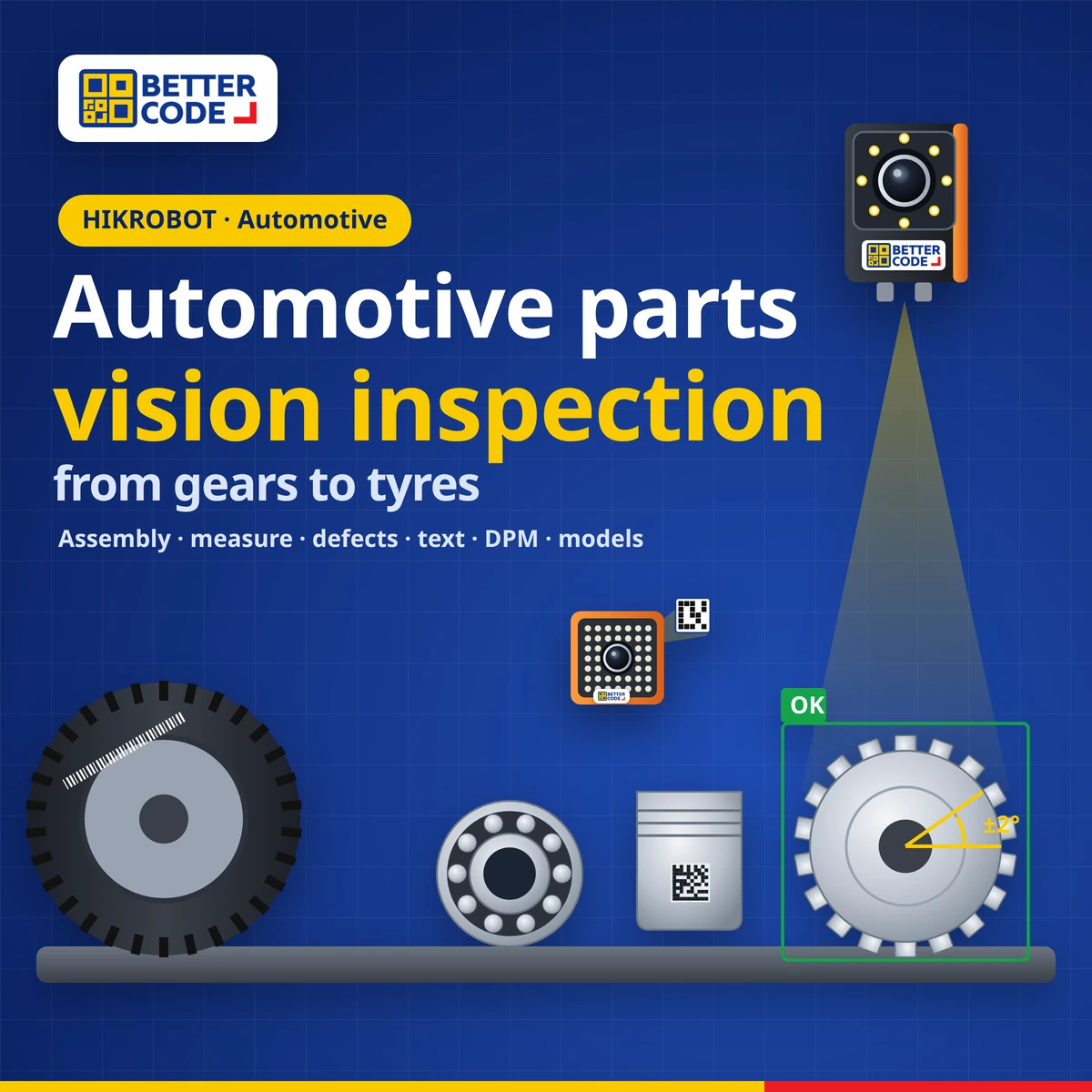
An automotive parts vision inspection camera is a machine vision system that checks every vehicle component on the production line. Six job groups are common: assembly and position checks, dimension and angle measurement, surface defect detection, character reading, DPM code reading for traceability, and model sorting. The automotive challenges are reflective metal, oil residue, 360° coverage and high accuracy. HIKROBOT case examples include measuring gearbox parts to 60 microns, gear shifter angles to ±2°, and DPM code reading on vehicle parts where read rates of 99.9% to 99.99% are required.
What is automotive parts vision inspection?
Automotive vision inspection means installing industrial cameras on vehicle component lines, such as engine parts, gearboxes, brake systems, interior plastics and tyres, to confirm every part is complete, correctly positioned, within tolerance, free of defects and carries a readable code for traceability. Automotive production usually requires 100% inspection with data records, because one defective part can lead to a large recall.
This guide covers inspection jobs specific to the automotive industry. For the basics of each camera type, read machine vision camera types.
What can automotive inspection cameras check?
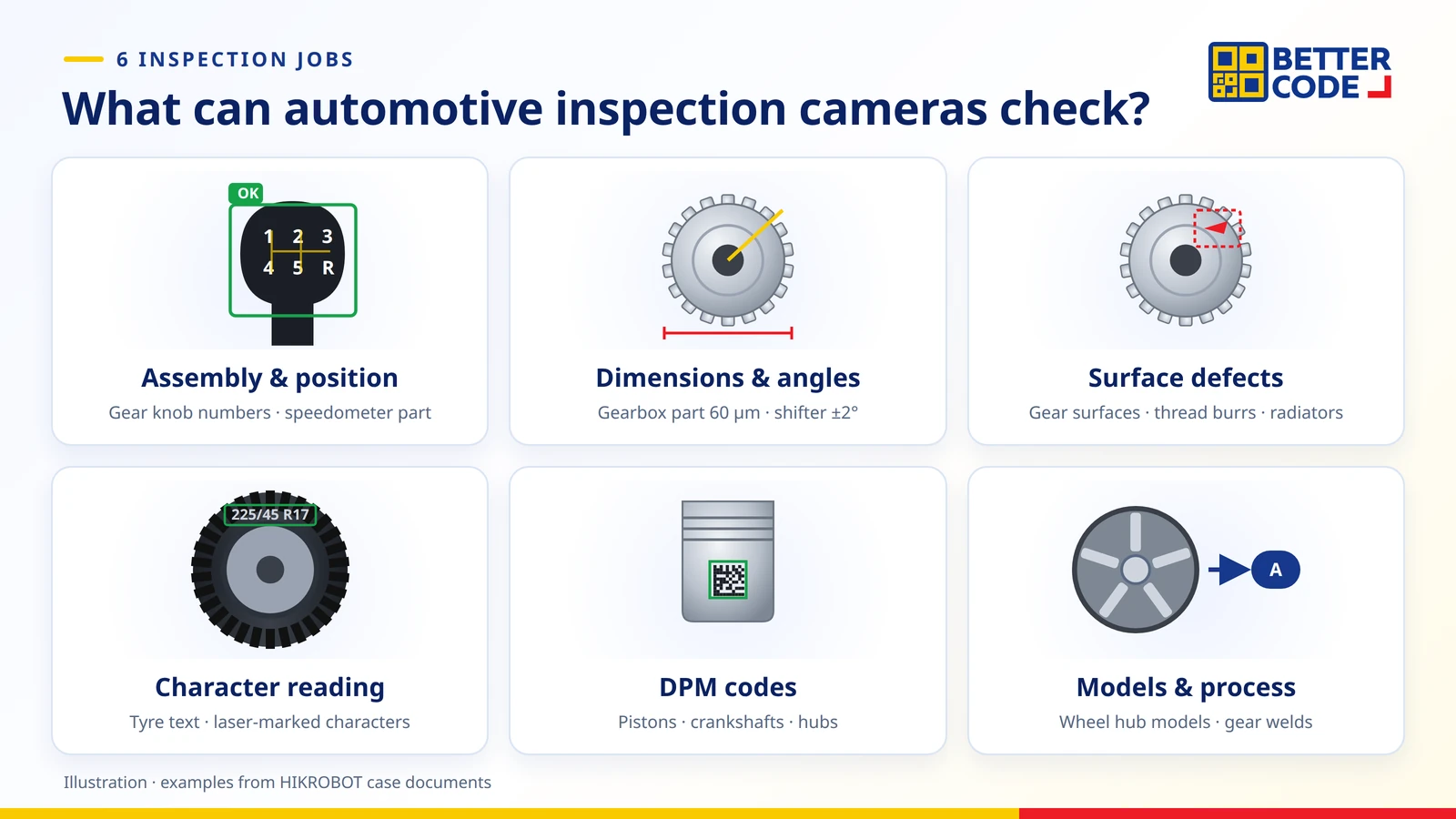
| Job | HIKROBOT case examples | Read more |
|---|---|---|
| Assembly and position | Gear knob: numbers present, correctly positioned, not shifted, line aligned · speedometer metal part presence and orientation · cut marks on gear parts on both sides · chain assembly | OK/NG sorting and assembly checks |
| Dimensions and angles | Gearbox child part ID/OD, height and width with 360° coverage to 60 microns · gear shifter angle to ±2° | dimension measurement cameras |
| Surface defects | Gear plate and rod surfaces · tooth dents and burrs in inner threads · surface scratches and dots with hole presence · deep learning defects on A/C radiators | defect detection cameras |
| Character reading (OCR) | Tyre text over a very large field of view · laser-marked characters on vehicle parts at 99.06% · deep learning OCR on automotive plastic parts | AI vision inspection |
| DPM codes / traceability | Codes on bearings, pistons, crankshafts, connecting rods, EPB modules, spark plugs, hubs and engine blocks · barcodes inside tyres | vision inspection and barcode reading |
| Model sorting and process checks | Wheel hub model recognition within 20 ms · confirming gearbox gears were welded, 100% correct on a 1,203-part test set | AI vision inspection |
Reading DPM codes on automotive parts for traceability
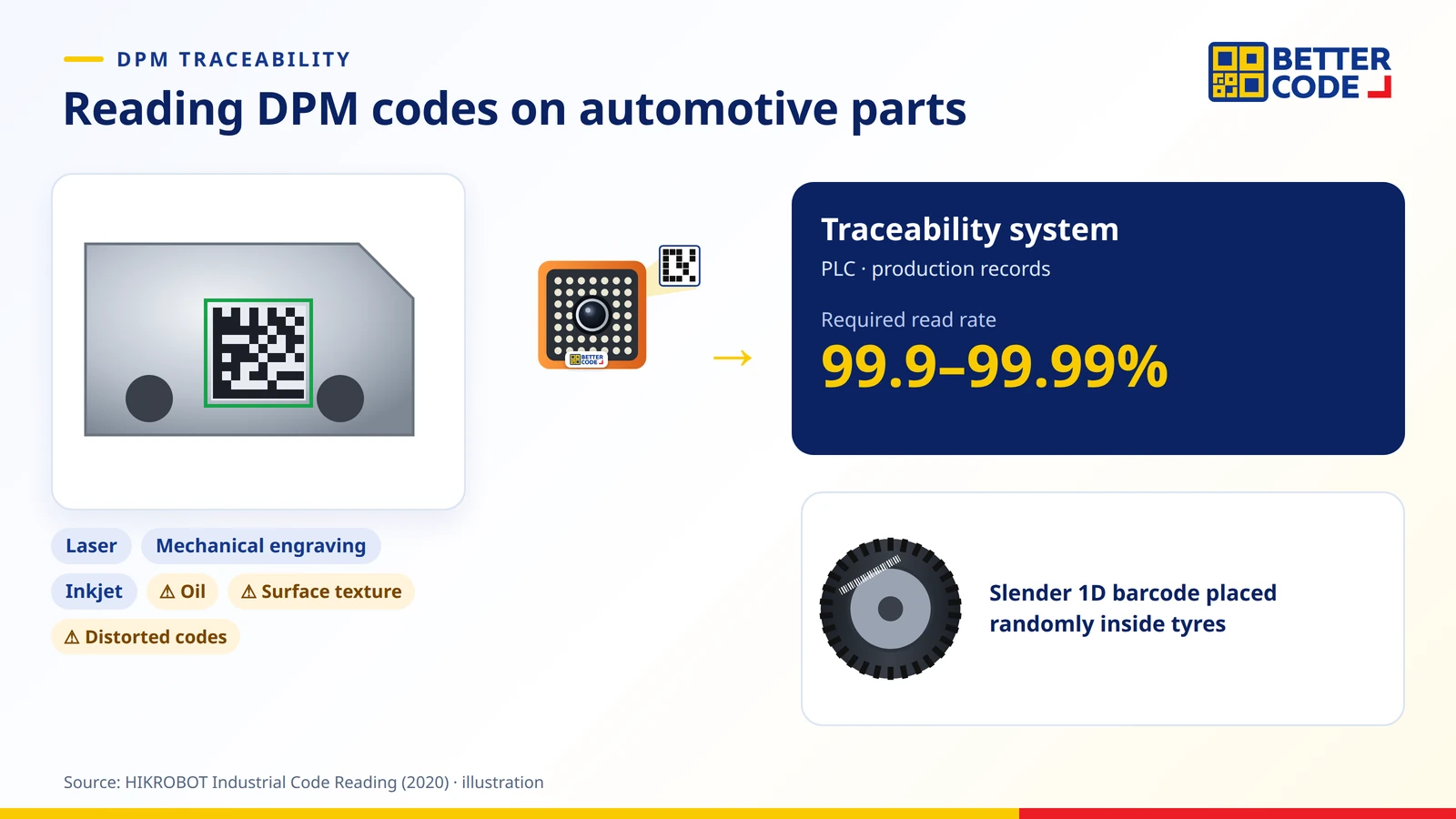
DPM (direct part marking) means codes applied directly to the part, such as Data Matrix codes laser-marked, mechanically engraved or inkjet-printed, identifying each component throughout its life. HIKROBOT documents summarise the requirements:
- Varied marking methods: laser, mechanical engraving and inkjet.
- Interference: oil, surface texture, quiet zone issues and distorted codes.
- Required read rate: 99.9% or 99.99%.
- Parts in production: bearings, pistons, crankshafts, connecting rods, EPB modules, switches, brake modules, spark plugs, hubs, radar units and engine blocks.
- Tyres: long, slender 1D barcodes placed randomly inside tyres of different sizes, read by a high-resolution code reader covering a wide field of view to reduce camera count, despite tread stripe interference.
If you need to mark codes on parts yourself, see ink-free marking in laser marking, and coding on pipes, cables and industrial parts in extrusion coding.
Automotive inspection challenges and how to solve them
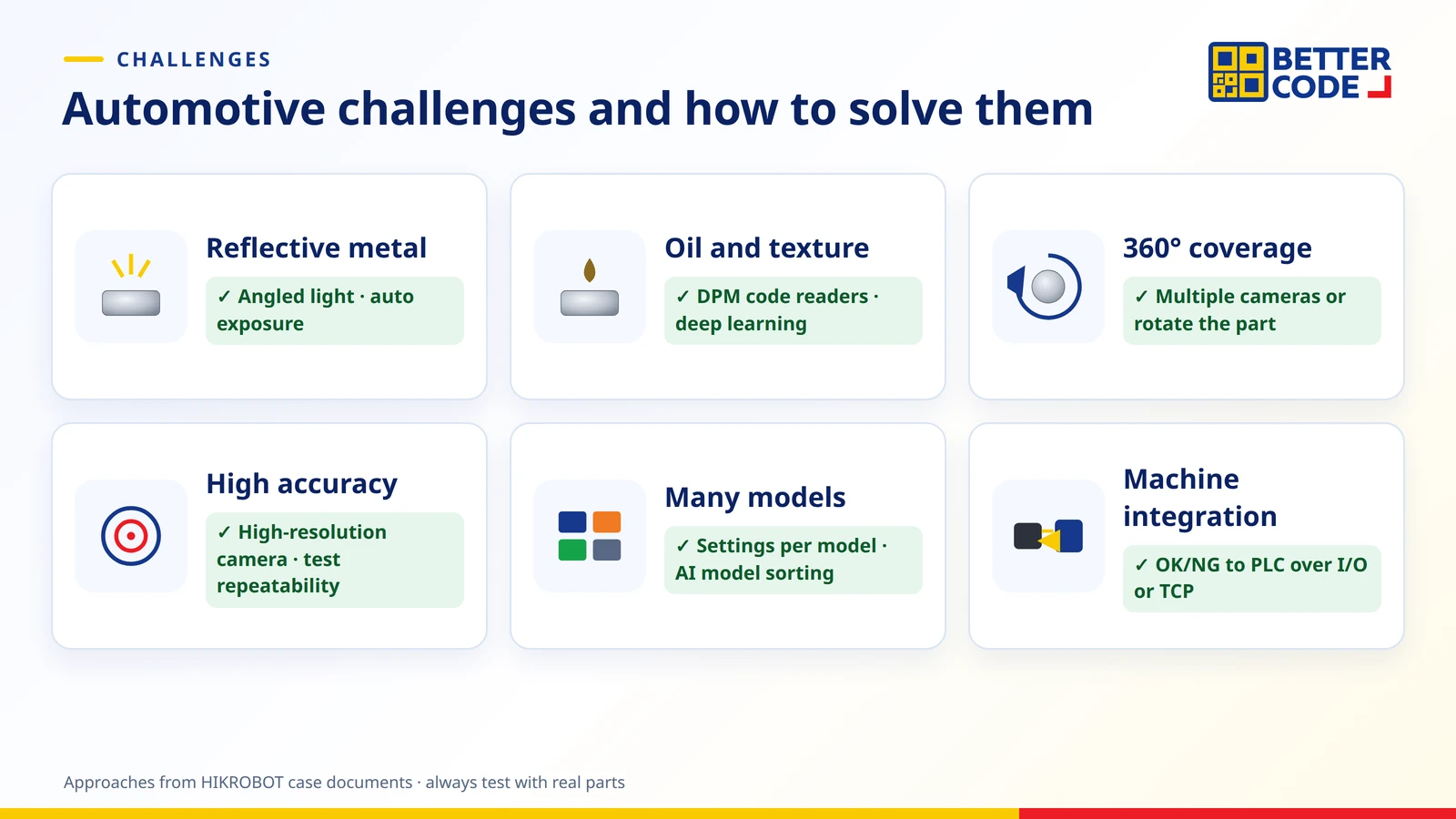
| Challenge | Approach |
|---|---|
| Reflective metal | Angle lighting to avoid glare and use auto exposure; HIKROBOT documents use auto exposure to handle reflection when reading laser-marked codes |
| Oil and surface texture | Choose code readers that support DPM on multiple materials, and deep learning when defects vary |
| 360° coverage | Use multiple cameras or rotate the part; the gearbox part and surface-defect-with-holes cases name 360° coverage as a key challenge |
| High accuracy | Select high-resolution cameras with suitable lenses and lighting, and test repeatability (the gearbox case required 60 microns) |
| Many models on one line | Save settings per model, or use deep learning to classify models |
| Machine integration | Send OK/NG to the PLC over I/O or a network; the gear knob case specifies I/O communication with the PLC over TCP |
Real-world examples: figures from HIKROBOT cases
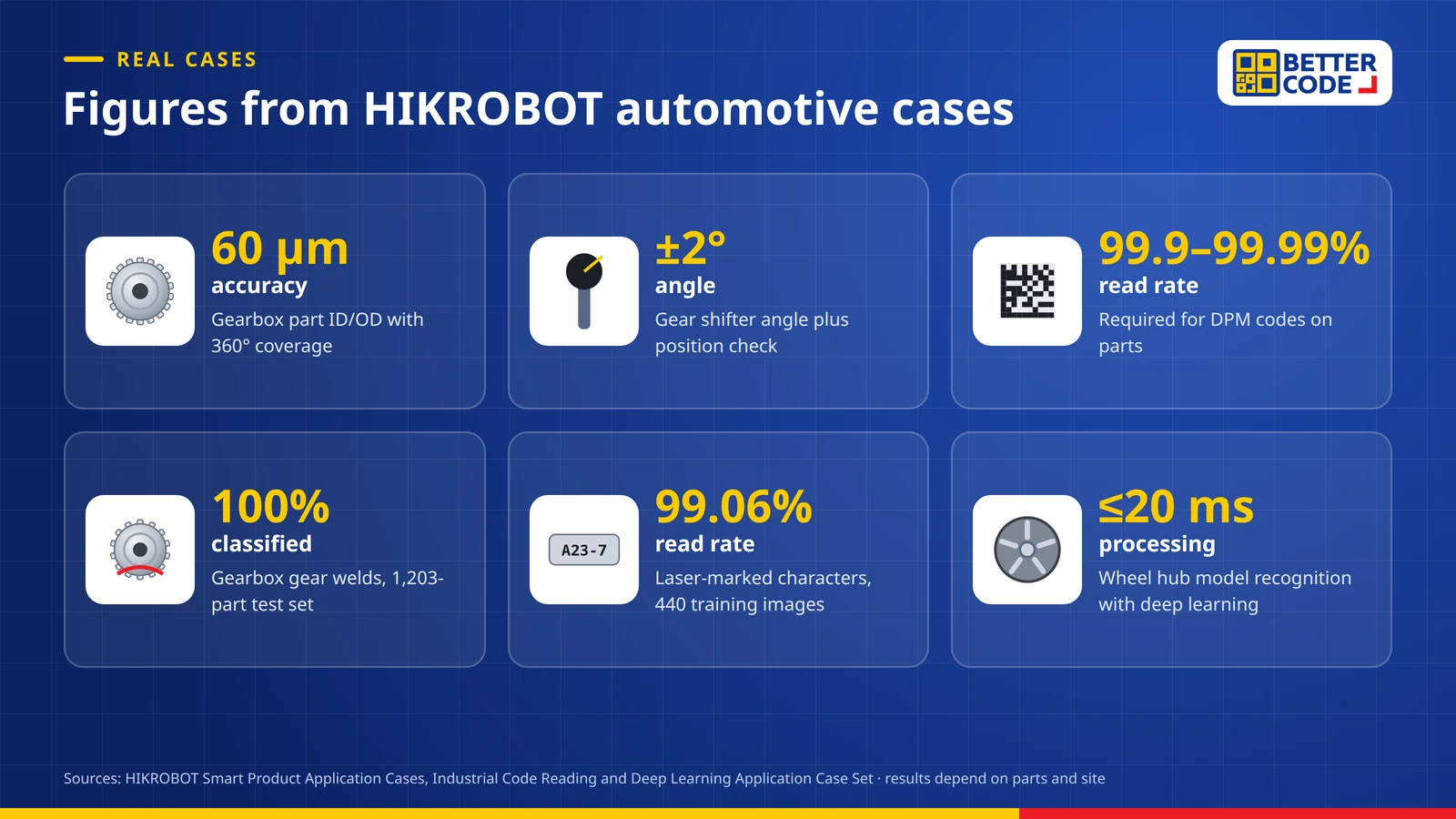
- Gearbox child part: tooth size variation, tooth dents, inner thread defects and burrs, plus ID/OD, height and width with 360° coverage to 60 microns
- Gear shifter: angle measured to ±2°, with presence and position checks
- DPM codes on vehicle parts: required read rate 99.9% or 99.99% despite oil and texture
- Gearbox gear welds: deep learning on a smart camera, 1,203-part test set, 100% correct
- Laser-marked characters on vehicle parts: worn surfaces and background interference, 440 training and 530 test images, 99.06% read rate, in production
- Wheel hubs: deep learning model recognition within 20 ms on GPU
- A/C radiators: customer required zero escapes and false rejects below 5%; a 261-sample test gave 1.15% escapes and 0.38% false rejects
Choosing a camera system for automotive work
| System | Best for automotive jobs |
|---|---|
| Code reader | DPM codes on metal parts and tyre barcodes for traceability |
| Smart camera | Assembly, position, angle and clear-cut defect checks, with results sent straight to the PLC |
| Industrial camera + PC | High-accuracy measurement, multi-camera 360° setups, or deep learning for defects and model sorting |
Information to prepare before a project
- Parts and inspection points: part photos, what to check, and OK/NG criteria or tolerances.
- Good and bad samples: every defect type and every model produced on the line.
- Part codes: code type, marking method (laser, engraving, inkjet), material and code size.
- Line data: cycle time per part, how parts are conveyed or held, and camera mounting space.
- Systems to connect: PLC, production data systems, and acceptable false reject and escape rates.
Summary
Automotive parts vision inspection cameras check assembly, measure dimensions and angles, find surface defects, read characters, read DPM codes for traceability and sort models on every part. The key challenges are reflective metal, oil, 360° coverage and high accuracy, so camera, lighting and analysis must match the job. Better Code, the official HIKROBOT distributor in Thailand, tests with your real parts, installs, connects to your PLC and provides after-sales support.
Frequently asked questions about automotive vision inspection
What can automotive inspection cameras check?
Assembly and position, dimensions and angles, surface defects, characters, DPM codes for traceability and part models. HIKROBOT cases include gear knob numbers, gearbox part measurement and code reading on pistons and crankshafts.
What is DPM and why does automotive need it?
DPM (direct part marking) is a code applied directly to the part by laser, engraving or inkjet, identifying each component throughout its life. Automotive plants use it to trace problems back to the source. HIKROBOT documents state that such applications require read rates of 99.9% or 99.99%.
Can cameras read codes on oily metal parts?
Yes, with code readers that support DPM on multiple materials, lighting suited to metal surfaces and auto exposure. HIKROBOT documents list oil, surface texture, quiet zone issues and distorted codes as interference to handle. Always test with real parts.
How accurately can cameras measure automotive parts?
It depends on camera, lens, lighting and field of view. In HIKROBOT cases, gearbox parts were measured to 60 microns and gear shifter angles to ±2°. Test repeatability with real parts before installation.
Can parts be inspected all around (360°)?
Yes, using several cameras around the part or rotating it past the camera. The gearbox part and surface-defect-with-holes cases in HIKROBOT documents name 360° coverage as a key challenge to design for from the start.
Can cameras read barcodes on tyres?
Yes. In a HIKROBOT case, long, slender 1D barcodes placed randomly inside tyres of different sizes were read with a high-resolution code reader covering a wide field of view to reduce camera count, decoding reliably despite tread stripes.
Where can I buy HIKROBOT automotive inspection cameras in Thailand?
Contact Better Code (Better Code Co., Ltd.), the official HIKROBOT distributor in Thailand, via LINE @bettercode or +66 2-170-9611. The team tests with your real parts, selects cameras, code readers and lighting, and handles installation and after-sales support.
Sources
- HIKROBOT – Smart Product Application Cases (Dec 2021): automobile and mechanical industry, including gear knob, tyre OCR, gear plate and rod surfaces, gearbox child part, surface defects with holes, chain assembly, gear cut marks, speedometer metal part and gear shifter angle
- HIKROBOT – Industrial Code Reading (2020): auto component industry DPM codes on metal parts and tyre production barcodes
- HIKROBOT – Deep Learning Application Case Set (2021): A/C radiator defects, gearbox gear welds, wheel hub recognition and automotive part OCR
Want every automotive part inspected by camera?
Send photos of your parts, the points to check or the codes to read. The Better Code team will test HIKROBOT cameras and code readers with your real parts and recommend the right system for your line.