Date Coding on Different Materials: Paper, Plastic, Film, Glass and Metal
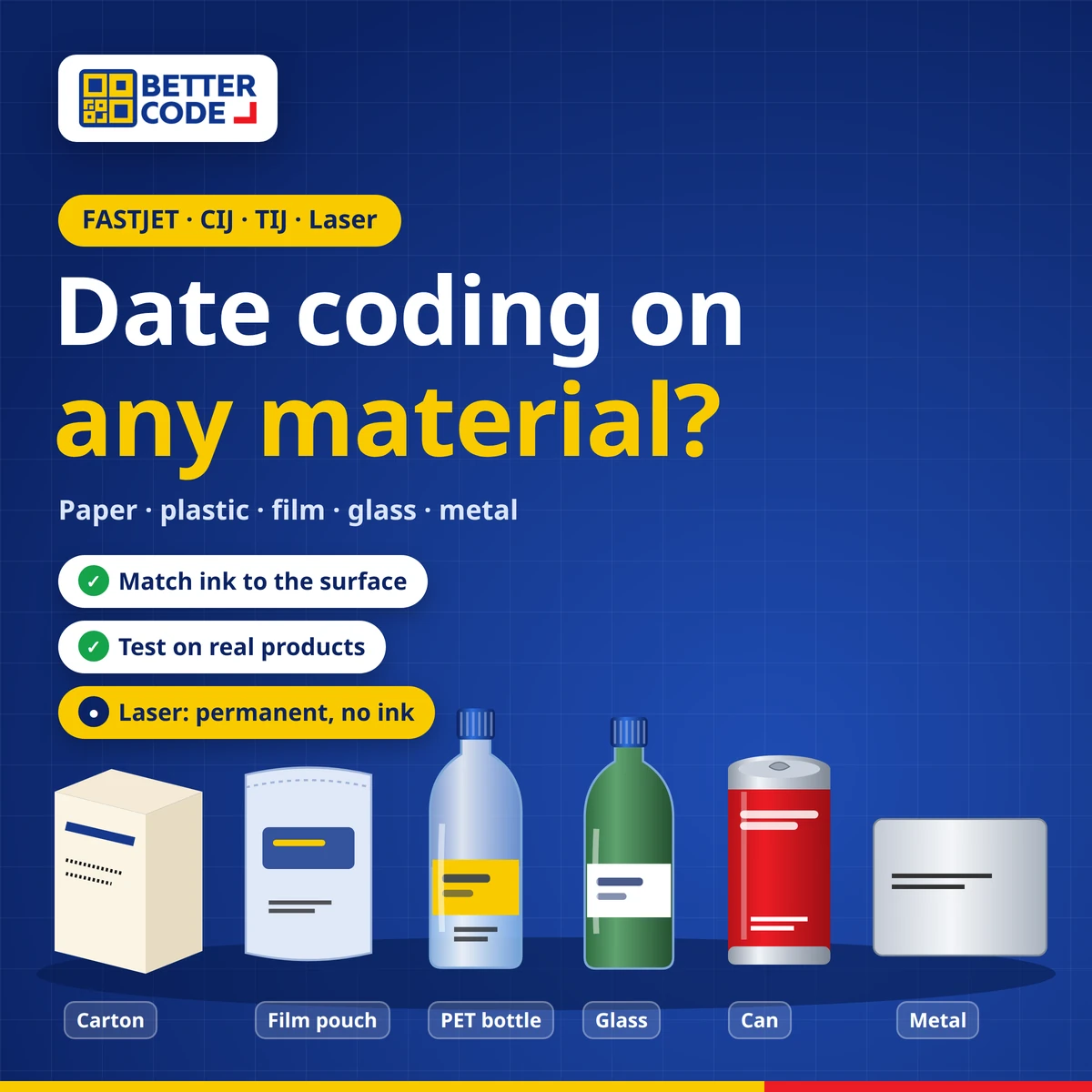
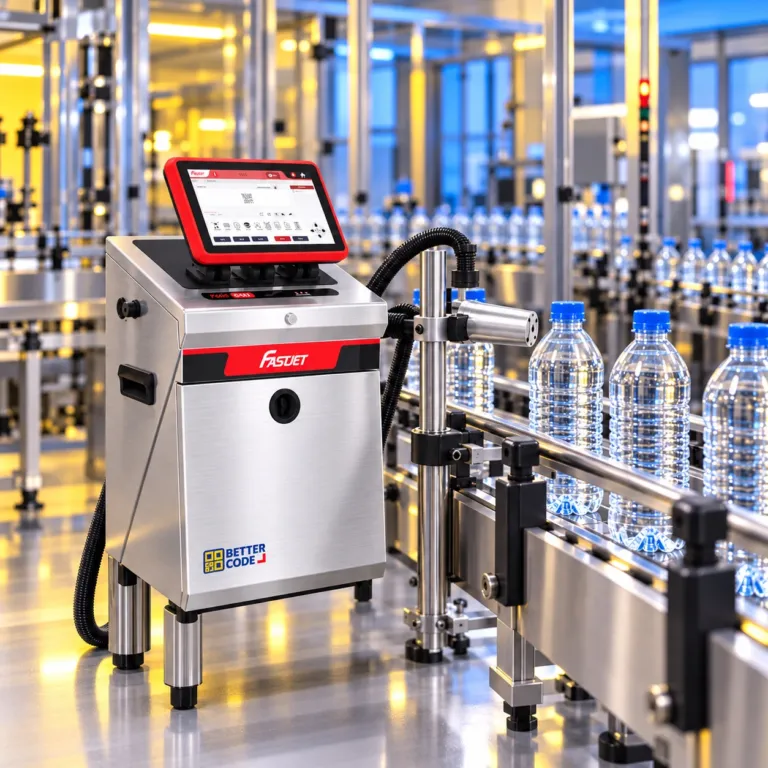
Date coders can print on almost every packaging material: paper and corrugated cartons, coated cartons, labels, plastic film and pouches, PET bottles, glass, and metal or cans. The key is matching the technology and ink to the surface. As a rule of thumb, uncoated paper and cartons can be coded by TIJ, CIJ or handheld printers, while plastics, film, PET and metal usually use CIJ with inks that adhere to PVC, PE, PET and metal, or a laser when you want permanent, ink-free codes (CO2 for non-metals such as coated paper and PET, UV for plastics, fiber for metals). Always test on real products before choosing a coder.
Why does the material matter when choosing a date coder?
Manufacturing dates, expiry dates and lot numbers must stay on, stay readable and survive transport. Each surface takes ink differently. Uncoated paper absorbs ink, so codes dry fast and stick easily. Film, plastic, glass and metal are non-porous, so the ink has to bond to the surface itself, which means choosing the right ink. The wrong combination can rub off, lift with moisture, or not dry before the product reaches packing.
Choosing a date coder by material
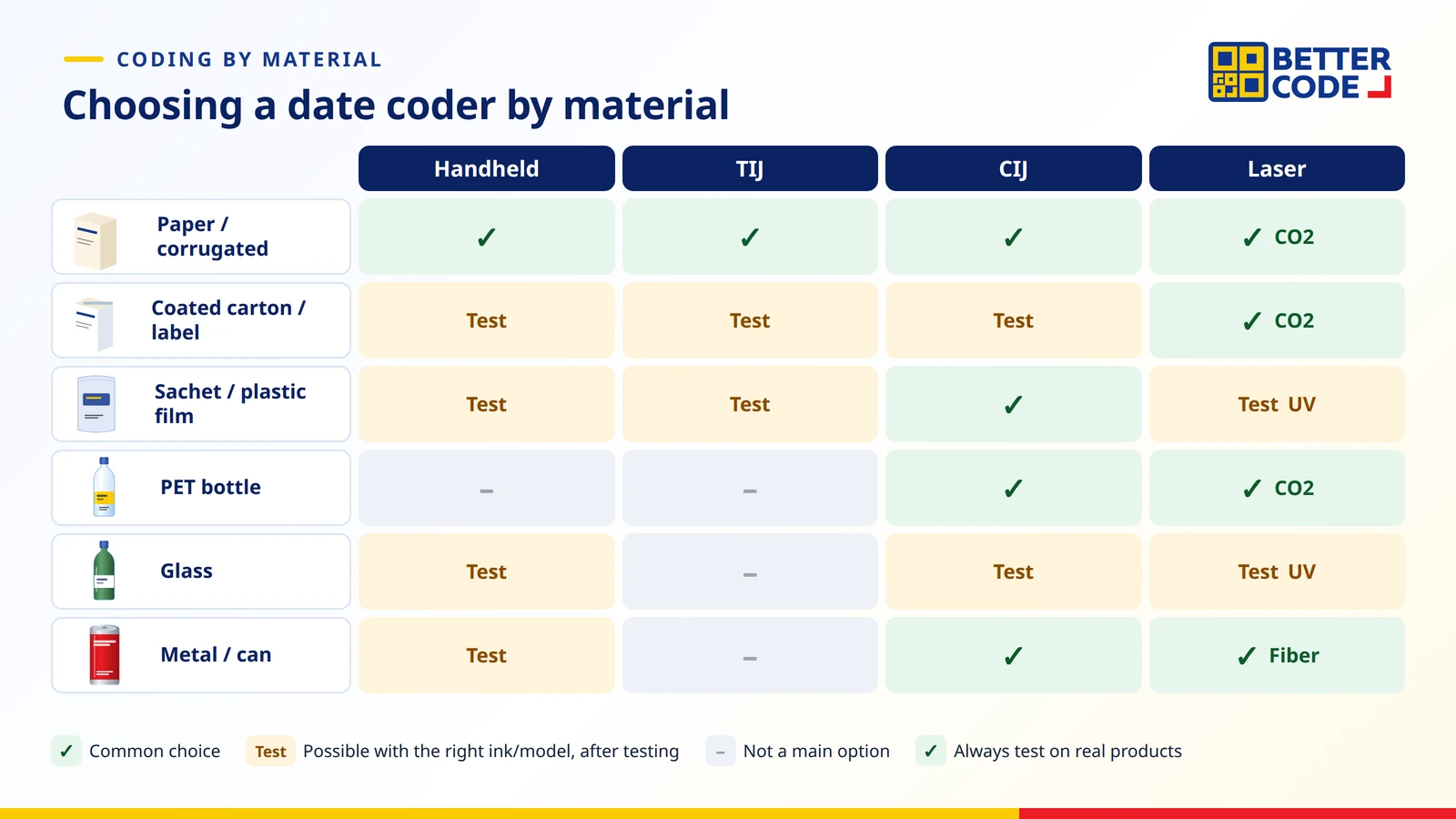
| Material | Common technologies | What to check |
|---|---|---|
| Paper, corrugated cartons, paper labels (uncoated) | TIJ, CIJ, S510 handheld · CO2 laser also works on paper | How absorbent the paper is, carton flatness and head distance. See CIJ or TIJ for cartons |
| Coated cartons and labels | TIJ or CIJ with ink matched to the coating · CO2 laser F7142C (10.2 µm) suits coated paper cartons | Coatings do not absorb ink, so test drying time and adhesion |
| Sachets, film and plastic bags | CIJ (inks for PVC, PE, PET) · TIJ with suitable ink · UV laser for many plastics | Film type and coating, drying time, rub resistance. See TIJ F3500 for cartons and film |
| PET bottles | CIJ · CO2 laser F7143C (9.3 µm) for PET beverage bottles | Curved surfaces, condensation and line speed. See ink adhesion on PET bottles |
| Glass bottles and jars | CIJ (check surface and moisture) · handheld with ink for glass · UV laser case by case | Smooth surfaces and moisture from washing or cold filling; test adhesion |
| Metal, cans, aluminium | CIJ (inks that adhere to metal) · handheld with ink for metal · F7100F fiber laser for aluminium, steel and metal packaging | Oil or coatings on the surface; printing on the base or lid. See laser coding on PET bottles and cans |
| Plastic bottle caps | CIJ or laser | Small area, curved surface, cap colour. See bottle cap date coding |
Material information comes from FASTJET brochures and model pages. For example, the CIJ F640/F650 brochures list multiple dye-based inks with adhesion on PVC, PE, PET and metal, and the F7100U UV laser lists PE, PVC, PP, PS, POM, PC, acrylic, nylon, metals, MDF wood and glass (subject to job size and complexity). Real results still depend on the material formula, colour and coating, so always test first.
Five surface factors to check before choosing
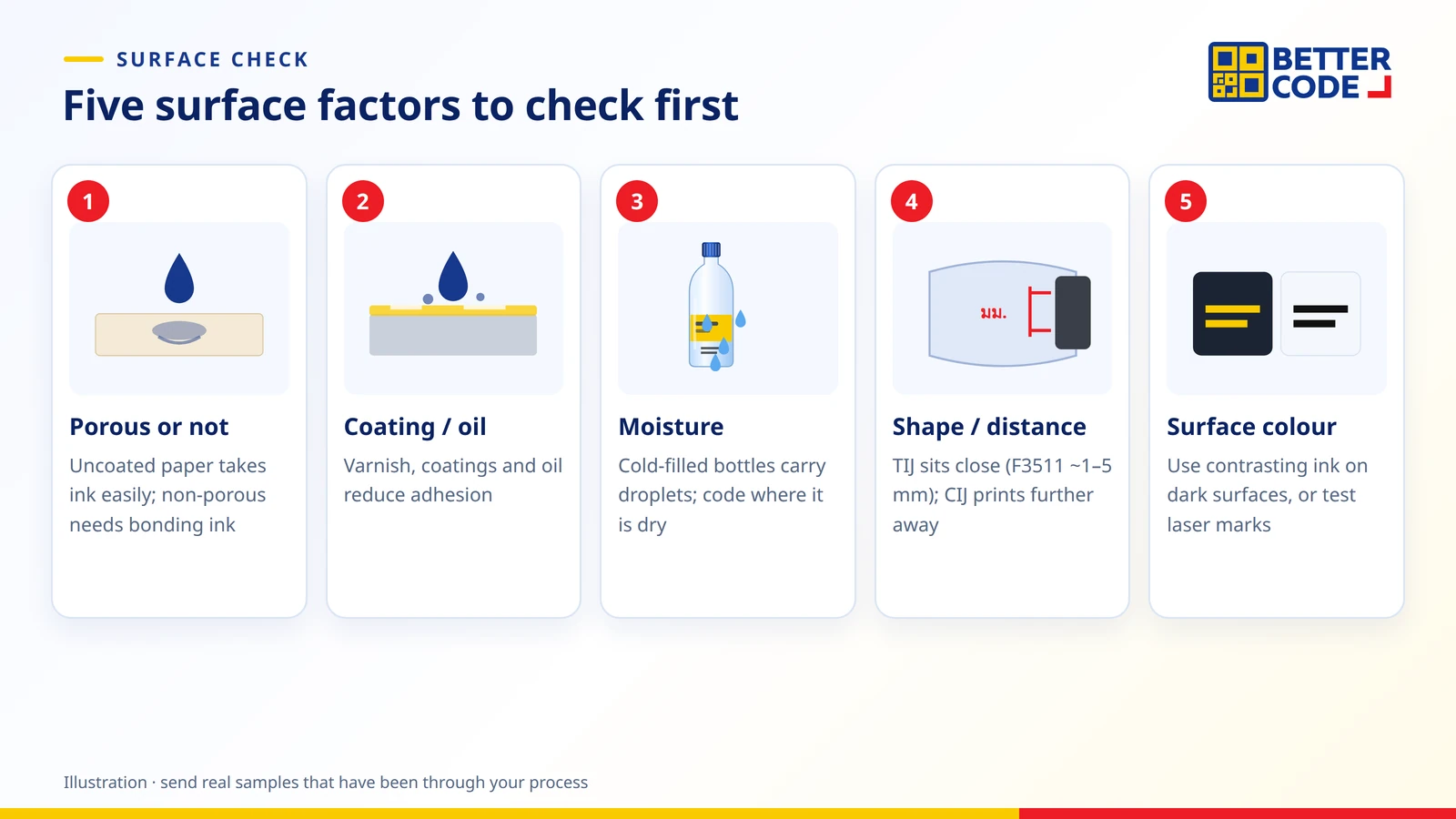
- Porous or not: uncoated paper accepts many inks; non-porous surfaces need ink that bonds to the surface and dries in time for the line.
- Coatings, oil or dust: varnish, coatings and oil films on metal reduce adhesion; test on surfaces that have gone through your real process.
- Moisture and condensation: cold-filled or washed bottles often carry droplets that stop ink sticking; place the coder where the surface is dry or add air drying.
- Shape and head distance: TIJ prints sharpest close to the surface (F3511: about 1 mm ideal, up to 5 mm), so it suits flat surfaces, while CIJ prints from further away and suits curved items and variable distances.
- Surface colour: dark surfaces need a contrasting ink colour, or a test to confirm the laser mark is readable on that material.
Extra checks for food, pharmaceutical and cosmetic packaging
When the code is on packaging close to or in contact with food, review the ink documentation and your customer or buyer requirements, not just whether the code sticks. Read choosing date coding inks for food packaging and where to print the expiry date on packaging.
How to test printing on your real material
- Send real samples that have gone through the same process as production, such as cold-filled bottles or finished coated cartons.
- Print the real message: dates, lot numbers, barcodes or QR codes at the size you will use.
- Check drying time, adhesion and rub resistance against your QC criteria and storage conditions, such as cold rooms or transport.
- Test at real line speed with the actual head position. See conveyor date coding installation.
Related: Inkjet date coders: CIJ, TIJ and handheld types compared
Related: CO2 vs fiber vs UV laser date coders
Summary
Date coders can print on paper, coated cartons, film, plastic, PET, glass and metal, but the technology and ink must match the surface. Uncoated paper and cartons give you the widest choice; non-porous surfaces usually use CIJ with an ink made for that material, or a laser for permanent ink-free codes. Check the five surface factors, then test on real products at line speed before deciding.
Frequently asked questions about date coding on different materials
What materials can a date coder print on?
Paper, corrugated and coated cartons, labels, plastic film and pouches, PET bottles, glass and metal. Choose the technology (TIJ, CIJ, handheld or laser) and ink to match the surface, then test on real products.
Which date coder is best for plastic bags or film?
CIJ with inks that adhere to plastics such as PE, PVC and PET is common, or TIJ with an ink suited to that film. Test drying time and rub resistance, because each film type and coating behaves differently.
Can you print expiry dates on glass bottles?
Yes, with CIJ or a handheld printer using ink suited to glass, while checking for moisture on the bottle. The UV laser lists glass as a possible substrate, but it must be tested case by case.
What is used to code cans or metal?
CIJ with inks that adhere to metal, a handheld coder with ink for metal, or a fiber laser such as the FASTJET F7100F for aluminium, steel and metal packaging. Surfaces with oil or coatings must be tested first.
Why does my date code rub off?
Common causes are ink that does not suit the surface, moisture, oil or coatings on the surface, codes rubbed before they dry, or the wrong head distance. Check each factor and test on real products.
Is there an option that uses no ink?
Yes. Lasers mark the code into the material without ink: CO2 for non-metals such as coated paper and PET, UV 355 nm for plastics and fine work, and fiber 1064 nm for metals.
What should I prepare for a print test with Better Code?
Real samples or product photos, the material type, the message to print, line speed and the print position. Our team will help choose the technology and ink and run a test before you decide.
Sources
- FASTJET – F640 / F650 Series Continuous Inkjet Printer brochures (dye-based inks for PVC, PE, PET and metal)
- FASTJET – F7100U Series Laser Marking Machine brochure (substrates) and F7100C / F7100F model information
- FASTJET – F3500 Series model information (F3511 print distance) and F3500 Series user manual
Not sure which coder suits your material?
Send photos or real samples, the material type, the message to print and your line speed. Better Code, the official FASTJET distributor in Thailand, will help you choose the technology and ink and test-print before you decide.