Industrial Laser Coding Machine Guide (CO2 vs UV vs Fiber Laser): Choosing 10.6µm, 9.3µm, 355nm & 1064nm Wavelengths for PET Bottles, Flexible Film & Metal Cans
How Do CO2, UV, and Fiber Laser Coding Machines Differ by Wavelength—and Why Do Thin PET Bottles Require 9.3µm CO2, PE/PP Films Require 355nm UV, and Metal Cans Require 1064nm Fiber Lasers?
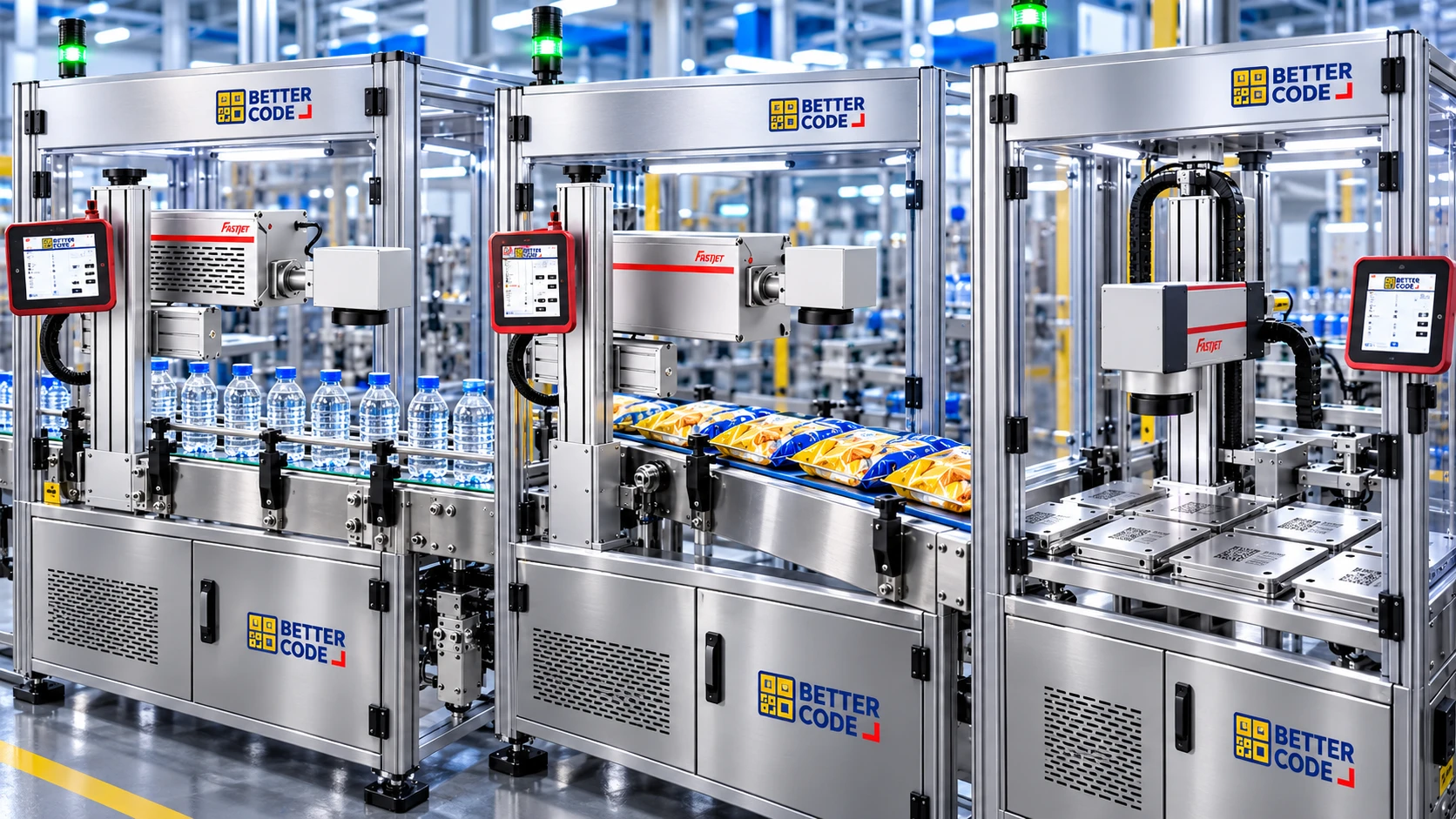
Industrial Laser Coding Machines (FASTJET F7100 Series) match specific optical wavelengths to packaging substrates with zero ink consumables: 9.3µm CO2 hits the absorption peak of thin clear PET bottles to create frosted white marks without perforation; 10.6µm CO2 marks paperboard and glass; 355nm UV (Cold Marking) photochemically marks PE/PP film without burning barrier layers; and 1064nm Fiber engraves metal cans with Better Code Co., Ltd.
4-Wavelength Engineering Comparison: CO2 (10.6µm) vs PET CO2 (9.3µm) vs UV Laser (355nm) vs Fiber Laser (1064nm)
The most costly mistake when specifying an industrial laser coding machine (Laser Marking Machine) is assuming a single laser source can mark every packaging substrate. In optical physics, polymers, glass, paperboard, and metals exhibit vastly different wavelength absorption spectra. The engineering matrix below compares all 4 core wavelengths in the FASTJET F7100 Series lineup:
| Engineering Criterion | 1. Standard CO2 Laser (10.6µm) | 2. Dedicated PET CO2 Laser (9.3µm) | 3. Cold-Marking UV Laser (355nm) | 4. Fiber Laser (1064nm) |
|---|---|---|---|---|
| 1. Optical Wavelength & Marking Physics | 10.6µm (10,600 nm · Far-Infrared) Thermal ink layer ablation on printed board or micro-surface etching on glass/wood | 9.3µm (9,300 nm · Dedicated PET Band) Matches PET’s C–O–C ester bond absorption peak to create surface micro-frosting without wall penetration | 355nm (Ultraviolet · Cold Marking) High-energy UV photons induce photochemical pigment color change (TiO₂ photoreduction) with minimal heat | 1064nm (Near-Infrared) High peak power density for metal engraving, surface oxide annealing, or coating/anodize ablation |
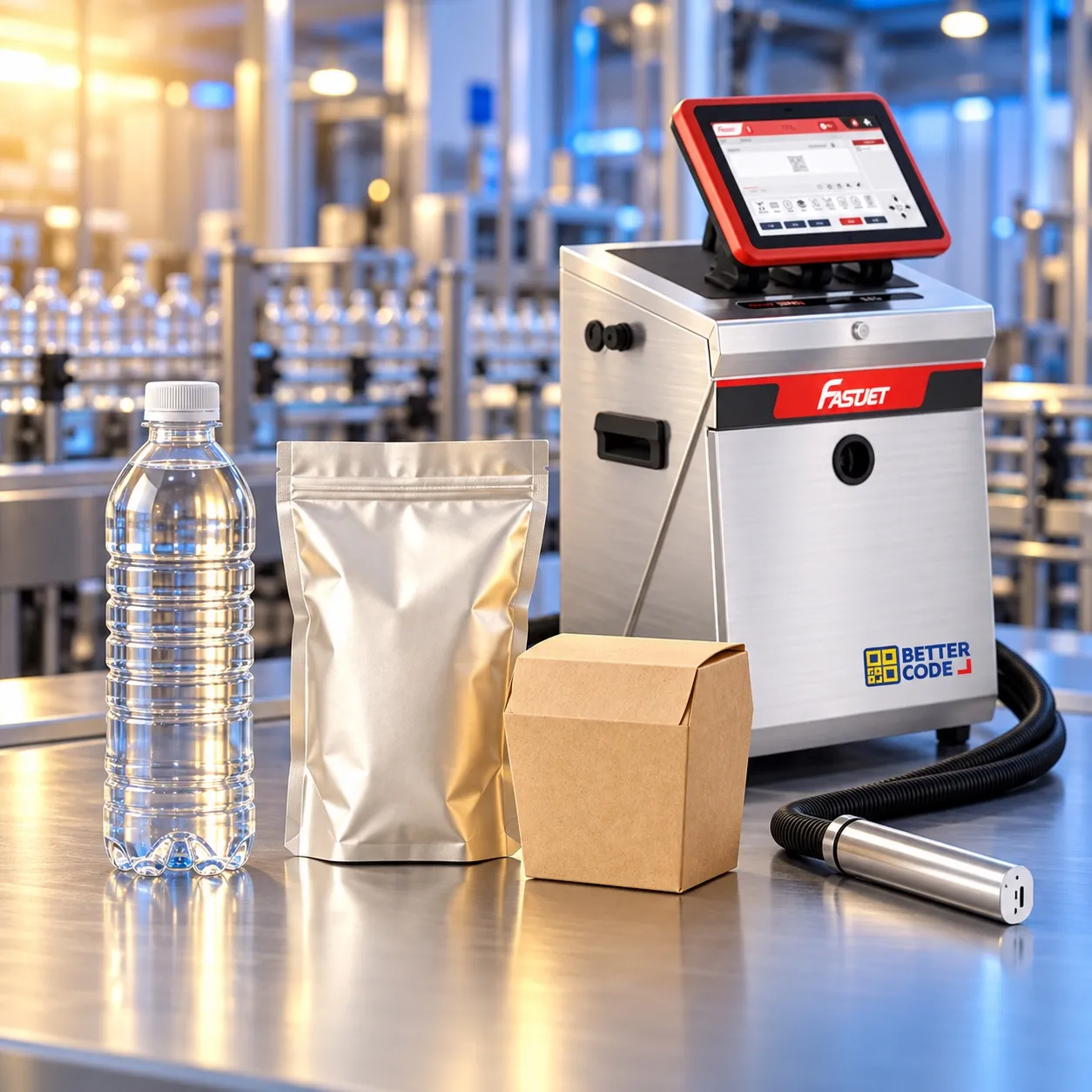
| 2. Best-Fit Packaging Substrates | Color-printed paperboard cartons (pharma/cosmetic boxes), paper labels, glass bottles, wood, and rubber | Clear thin-wall PET water & beverage bottles, carbonated soft drink PET bottles, clear PET thermoformed trays | Flexible PE, PP, BOPP & HDPE films, laminated retort pouches, HDPE/PP bottle caps, cosmetic jars, and wire jacketing | Aluminum beverage cans, metal closures, tinplate cans, stainless steel & automotive parts, heavy aluminum foil, dark ABS/PC plastics |
| 3. Substrates to Avoid (Risk of Pinhole or Burn) | Avoid on thin clear PET bottles (beam penetrates wall and risks pinholes/leaks!) and bare metals (reflects 10.6µm) | Not suited for bare metals or unpigmented PE/PP films requiring dark contrast marks (use 355nm UV instead) | Not cost-effective for deep metal engraving (use 1064nm Fiber for dedicated metal lines) | Avoid on clear PET bottles, clear glass, or transparent films (1064nm passes straight through or burns film) |
| 4. Visual Mark Appearance | High-contrast white paper substrate revealed under dark printed carton ink, or frosted etching on glass | Crisp frosted white surface mark on clear PET bottles with 100% structural burst-pressure integrity preserved | Razor-sharp dark black/charcoal mark on white/light PE/PP films and caps, with smooth unbroken surface texture | Permanent white, silver, or dark annealed mark on metal cans and parts; ideal for high-density 2D DPM Data Matrix codes |
| 5. Recommended Output Wattage | 20W / 30W / 50W (30W–50W recommended for high-speed cartoners and glass bottling lines) | 30W / 40W / 50W (30W–40W ideal for 200–600+ BPM beverage filling lines) | 3W / 5W / 10W (5W UV delivers rapid photochemical marking on PE/PP pouches and closures) | 20W / 30W / 50W (30W–50W for high-speed aluminum can lines and industrial metal marking) |
| 6. Recommended FASTJET F7100 Series Model | FASTJET F7120C (20W) / F7130C (30W) CO2 Laser Marking Machine | FASTJET F7143C (9.3µm PET Laser) with optional IP65 beverage enclosure | FASTJET F7100U Series (3W / 5W / 10W) UV Cold Laser Marking Machine | FASTJET F7100F Series (20W / 30W / 50W) Fiber Laser Marking Machine |
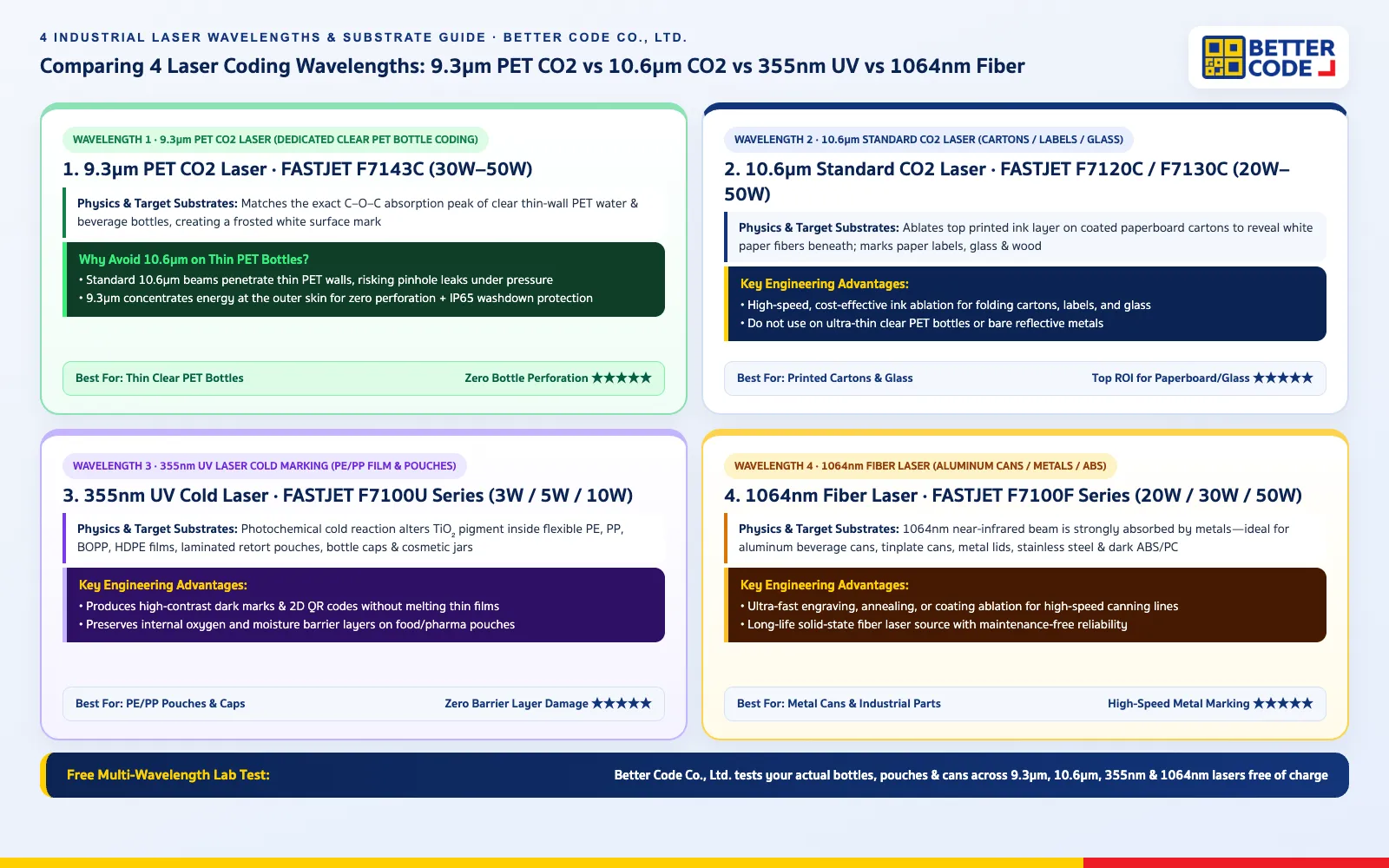
Engineering Deep Dive: Why Thin Clear PET Bottles Require 9.3µm CO2 (FASTJET F7143C) and Flexible PE/PP Films Require 355nm UV Cold Marking
In beverage, food, and flexible packaging plants, the two most unforgiving substrates for laser date coding are (1) ultra-thin clear PET water bottles and (2) multi-layer flexible PE/PP/retort pouches. Specifying the wrong wavelength leads directly to leaking bottles or compromised oxygen barriers. Here is the optical engineering behind both solutions:
Why Standard 10.6µm CO2 Lasers Perforate Thin PET Bottles—and How 9.3µm Solves It
Modern lightweight PET water bottles feature wall thicknesses as thin as 0.15–0.25 mm. At the standard 10.6µm wavelength, PET exhibits low absorption—allowing infrared energy to penetrate deep into the wall and melt micro-pinholes that cause leaks during pallet stacking.
At 9.3µm (FASTJET F7143C PET Laser), the beam hits the exact C–O–C ester bond absorption peak of PET. Over 90% of the optical energy is absorbed within the outermost few microns of the bottle skin, generating a crisp frosted white micro-foam mark while leaving structural wall thickness intact.
Why Flexible PE / PP / BOPP Films & Retort Pouches Require 355nm UV Lasers
Flexible polyolefin packaging (PE, PP, HDPE) and multi-layer laminated pouches cannot tolerate thermal infrared lasers, which melt thin films and compromise internal oxygen/moisture barrier layers.
A 355nm UV Laser (FASTJET F7100U Series) operates via Photochemical Cold Marking. High-energy 355nm ultraviolet photons directly alter pigment molecules (such as Titanium Dioxide, TiO₂) inside the polymer matrix—turning white or colored PE/PP film and bottle caps dark black with virtually zero thermal heat transfer.
When to Choose a Zero-Ink Laser vs a CIJ Continuous Inkjet Date Coder
While zero-ink laser coding machines eliminate all ink consumables and deliver 100% permanent marks, lines that switch hourly between radically different substrates (e.g., clear PE bags without a printed color window, dark glass bottles, and metal tins on the same conveyor) may benefit from the universal flexibility of a FASTJET CIJ Inkjet Coder paired with specialized inks from our Date Coder Ink Selection & Adhesion Guide.
For dedicated medium-to-high volume lines, however, laser coding eliminates ongoing ink and make-up solvent budgets completely.
Illustrative TCO Comparison Example (ตัวอย่างจำลองการเปรียบเทียบโครงสร้างต้นทุนระยะยาว: Laser Coding vs Ink/Consumable Coders)
The table below provides an Illustrative TCO Comparison Example (ตัวอย่างจำลองการเปรียบเทียบโครงสร้างต้นทุนระยะยาว) comparing a zero-ink FASTJET Laser Coding Machine against consumable-based date coders over a multi-year operating horizon (see full formulas in our CIJ vs TIJ vs Laser Cost-Per-Print Calculator):
| Cost Structure Category (Illustrative TCO Item) | Zero-Ink Laser Coding Machine (FASTJET CO2 / UV / Fiber) | Continuous Inkjet Date Coder (CIJ) | Cartridge / Ribbon Coder (TIJ / TTO) |
|---|---|---|---|
| 1. Ongoing Ink, Make-Up Solvent & Ribbon Consumables | Zero Consumables (0 THB/yr)—requires no ink, no make-up solvent, and no thermal ribbons over its service life | Requires ongoing ink + make-up solvent replenishment (evaporative + print consumption) and scheduled filter kits | Requires 42 ml ink cartridges (TIJ) or thermal transfer ribbons (TTO) proportional to print volume |
| 2. Daily Operator Maintenance & Line Uptime | Zero nozzle flushing or fluid refilling; periodic lens wipe and HEPA/carbon fume extractor filter replacement only | Automated nozzle flush with periodic printhead cleaning and fluid level monitoring | Zero maintenance snap-in cartridges (TIJ) or periodic roll-change stops to reload ribbons (TTO) |
| 3. Mark Permanence & Tamper Resistance | 100% permanent & indelible—cannot be wiped off with alcohol, solvents, oil, or abrasion; prevents date tampering | Fast-drying adhesion across all surfaces, though removable with specific industrial solvents | High optical resolution; rub and chemical resistance depend on ink/ribbon formulation |
| 4. Chemical Handling, Cleanroom Air & ESG Impact | Zero VOC solvent evaporation; eliminates flammable fluid storage when paired with a HEPA + Carbon Fume Extractor | Requires storage and handling of volatile solvent inks and make-up fluids | Clean operation without bulk fluid tanks, generating spent cartridges or ribbon cores |
5 Essential Engineering Components of an Inline Flying Laser Marking System
Marking products moving at hundreds of units per minute on a conveyor (Flying Laser Marking) is far more demanding than static benchtop engraving. The laser controller must apply real-time vector speed compensation while maintaining optical focus, operator safety, and cleanroom air quality. Here are the 5 essential components engineered by Better Code Co., Ltd.:
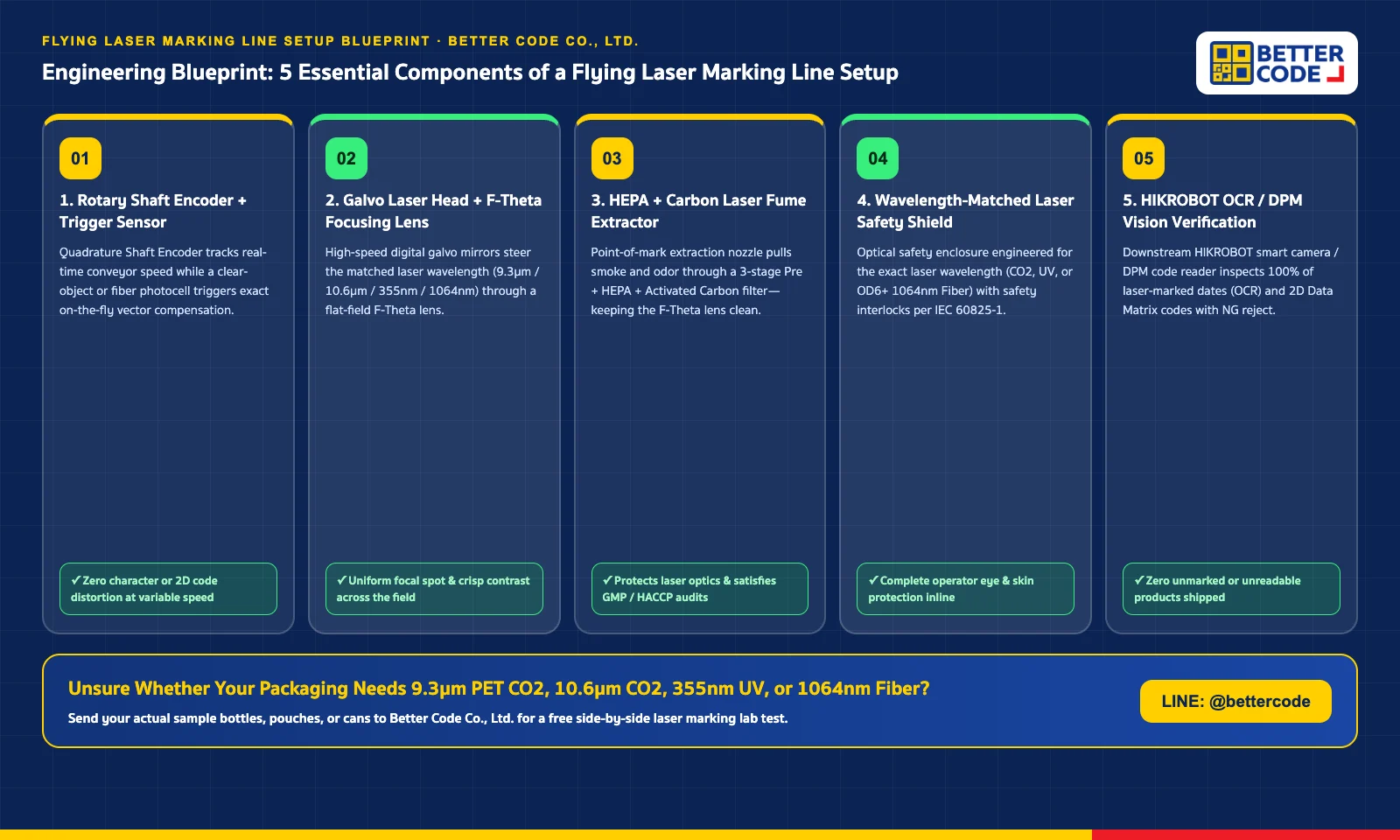
Component 1: High-Speed Digital Galvo Scanner & Flat-Field F-Theta Focusing Lens
Inside every FASTJET F7100 Series laser head, dual-axis digital galvanometer mirrors steer the laser beam at thousands of characters per second through a precision F-Theta Flat-Field Focusing Lens. The F-Theta lens ensures a uniform focal spot across the entire marking window (e.g., 100×100 mm). Because laser energy density peaks sharply at the exact focal plane, Better Code engineers install rigid side guide rails to hold bottles, pouches, or cans precisely at the lens’s working distance.
Component 2: Real-Time Conveyor Speed Synchronization via Rotary Shaft Encoder & Trigger Sensors
When marking products moving at 60 to 600+ units per minute, any conveyor speed fluctuation without encoder feedback causes characters to slant, stretch, or overlap. We integrate a quadrature Rotary Shaft Encoder alongside substrate-specific trigger sensors (such as clear-object retroreflective photocells for transparent PET bottles or high-speed fiber sensors for foil pouches) so the FPGA laser controller computes real-time vector speed compensation.
Component 3: 3-Stage HEPA & Activated Carbon Industrial Laser Fume Extractor (GMP / HACCP)
Laser ablation of carton ink, polymer skin, or metal lacquer releases microscopic particulate smoke and volatile odors. Left uncollected, laser plume condenses onto the F-Theta lens—attenuating beam power and overheating optics—while contaminating plant air. Integrating a dedicated Industrial Laser Fume Extractor (Pre-Filter + 99.97% HEPA filter + Activated Carbon bed) positioned right at the marking zone protects optical lenses and satisfies strict food & pharma GMP / HACCP audits.
Component 4: Wavelength-Matched Laser Safety Enclosure & HIKROBOT DPM Vision Verification
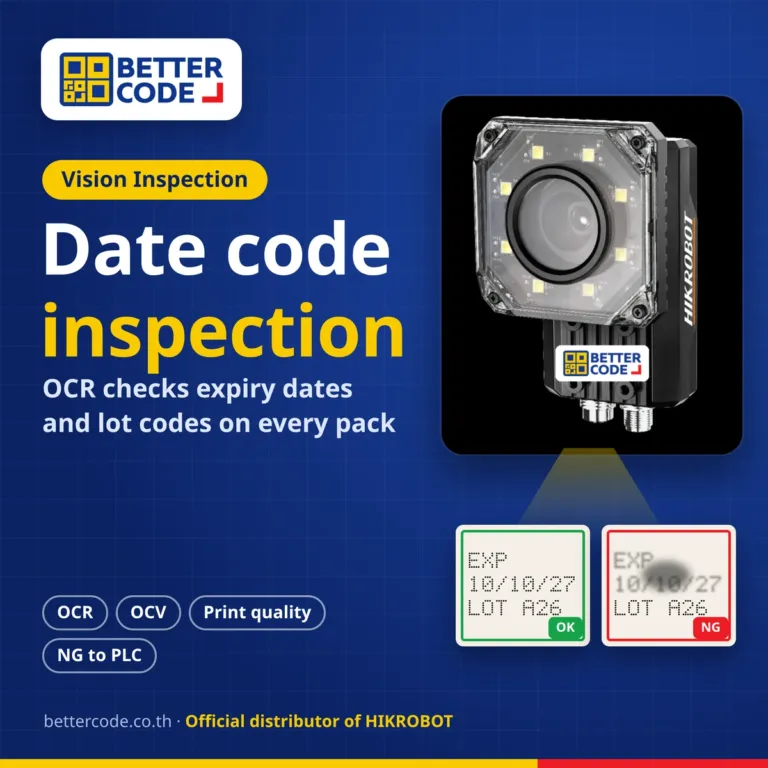
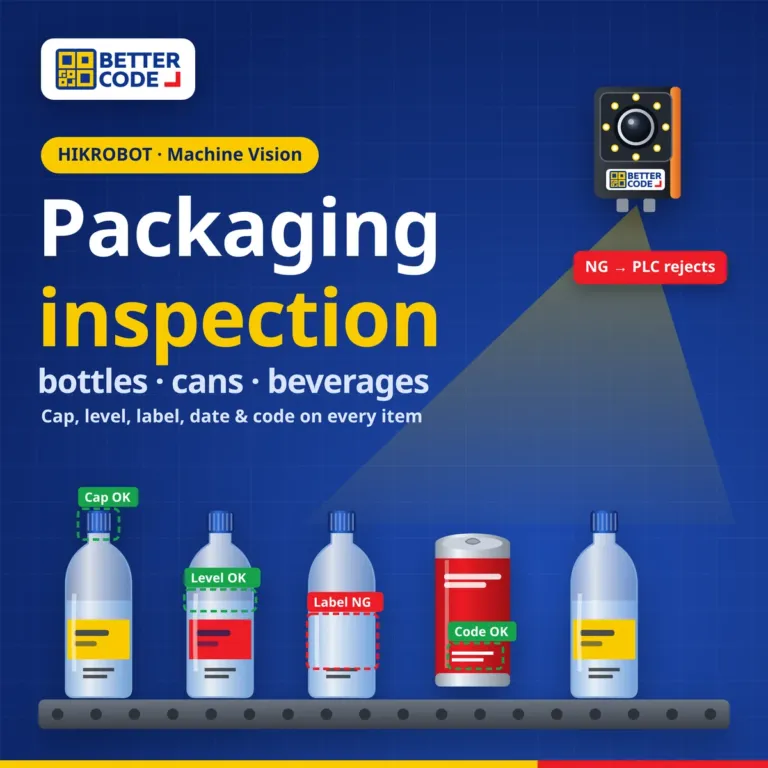
To protect line operators in accordance with IEC 60825-1 laser safety standards, we fabricate a custom Laser Safety Enclosure / Shield using optical-grade acrylic or polycarbonate rated for the specific wavelength (10.6µm/9.3µm CO2, 355nm UV, or OD6+ 1064nm Fiber). Downstream of the shield, we integrate HIKROBOT Machine Vision & DPM Code Readers to verify 100% of laser-marked dates (OCR) and 2D Data Matrix codes inline.
Component 5: Free Sample Laser Marking Lab Test at Better Code Co., Ltd. Before You Invest
Two plastic pouches or PET bottles that look identical to the naked eye can react very differently under a laser beam due to variations in masterbatch pigments, rPET content, wall thickness, or overprint varnish. Never buy an industrial laser coder based on datasheet claims alone! Better Code Co., Ltd. provides complimentary sample testing in our engineering lab across all 4 wavelengths (10.6µm CO2, 9.3µm PET CO2, 355nm UV, and 1064nm Fiber)—returning your marked samples, cycle-time data, and video proof before you commit.
6-Point Checklist to Request a Free Sample Laser Marking Lab Test from Better Code Co., Ltd.
Want to compare actual mark contrast across 10.6µm CO2, 9.3µm PET CO2, 355nm UV, and 1064nm Fiber lasers on your own bottles, pouches, cartons, or cans? Ship us your sample packaging along with these 6 details via LINE @bettercode or our Request a Quote page:
Clear thin-wall PET bottle, PE/PP/HDPE pouch, laminated foil, color-coated paperboard carton, or metal can? Is the target zone clear, white, or dark-ink printed?
Specify the number of lines (e.g., 2–3 lines of MFG/EXP/Lot at 2–3 mm height) and whether dynamic 2D QR or Data Matrix codes are required.
Share your line speed (m/min) and output rate (e.g., 120 BPM or 400 pouches/min) so our engineers can size laser wattage (5W / 20W / 30W / 50W) accurately.
Will the laser mark products moving continuously on a conveyor (Flying Marking) or during the dwell cycle of a VFFS bagger / thermoformer?
Does your line require an IP65 washdown-rated cabinet for wet beverage filling or a HEPA + Activated Carbon Fume Extractor for GMP/HACCP cleanrooms?
Specify if you need an inline HIKROBOT smart camera or DPM code reader to verify 100% of laser marks and trigger automated NG rejection.
Frequently Asked Questions: CO2, UV & Fiber Industrial Laser Coding Machines (FAQ)
How does an industrial laser coding machine differ from CIJ or TIJ inkjet date printers?
An industrial laser coding machine (Laser Marking Machine) is a zero-ink coding system that steers a focused laser beam via a high-speed digital galvo scanner to create permanent, tamper-proof date, lot, and 2D codes directly on packaging surfaces. Unlike CIJ or TIJ inkjet printers, laser coders require zero ink or make-up solvent consumables over their entire operating life.
Why can’t standard 10.6µm CO2 lasers mark thin clear PET water bottles without risking leaks, and why is 9.3µm required?
Thin-walled clear PET (Polyethylene Terephthalate) has poor optical absorption at the standard 10.6µm wavelength—causing the laser beam to transmit through the wall and melt pinholes along the character stroke. At 9.3µm, however, PET exhibits a sharp molecular absorption peak. The FASTJET F7143C (9.3µm PET CO2 Laser) concentrates energy strictly at the outer skin to create a crisp, frosted white mark without penetrating the bottle wall.
Why is a 355nm UV Laser (Cold Marking) recommended for PE, PP, BOPP flexible films and retort pouches?
Flexible polyolefin films (PE, PP, BOPP, HDPE) and laminated barrier pouches are highly sensitive to thermal damage from infrared CO2 lasers, which can warp film or compromise oxygen/moisture barrier layers. A 355nm UV Laser (FASTJET F7100U Series) relies on high-energy ultraviolet photons to break molecular bonds photochemically (“Cold Marking”)—creating high-contrast dark marks on white or colored PE/PP packaging with negligible heat-affected zones.
Which laser wavelength is required for aluminum beverage cans, metal lids, and stainless steel parts?
Bare and coated metals—including aluminum beverage can domes, tinplate food cans, metal closures, stainless steel components, and dense engineering plastics (ABS/PC)—require a 1064nm Fiber Laser (FASTJET F7100F Series, 20W / 30W / 50W). Metals reflect long-wave CO2 beams but absorb 1064nm near-infrared energy efficiently for high-speed engraving, annealing, or coating ablation.
Is an industrial Fume Extractor mandatory when installing a laser coding machine in GMP / HACCP food and pharma plants?
Yes. Laser interaction with plastics, varnished paperboard, or coated metals generates microscopic particulate fumes and volatile odors. Without extraction, residue coats the F-Theta focusing lens—attenuating laser power—and contaminates cleanroom air. Installing a 3-stage HEPA + Activated Carbon Fume Extractor alongside an acrylic Laser Safety Shield ensures full GMP/HACCP compliance and protects optical components.
Can we send our actual PET bottles, flexible pouches, or cans to Better Code Co., Ltd. for a free sample laser marking test?
Absolutely—100% free of charge. Because polymer additives, wall thickness, and ink coatings vary across suppliers, Better Code Co., Ltd. operates a full laser testing lab equipped with 10.6µm CO2, 9.3µm PET CO2, 355nm UV, and 1064nm Fiber lasers. Ship us your samples and we will return marked specimens, high-resolution photos, and exact cycle-time benchmarks.
Send Your Bottles, Pouches, or Cans for a Free Multi-Wavelength Laser Marking Test at Better Code Co., Ltd.
Whether your plant requires a FASTJET Industrial Laser Coding Machine (10.6µm CO2, 9.3µm PET CO2, 355nm UV, or 1064nm Fiber), wants to compare ROI against a FASTJET CIJ Inkjet Coder using our CIJ vs TIJ vs Laser Cost-Per-Print Calculator, or needs inline HIKROBOT DPM & OCR Vision Inspection, Better Code Co., Ltd. is ready to run free lab marking tests on your actual packaging.
Request Quote / Free Sample Laser Test ↗Explore FASTJET Laser Coding Machines ↗Explore HIKROBOT Vision Systems ↗Send Packaging Photos on LINE @bettercode ↗Engineering References & Industrial Laser Standards
- Technical specifications for FASTJET F7100 Series Industrial Laser Marking Systems: F7120C/F7130C (10.6µm CO2), F7143C (9.3µm PET CO2), F7100U (355nm UV Cold Marking), and F7100F (1064nm Fiber Laser): Industrial Coding Engineering Division, Better Code Co., Ltd.
- IEC 60825-1 Safety of Laser Products standard for industrial enclosures and ISO/IEC 29158 (AIM DPM) Direct Part Mark quality verification using HIKROBOT industrial vision systems.