Drinking Water Bottle & High-Speed Beverage Date Coding Guide: Condensation-Resistant CIJ Inkjet vs 9.3µm CO2 Laser for PET Bottles, Caps & Cans
How Should Drinking Water and Beverage Factories Choose Between Condensation-Resistant CIJ Inkjet Printers and 9.3µm PET CO2 Lasers, and How Should Bottle Neck, Cap, or Can Bottom Coding Stations Be Engineered for High-Speed Bottling Lines?
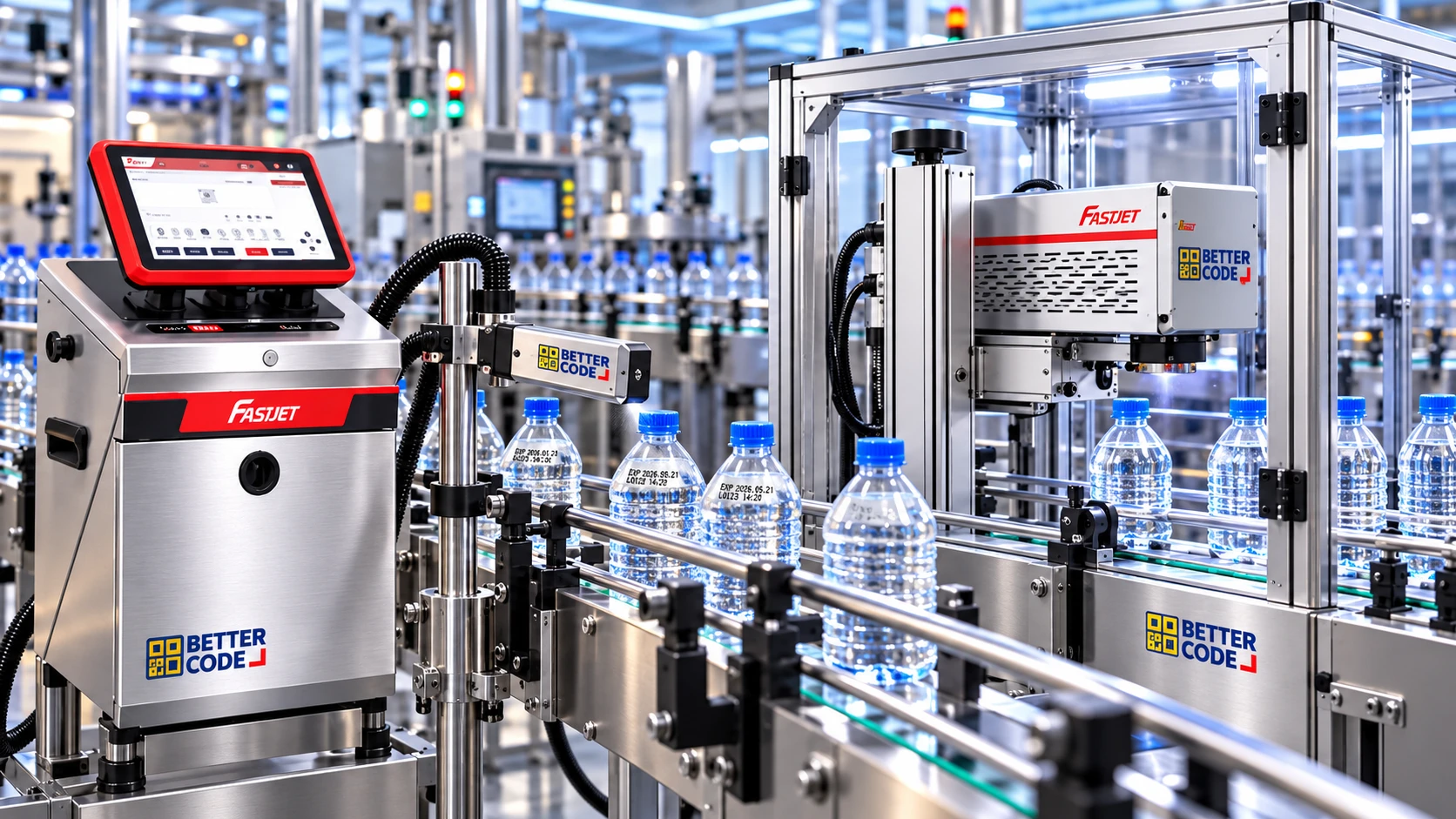
Beverage factories choose between two core technologies: (1) Condensation-Resistant CIJ Inkjet (FASTJET F650/F640 IP65) using fast-drying MEK ink for high-contrast black/yellow codes on wet PET bottles, caps, and cold-fill cans; or (2) 9.3µm CO2 Laser (FASTJET F7143C) for frosted PET shoulder engraving and 355nm UV Laser for HDPE caps with zero ink costs—mounted with an inline Air Knife and bottle neck guide by Better Code Co., Ltd.
3-System Beverage Coding Comparison: Condensation-Resistant CIJ (FASTJET F650/F640) vs 9.3µm PET CO2 Laser (FASTJET F7143C) vs 355nm UV Cap Laser (FASTJET F7100U)
Selecting a drinking water bottle date coder or high-speed beverage expiry printer requires matching wavelength and ink chemistry to your exact container—whether thin-wall clear PET, opaque HDPE/PP caps, dark glass, or cold-fill aluminum cans. Below is the complete 3-system engineering matrix:
| Engineering Criterion | 1. Condensation-Resistant CIJ Inkjet (FASTJET F650 / F640 IP65) | 2. 9.3µm PET CO2 Laser Coder (FASTJET F7143C) | 3. 355nm UV Laser for Bottle Caps (FASTJET F7100U) |
|---|---|---|---|
| 1. Visual Mark Appearance on Bottles, Caps & Cans | High-contrast black, yellow, or blue ink dot-matrix characters visible from any lighting angle on clear PET shoulders, colored caps, and aluminum cans | Clean white frosted surface etching directly on clear PET bottle shoulders—delivers a premium look without perforating thin PET walls | Crisp dark photochemical color change (Cold Marking) on white/colored HDPE & PP caps—sharp enough for micro-text and scannable 2D QR codes |
| 2. Consumable Cost per Bottle | Uses CIJ ink & make-up solvent at fractions of a satang per bottle (~0.005–0.015 THB/bottle); lowest upfront capital investment | Zero ink & zero solvent cost forever (0 THB consumables); powered purely by electricity for rapid ROI on high-volume water lines | Zero ink & zero solvent cost forever; completely eliminates ink-room storage and daily nozzle cleaning |
| 3. Resistance to Ice-Bucket Immersion & Multipack Abrasion | Uses condensation-penetrating MEK ink that dries in 1–2 seconds and survives ice water and shrink-pack rub (yet removable via caustic bottle-washer for returnable glass) | 100% Permanent & Tamper-Proof—physically etched into the PET surface; impossible to rub off, smear, or alter expiration dates | 100% Permanent inside the cap polymer—never peels or smudges in cold-chain transit and causes zero plastic burrs |
| 4. Ideal Print Zone & Container Compatibility | Universal All-in-One Flexibility: codes PET shoulders, HDPE caps, shrink sleeves, wet glass bottles, and recessed aluminum can domes (12–25 mm throw distance) | Specialized for clear PET drinking water bottle shoulders/necks and labels (not suited for bare aluminum cans or thick HDPE caps) | Specialized for HDPE / PP bottle caps, opaque white HDPE dairy bottles, and flexible packaging films |
| 5. Washdown & High-Humidity Bottling Room Protection | IP65 stainless steel cabinet + Positive Air Printhead pressurization that blocks water vapor and condensation from entering the nozzle | Sealed industrial Galvo scanhead paired with an inline HEPA/Carbon Fume Extractor to keep cleanroom bottling halls odor-free | Sealed optical enclosure engineered for continuous operation in humid beverage filling environments |
| 6. Maximum Bottling Line Speed (Bottles / Cans per Hour) | Supports 1,500 to 36,000+ bottles or cans/hour (1–2 line MFD/EXP dates and lot codes) | Supports up to 12,000–48,000+ bottles/hour via ultra-high-speed digital Galvo mirrors | Supports up to 12,000–36,000+ bottles/hour for both 2-line expiration dates and dynamic cap QR codes |
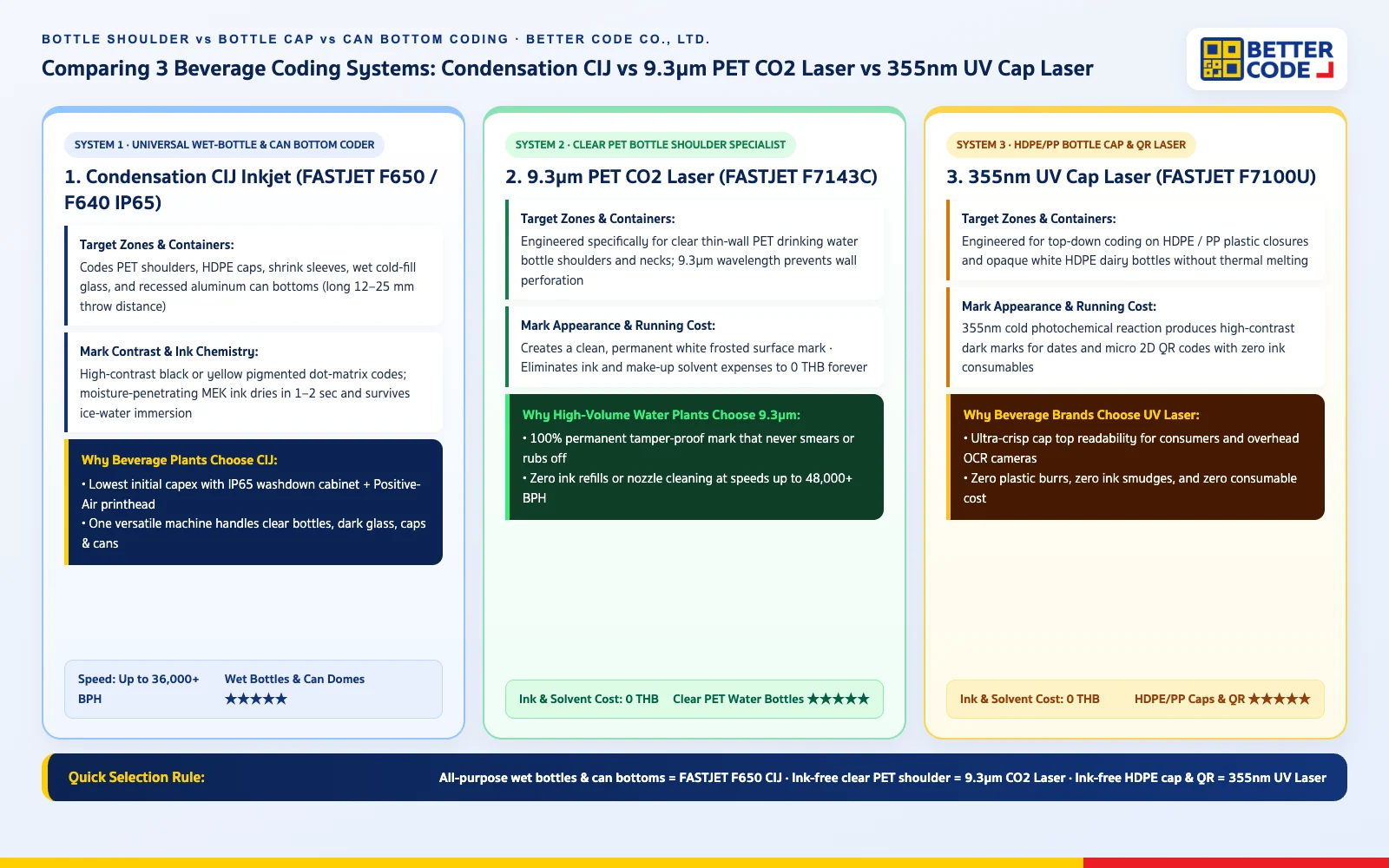
Print Zone Comparison on Drinking Water & Beverage Bottles: Bottle Cap Top vs Bottle Shoulder/Neck vs Shrink Sleeve Label
Beyond choosing between CIJ and laser, beverage plant engineers must decide where on the bottle to place the expiration code to maximize readability and minimize mechanical changeover time between bottle sizes. Here is how the 3 primary beverage print zones compare:
1. Bottle Shoulder / Neck Below the Neck Ring (Most Popular for PET Water)
Coding onto the upper PET shoulder or neck keeps the traceability code permanently attached to the primary bottle—even after the consumer discards the cap or strips off the label for recycling.
2. Flat Bottle Cap Top (HDPE / PP Closure) for Instant Top-Down Visibility
Mounting a top-down bottle cap coder over the conveyor shoots directly onto the flat HDPE/PP closure surface—eliminating curvature distortion and making expiration dates immediately visible through top shrink-pack film.
3. Shrink Sleeve Label Window or Side Wall After the Shrink Tunnel
Ready-to-drink teas, juices, and dairy beverages wrapped in full-body shrink sleeves frequently include a dedicated white date box window for high-contrast CIJ date coding.
| Bottle Print Zone | Consumer & OCR Camera Readability | Impact of Bottle Height Changeovers | Recommended Coding Technology & Ink |
|---|---|---|---|
| 1. Clear PET Bottle Shoulder / Neck | High readability when printhead is angled perpendicular to shoulder curve (9.3µm CO2 laser produces clean frosted white numerals) | Minimal adjustment on neck-guided lines or with a graduated screw-jack stand | 9.3µm PET CO2 Laser (FASTJET F7143C) or FASTJET F650/F640 IP65 CIJ |
| 2. Flat Bottle Cap Top (HDPE / PP) | Highest Readability (★★★★★) for both shoppers looking down at multipacks and top-mounted OCR inspection cameras | Requires vertical height adjustment when switching between 350 ml, 600 ml, and 1.5 L bottles | High-Adhesion MEK CIJ Inkjet or 355nm UV Laser (FASTJET F7100U) |
| 3. Recessed Aluminum Can Bottom / Dark Glass | Crisp contrast inside silver aluminum domes (or yellow pigmented CIJ ink on amber/green beer & juice bottles) | Zero height changeover when firing bottom-up between side-grip belts | FASTJET F650 IP65 CIJ (12–25 mm throw) + Condensation / Retort Ink |
4 Bottling Line Engineering Techniques for 24/7 Smudge-Free Date Coding Without Bottle Tip-Overs
In real-world beverage plants, smeared expiration codes, skewed cap marks, or frequent nozzle faults are almost always caused by surface moisture and lightweight PET bottle vibration on the conveyor. Here are the 4 engineering controls Better Code Co., Ltd. implements on high-speed bottling lines:
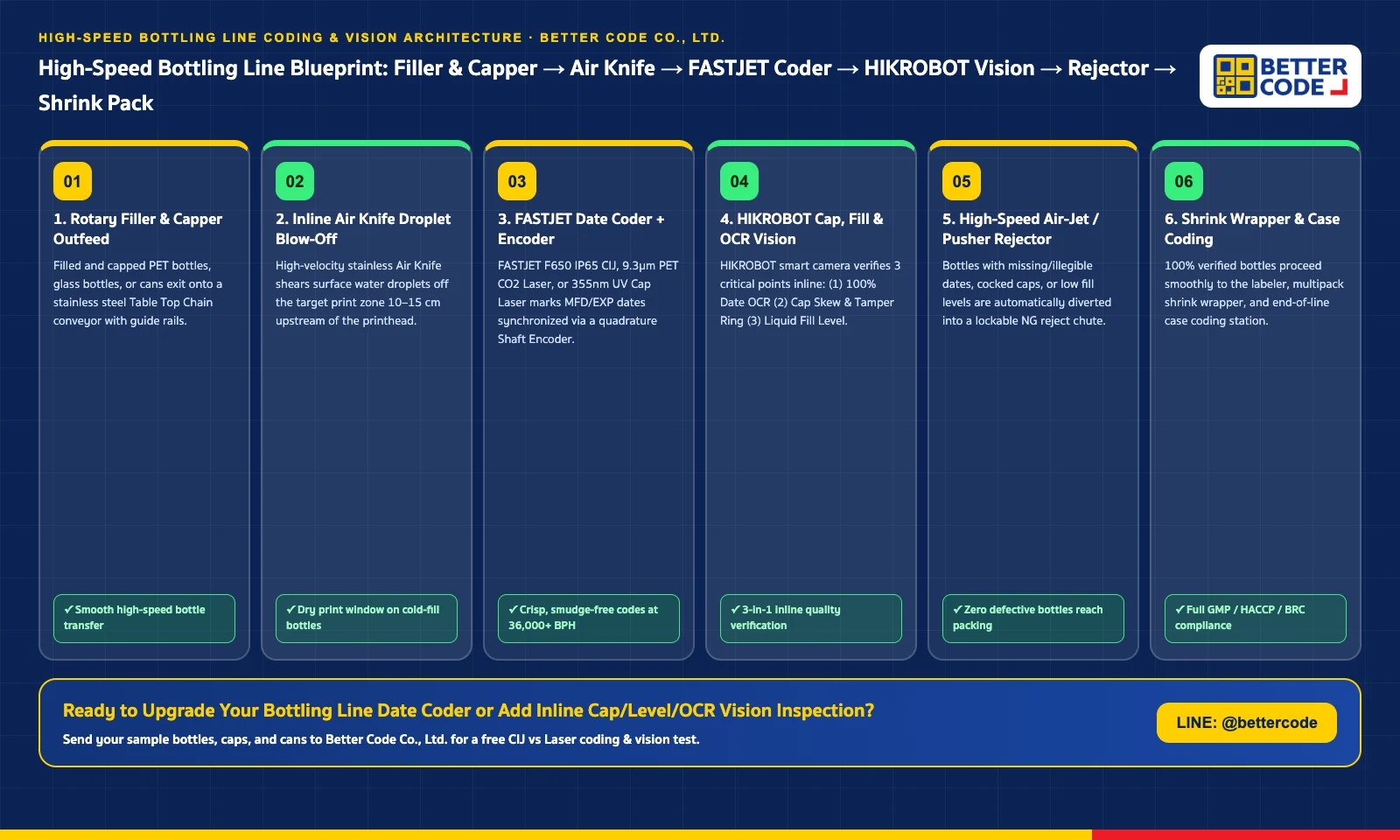
Technique 1: Install an Inline High-Velocity Air Knife to Shear Off Condensation Droplets on Cold-Fill Lines
In cold-fill juice, dairy, beer, soda, or chilled water lines (4–15°C), ambient humidity condenses into thick water beads on bottle walls and can domes the moment containers exit the filler. Jetting ink onto a thick water droplet causes the ink to float and wash away. Mounting a stainless steel Air Knife 10–15 cm upstream of the printhead shears off surface droplets across the target print strip for 0.2 seconds—allowing FASTJET condensation-penetrating MEK ink to bond directly to the container wall.
Technique 2: Align the Printhead Perpendicular to the Bottle Shoulder Curve with Bottle Neck Guides & Shaft Encoder
Lightweight PET water bottles easily wobble or rotate on high-speed stainless Table Top Chain conveyors. Coding onto a vibrating bottle distorts characters. Better Code engineers install low-friction UHMW-PE bottle neck and side guide rails at the print station to stabilize every bottle, angle the printhead 30–45° so the ink stream or laser beam strikes perpendicular (90°) to the curved shoulder, and synchronize firing with a quadrature Shaft Encoder.
Technique 3: Specify IP65 Stainless Cabinets & Positive-Air Printheads to Block Bottling-Hall Moisture Ingress
Beverage filling rooms undergo daily foam and water washdowns while operating in high relative humidity. FASTJET F650 / F640 CIJ printers feature an IP65 washdown-rated stainless steel enclosure paired with a Positive Air Printhead system that continuously purges clean dry air out of the printhead slot—preventing water mist, sugar aerosols, and condensation from entering the nozzle or ink gutter.
Technique 4: Integrate HIKROBOT Vision Inspection for Date OCR, Cap Skew, Fill Level & Automated Rejection
To satisfy strict retail and GMP/HACCP/BRC audits before bottles enter the multipack shrink wrapper, we integrate an inline HIKROBOT Machine Vision Inspection Station immediately after the date coder. At speeds up to 36,000+ BPH, the camera simultaneously verifies: (1) MFG/EXP Date OCR legibility, (2) Cap Skew, High Cap & Tamper-Evident Ring integrity, (3) Liquid Fill Level, and (4) Label alignment—triggering a high-speed Air-Jet or Pusher Rejector to divert defective bottles.
6-Point Checklist to Request a Free Bottle, Cap & Can Sample Coding Test from Better Code Co., Ltd.
Want to compare live sample marks on your own bottles between the FASTJET F650/F640 IP65 CIJ Inkjet, FASTJET F7143C 9.3µm PET CO2 Laser, and FASTJET F7100U 355nm UV Cap Laser? Share these 6 details via LINE @bettercode or our Request a Quote page:
Clear lightweight PET bottle (specify preform gram weight), opaque HDPE/PP bottle, clear/amber glass bottle, or aluminum beverage can? (Ship us samples for free lab testing!)
PET bottle shoulder/neck below the neck ring, flat HDPE/PP cap top (specify cap color), shrink sleeve window, or recessed aluminum can bottom?
Ambient dry filling (drinking water), chilled cold-fill with heavy surface condensation, steam shrink tunnel, or high-temperature retort sterilization?
How many bottles or cans per hour (BPH), and how many container sizes (e.g., 350 ml, 600 ml, 1,500 ml) run on the same conveyor?
Do you need 1–2 lines of MFD/EXP/Lot/Time text, or high-density 2D QR codes printed on bottle caps for consumer loyalty campaigns?
Do you need Food-Grade Table Top Chain conveyors, an inline Air Knife dryer, or a HIKROBOT camera for Cap Skew, Fill Level & Date OCR inspection?
Frequently Asked Questions: Drinking Water Bottle, Cap & Beverage Date Coding (FAQ)
Why do clear PET drinking water bottles require a 9.3µm CO2 laser instead of a standard 10.6µm CO2 laser?
Thin-wall clear PET bottles transmit most standard 10.6µm infrared laser energy, which either leaves a faint mark or melts right through the bottle wall causing pinholes and leaks. A specialized 9.3µm CO2 laser (such as the FASTJET F7143C) matches the exact molecular absorption peak of polyethylene terephthalate (PET)—producing a crisp, high-contrast white frosted mark on the bottle shoulder surface without perforating the container.
Can a CIJ inkjet printer code reliably onto cold-fill beverage bottles and aluminum cans covered in heavy condensation?
Yes, when two engineering controls are combined: (1) an inline high-velocity Air Knife positioned 10–15 cm upstream of the printhead to shear off surface water droplets for a fraction of a second, and (2) an IP65-rated FASTJET F650 / F640 CIJ printer loaded with condensation-penetrating MEK ink that bonds through microscopic moisture films in 1–2 seconds and withstands ice-bucket immersion.
Should we choose CIJ Inkjet or a 355nm UV Laser for coding HDPE and PP bottle caps?
Both perform excellently depending on your priority. If you want high-contrast black ink on white or blue caps with lower initial capex, the FASTJET F650/F640 CIJ is ideal. If you want zero consumable cost forever, permanent tamper-proof marks, or high-density promotional QR codes on HDPE/PP caps without melting the plastic, the FASTJET F7100U 355nm UV Laser triggers a cold photochemical color change with micron precision.
Is it better to code on the bottle cap top, bottle shoulder/neck, or shrink sleeve label?
Coding on the flat cap top offers the easiest human and camera readability when bottle height is constant. However, for bottling lines that frequently switch between 350 ml, 600 ml, and 1,500 ml PET bottles using neck-handling conveyors, coding on the bottle neck/shoulder just below the neck ring keeps the target print zone at a constant elevation with minimal mechanical changeover.
How do you print expiration dates into the concave dome at the bottom of aluminum beverage cans?
Aluminum beverage cans feature a recessed concave bottom dome (8–12 mm deep). High-speed CIJ printers like the FASTJET F650 are engineered with a long 12–25 mm throw distance, allowing the printhead to mount underneath a side-grip belt conveyor and jet condensation-resistant (or thermochromic retort) ink cleanly into the center of the dome at up to 30,000–60,000+ cans/hour.
Does Better Code Co., Ltd. offer free sample coding tests comparing CIJ vs 9.3µm CO2 Laser vs UV Laser on our actual bottles?
Yes, completely free of charge. Send your PET bottles, HDPE caps, glass bottles, or aluminum cans to Better Code Co., Ltd. Our engineers will produce side-by-side sample marks using condensation-resistant CIJ, 9.3µm PET CO2 laser, and 355nm UV laser systems, test ice-water durability, verify OCR readability with a HIKROBOT vision camera, and calculate your exact cost per bottle.
Send Your Bottles, Caps & Cans for a Free CIJ vs Laser Sample Test with Better Code Co., Ltd.
Whether your beverage plant needs an IP65 FASTJET F650 / F640 CIJ printer with condensation-resistant ink, zero-consumable 9.3µm PET CO2 or 355nm UV cap lasers, an exact cost-per-bottle ink calculation, or stainless bottle conveyors integrated with HIKROBOT cap/fill-level/OCR vision inspection, Better Code Co., Ltd. is ready to run free sample tests and provide a complete engineering quotation.
Request Quote / Free Bottle Sample Test ↗Explore FASTJET CIJ Printers ↗Explore FASTJET Laser Systems ↗Send Bottle Photos on LINE @bettercode ↗Engineering References & Beverage Bottling Standards
- Technical specifications for FASTJET F650 / F640 IP65 Continuous Inkjet (CIJ) printers, FASTJET F7143C 9.3µm PET CO2 Laser systems, and FASTJET F7100U 355nm UV Laser coders: Industrial Coding Engineering Division, Better Code Co., Ltd.
- Automated beverage bottling quality inspection standards (Cap Skew, Tamper-Evident Band integrity, Fill Level, and inline OCR Date Verification) powered by HIKROBOT Machine Vision systems.